Umeå University | S UMEA01
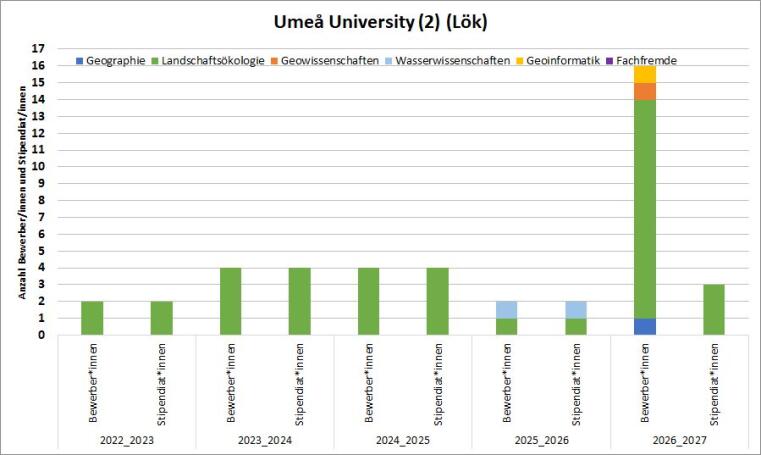
2 spots Landscape Ecology
Information about the university
Partner institute: Department of Ecology, Environment and Geoscience
ISCED Code: 0532 - Earth Sciences | 0521 - Environmental Sciences
Language of instruction: Swedish and English
Language requirement: B2 English
Areas of specialisation:
Department of Ecology and Environmental Sciences (partner institute)
- Environmental Sciences (Master)
- Earth Science (Master)
- Ecology (Master)
- Interesting courses for example:
- Arctic Geoecology und Arctic Ecosystems (Kurse finden in Abisko in Lappland statt)
- Ecosystem Management
- Forest Ecology (mit Exkursion)
- Analyses of Environmental Changes
It is possible to take courses in other departments. It is also possible for undergraduate students to take graduate-level courses, and vice versa.
Links
Information for exchange students
Deadlines and dates
Wintersemester: Late August - mid-January
Summersemester: Mid-January - early June
Wintersemester and full academic year: 15. April
Summersemester: 15. Oktober
Advice from former students
Studies
- The academic system in Sweden is different from ours; the semester is divided into two parts, and each of those is further divided into two parts, so the semester consists of four so-called “oktil.” Students usually take only one course, which is then concluded with an exam after a certain period of time. The advantage is that you can focus entirely on one subject
- Independent study is fully supported by the university; there are many opportunities to work on projects on your own.
-
Be sure to check that full-time courses do not overlap.
-
Recommended courses: Forest Ecology and Alpine Ecosystems (taught in Abisko)
-
It is possible to complete your research projects (LÖK) there
-
Additional study opportunities in Umeå at SLU (Swedish University of Agricultural Sciences; in Umeå, the focus is on forestry and natural resources as well as agricultural sciences
-
You can take courses at other faculties
Mobility
- A car is a good option for traveling (rental cars are available, for example, from “Rent a Wreck” or “Eurocar”); interesting destinations include Höga Kusten, Skuleskogen National Park, Holmö Island, Tavelsjöleden, Lapland, Abisko, and Narvik. Kayaking is a great and relatively inexpensive activity in the area
- With your student ID (available through the Student Union), you can get discounts, for example, on train travel
Life
- The IKSU card for “college sports” is worth it
- The Buddy Program is worth it—you get to meet a lot of people, and they organize great events
- A lot of recreational activities are organized on Facebook; without it, you don't really hear about them
Other
- Language courses (to a certain extent) and, above all, movies (which can be borrowed from the Institute of Nordic Philology in Münster) can help you learn Swedish. Stick with it! Since most Swedes speak English very well, it’s not necessary to know or learn Swedish.
- There’s hardly any cash in circulation in Sweden anymore, since you can pay with a credit card everywhere—and in some places, that’s the only option. So you should have one if you’re going to Sweden and make sure there are no fees for international transactions.
Further information
Acceptance: Landscape ecology, geographers, geoscientists, and non-faculty students
Finances: Sweden is more expensive; according to the university, you'll need at least 7,500 to 8,000 kronor (approximately 750 to 800 €).
Accomodation: Student dormitories run by the International Housing Office (IHO); based on past experience, you’ll always get a room here if you register on time
- Possible neighborhoods: Alidhem (5 minutes to campus, livelier neighborhood, many exchange students), Mariehem (15–20 minutes to campus, quiet, right on Lake Nydala, fewer exchange students), Nydalahöjd (close to the university and the lake, quiet, new), Berghem (close to campus, a bit less bustling than Alidhem)
Support from the host university: Excellent support from the dedicated team at the International Office. There are also orientation sessions and a mentoring program; overall, the support is good.
Fact-sheet
[As of 15.11.2026]