NTNU Trondheim | N TRONDHE01
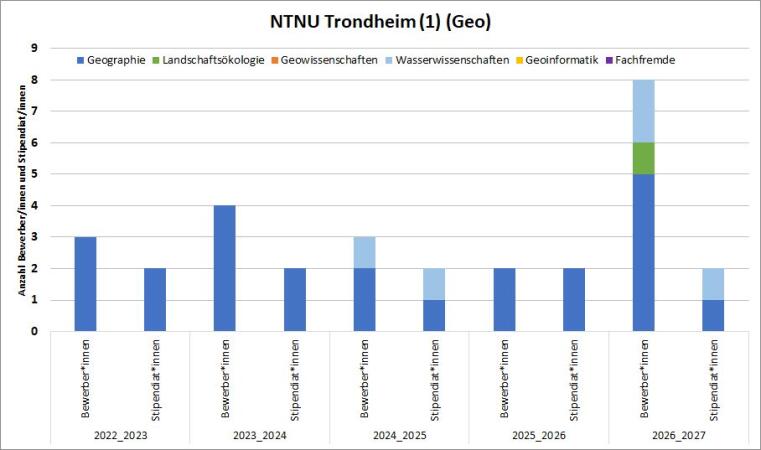
1 spot Geography
Information about the university
Partner institute: Department of Geography and Social Anthropology
ISCED code: 0532 - Earth Sciences
Language of instruction: Basic selection of English-language courses; however, the selection of Norwegian-language courses is much larger
Language requirement: B2 English
Areas of specialisation:
Geography
- Landscape and Spatial Planning
- Development Geography
- Social Geography, Political Geography
- Economic Geography
- Globalization
- Physical Geography (and its influence on anthropogenic processes)
- Cartography
- Remote Sensing
Landscape ecology
- Physical Geography—particularly geomorphology and river systems
- Geology (very broad range of courses)
- Marine Ecology
- The Department of Biology offers a wide range of courses covering all areas of ecology
Specifically Master's programmes
- Natural Resources Management
- Marine Coastal Development
- Urban Ecological Planning
Links
Deadlines and dates
first semester: August - mid-January
second semester: January - mid-June
first semester and full academic year: 1. May
second semester: 15. October
Advice from former students
Studies
- It is possible to take courses at the Institute of Geoinformatics and the Institute of Spatial Planning
- In general, you can take courses throughout the entire university without any problems, and these are usually available at both the BSc and MSc levels.
- In the Department of Geography, there is a basic selection of courses in English for undergraduate students, which is sufficient to earn 30 ECTS per semester. However, the selection of courses taught in Norwegian is much larger. Exams, etc., can usually be taken in English by arrangement. The same applies to other subjects: courses are mostly taught in Norwegian, but sometimes they can be held in English upon request, and some courses are taught exclusively in English. Exams can often be taken in English, but this must be clarified in advance.
- I took the courses “Introduction to Norway” and “Local and Global Perspectives on Environmental and Natural Resources Management.” I thought both were excellent; I found the latter particularly fascinating from an academic standpoint, and I also liked the teaching style, which was different from what I’m used to in the seminars at Münster. Accordingly, I’m happy to recommend them!
- I was able to get credit for the course “Local and Global Perspectives on Environmental and Natural Resources Management” toward the “Applied Geography” seminar in my single-major bachelor’s program, and for the lecture “Introduction to Norway” toward the “Regional Geography” seminar.
- In terms of academic content and facilities, the university is simply excellent.
- Some courses are taught in Norwegian, so the selection of English-taught courses is limited.
Housing
- The dormitory administration is often not very helpful, and it’s usually necessary to follow up multiple times. At the front desk, Resident Assistants often provide insufficient or even incorrect information—for example, regarding the availability of apartments or the possibility of switching rooms. Therefore, you should seek out the more knowledgeable Resident Consultants.
Life
- Take advantage of the Unisportverein (NTNUI)'s selection of mountain huts. It's a one-of-a-kind opportunity that offers lots of fun and wonderful experiences in nature.
Further information
Acceptance: Geography, very popular
Finances: Estimates vary from ~600–800 € to ~800–1,000 € per month—Norway is expensive, and it often depends on how much you go out and how much you travel around the country
Accomodation: via sit bolig—you’ll automatically receive the application form when you’re accepted to NTNU—accommodation in student dorms, usually 4-person shared rooms, fully furnished (you only need to buy dishes, pots, and bedding); the dorms are significantly cheaper than private housing, though living standards vary widely; especially at the start of the fall semester, the dorms are often overcrowdedSupport from the host university: Good—comprehensive information before starting school, a relatively straightforward application process, good orientation weeks, many language course options, the opportunity to participate in the buddy program, no tutors—but the International Office is always there to help when you ask, as are the professors; everyone is very helpful
Fact-Sheet
[As of 06.10.2026]