University of Eastern Finland | SF Joensuu01
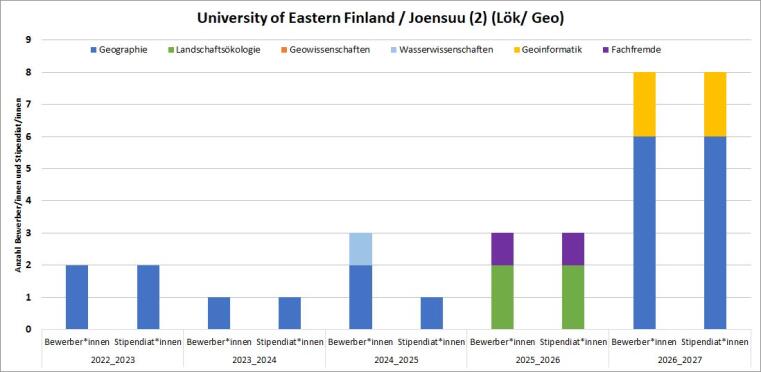
2 spots Geography / Landscape Ecology
Information about the university
Partner institute: Department of Geography/Joensuu Campus
- Courses can also be taken at other faculties, e.g. Environmental Sciences/Kuopio Campus or the Faculty of Forestry/Joensuu Campus. It is, however, difficult to take courses exclusively at the Department of Languages (only the beginner’s Finnish course is available there, not the advanced one).
- UEF is very flexible when it comes to accepting incoming students. It is also possible to spend one semester at the Kuopio Campus and the other at the Joensuu Campus; these are approximately 150 km apart. Upon enquiry with the ERASMUS coordinator there, it was not a problem to take courses in Kuopio only, regardless of whether they were outside one’s field of study or not.
ISCED Code: 0532 – Earth Sciences (Human Geography, Landscape Ecology)
Language of instruction: English
- A wide range of English-taught (Master’s) courses is available. Bachelor’s courses are mostly taught in Finnish. However, GIS courses from the Bachelor’s programme can be attended as the English version of ArcGIS is used. With sufficient prior knowledge, Bachelor’s students can choose courses from the numerous international/English-taught Master’s programmes.
Language requirement: B2 English
Main areas of study:
- Forestry (forest ecology and economics)
- Fish biology (limnology)
- Ecology of the Baltic region
- International environmental law
- Russia, Eastern border
- Spatial planning
- Methodology
- Pedagogy/Educational science
Links
Department of Geographical and Historical Studies [en]
Department of Environmental Sciences [en] (in Kuopio)
School of Forest Sciences [en]
Information für Erasmusstudenten [en]
Environment, Natural Resources & Climate Change [en]: Master’s Degree Program in Environmental Policy and Law. The program provides advanced training in policy, law and impact assessment for climate change and sustainable management of natural resources. Kurse [en].
Forestry and Environmental Engineering [en]: Es handelt sich um ein CBU-Programm (CrossBorderUniversity). Erasmus Studierende können an den Kursen der UEF teilnehmen.
Environmental Biology [en]: First Year: In Kuopio the teaching is specially directed to climate change related bioprocesses and biogeochemistry. Second Year: In Joensuu the teaching is directed to environmental plant biology and forestry.
Masterprogramme [en]: Als Erasmus Student muss man sich nicht für ein Masterprogramm bewerben, sondern kann Kurse, auch aus verschiedenen Programmen, belegen. Erasmus Studenten können max 2 Semester des angebotenen Masterprogramms besuchen und keinen Abschluß an der Partneruni erlangen. Die Masterkurse sind i.d.R. auf englisch.Deadlines and dates
- Autumn semester: early September – mid-December
- Spring semester: early January – late May (exams partly in June/August)
Application deadlines:
- 30 April for the autumn semester / full academic year
- 30 September for the spring semester
Advice from former students
General information
- If you only want to study for one semester, you should choose the summer semester. As is also the case in Joensuu, the weather is definitely more pleasant during the summer semester (January–May). You’ll get a proper winter with loads of snow, followed by spring with the days getting longer (19 hours on 30 May!). However, many courses are only offered in either the summer semester or the winter semester, so you can base your decision on which semester to attend on this. The Finnish summer takes a while to get going, but once it does, it’s lovely and mild. If you’re going in the summer semester, it’s worth staying a bit longer and travelling around in June, for example.
Courses:
- Courses are usually organised in blocks: a 1–2-week course, which is completed relatively quickly with an exam or essay. It’s also possible not to stick strictly to the semester schedule, or to continue attending courses after the autumn semester until March and then rejoin the summer semester in Münster.
- As Kuopio and Joensuu are so far apart, there are an increasing number of e-learning options available.
- Academic writing in English: in these courses, students practise academic writing in English through their own assignments (for the courses they are taking).
Getting there (to Kuopio):
- The best option is to travel to Helsinki first, either by ferry (Finnlines, 31 hours from Travemünde, from €125) or by plane. From there, there is a regular train service to Kuopio (vr.fi, approx. 4 hours 30 minutes, €22).
- It is also possible to travel via Hamburg–Stockholm–Turku using a combination of night train and ferry.
Accommodation and living:
- The best way to apply for a flat is through KUOPAS, a municipally-owned company that provides accommodation for students. Exchange students are usually accommodated in either Neulamäki or Katiska – both have their own advantages and are good places to stay, from which you can reach the campus in 15–20 minutes. For €20 a month, you can book a weekly slot in the sauna, which every hall of residence has. A typically Finnish experience and highly recommended!
- Although the flats are furnished, they aren’t always equipped with kitchen utensils. The Student Union’s ‘Survival Package’ is well worth it, but you should book it before you arrive in Kuopio, as there are only a limited number available. If you still find yourself missing any kitchen utensils, it’s worth visiting one of the numerous second-hand shops. Personally, I went to Tukeva at Teollisuuskatu 1 (wide selection, low prices) and to SPR-kontti (slightly more expensive, smaller selection, closer to the Katiska hall of residence).
- There are two good second-hand shops that also sell furniture and even offer a delivery service. If you don’t need furniture in your room straight away on the first day (a 90 cm bed – which is uncomfortable – plus a small desk and chair), you should take an unfurnished room. Especially if you’re staying for a year. The rent for the furniture is 17 EUR a month, and in the second-hand shop you can get a bed, table and chair for around 50 EUR (including delivery).
- Hukanhauta, Noljakkka and the town centre have DSL internet (Rantakylä Wi-Fi). You’ll need a DSL modem for this, but not one from Germany (it’s a different standard). New modems are available for 50 EUR. However, it’s worth mentioning that you’re a student. Sometimes you can get a discount, or you could check the ‘Joensuuaner’ group on StudiVZ beforehand to see if anyone wants to sell their old one. There are lots of alumni there who are always happy to help! All the important links can be found at www.joensuu.fi.
- If you have a good bike and enjoy cycling, I’d recommend bringing it with you (you can even take it on a plane quite cheaply). Bikes here are either expensive or old bangers.
- Kuopio has a good network of cycle paths, and despite the temperatures, it’s worth having your own bike – with a bit of care, you can cycle on compacted snow without any problems; you just need to be particularly careful during the first thaw in March/April. You can get bikes for €60–120 at the Tukeva second-hand shop.
- Throughout Finland, there are public lean-to shelters (laavu) with fire pits and firewood, which are ideal for multi-day hikes or even short day trips. retkikartta.fi is a GIS service provided by the Forestry Administration, which also maps out hiking routes and other infrastructure. If you’re planning to go hiking during the summer term, you should bring warm kit and hire snowshoes or touring skis – the snow cover usually lasts until 15 April on average.
- You can borrow books for free from the city library, including many in English.
- In winter, a 12 km-long ice rink is set up on the lake, usually from mid- to late January for 1.5–2 months. You can hire ice skates right at the harbour, or buy them at a second-hand shop or the Stadium Outlet. At the Rauhalahti Hotel, you can hire cross-country skis and snowshoes; there are cross-country trails practically everywhere.
- You can enjoy an authentic Finnish sauna experience at the Jätkänkämppä smoke sauna; the Saana Thermal Baths are also good.
- As a general rule, always ask for a student discount in every shop. You’ll usually get a 10–15 per cent discount almost everywhere (including cafés). Bargaining is also a tradition in Eastern Finland – and it works. Joensuu is a lovely city with plenty of nature and many walking trails in the surrounding area.
Travel:
Long-distance travel:
- For travel within Finland, you can use coaches as well as the reliable and affordable trains (student discount available with a Finnish student ID). Onnibus is similar to Flixbus – i.e. very cheap (especially if you book early) – but only stops in the larger cities. Unfortunately, the connections from Kuopio aren’t that great. Matkahuolto has a better network, but is more expensive.
Buses:
- The rechargeable Waltti Travel Card for students is well worth it, even if you rarely use the city buses. It costs just €5, but you’ll pay only about half the price for all bus journeys in Kuopio when using the card.
Coriolis – Geography Students’ Association excursions
- St Petersburg (5–6 days; entry visas are very easy to obtain if you’re a resident of Finland, as Erasmus students are required to register with the Finnish Population Register Centre.)
- Lapland
- The Baltic States/Eastern Borderland (3 weeks)
Paid internships are available in the Geography Department (2 months as a research assistant)
Further Information
Acceptance:
- Geography, Landscape Ecology & Life Sciences
Finances:
- ~ €500–600 per month
Accommodation:
- via Joensuu’s Elli Student Housing
- Student accomodation is good, spacious and affordable (approx. €200)
- Erasmus students are accommodated in shared flats. It is possible to live with Finnish students if you wish. In that case, life tends to be quieter, with fewer Erasmus parties in the building.
- There are studio flats in the city centre, but these are more expensive (approx. €300).
Support from the host university:
- excellent and very professional! (Tutors, coordinators, Student Union, free language courses)
- Departmental Coordinator for Geography: Paul Freyer. You’re also welcome to contact Moritz Albrecht, a PhD student in the Geography Department from Germany.
Fact Sheet
[as of 22.09.2026]