Harokopio Universtiy | G KALLITH01
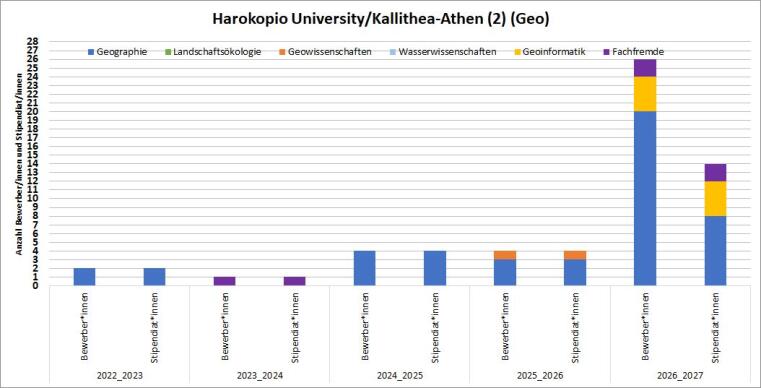
2 spots Geography
2 spots Geoinformatics
Information about the university
Partner institute: Geography Department
ISCED code: 0532 – Earth Sciences (Geo) | 0613 – Software and applications
development and analysis (Geoinfo)Language of instruction: Greek, but by arrangement, some seminars and laboratory courses may also be held in English or French.
Language requirements: B2 English / B1 Greek
Areas of specialisation:
Geography:
- Physical Geography
- Human Geography
- Spatial Development and Planning
- Geoinformatics
- Meteorology, Climatology, Oceanography
- Hydrology – Water Resources Management
In later semesters of the Bachelor’s programme, specialisations are also available in the fields of geoinformatics, physical geography, globalisation and economics, the EU, and the geography of the Mediterranean region
Applied Geography and Spatial Planning:- Management of Natural and Human-Induced Hazards
- European Policies, Planning and Spatial Development
- Geoinformatics
Links
Deadlines and dates
Application deadline:
- 15 June: Winter semester or full academic year
- 15 November: Spring semester
Academic calendar:
- Winter semester: mid-September – mid-January
- Spring semester: mid-February – mid-June
Advice from former students
Studying
- Whether you can take courses in other faculties depends on the individual case and the subject
- Committed and helpful lecturers
- Many courses are taught in Greek, which means that the programme involves a great deal of self-study
- Examination requirements can be adapted to the University of Münster’s guidelines in consultation with the lecturers.
- As a Bachelor’s student, you can also take Master’s courses, and vice versa
- There’s a very close-knit atmosphere at the university, as there are ‘only’ three faculties with a total of around 3,000 students. We were a group of about 25 Erasmus students, which also contributed significantly to this feeling.
- Courses are at a lower level than in Germany, and there is less bureaucracy at the university
Living
- The university places great emphasis on supporting Erasmus students, particularly through the dedicated Erasmus coordinator and the active ESN network.
- All students can eat for free at the canteen at lunchtime and in the evening
- Supermarkets tend to be slightly more expensive than in Germany, but there’s plenty of affordable street food and cheap weekly markets
Accomodation
- Finding accommodation: It’s easy to find something via Facebook groups (search terms e.g. “Student housing Athens” or “Erasmus accommodation Athens”); rent is approx. €280–380 including utilities
- Good neighbourhoods to live in: Exarcheia, Neapoli, Koukaki, Kypsely, Victoria, Petralona, Kallithea
Further information
Support from the host university:
- On-site support is sometimes good
- However, some students also report problems and misunderstandings
- Lack of communication with lecturers
Fact Sheet
[As of 22 September 2026]