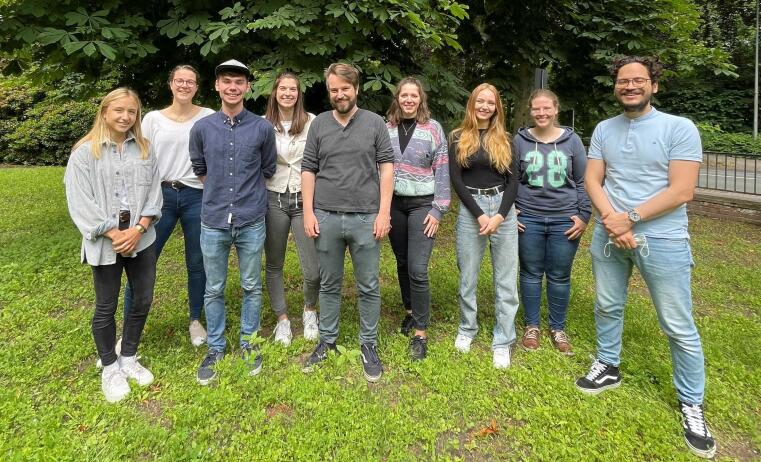


Research Focus
adaptation genomics, population genomics, myrmecology
I am intrigued by the possibilities of using large genomic datasets to retrace ancient and recent evolutionary events that have led to speciation and the emergence of new and adaptive phenotypes. More specifically in my case, the phenotypes of ants. The ants are one of the most diverse animal lineages on this planet and they show an absolutely remarkable diversity in terms of phenotype, niche specialization, and life history. One of my research focuses currently lies on the evolution of social parasitism in leaf-cutting ants, where I compare the genomes of several convergently evolved social parasite species with their closely related host species. Despite the recent divergence, the phenotypic differences between hosts and parasites are substantial and we have already found evidence for convergent gene loss and other genomic changes in the parasites. A second major focus of my work lies in understanding the genetic and genomic mechanisms that allow the rapid adaptation of populations and species to changing environments. For this, I use the invasive and wide-spread ant species Cardiocondyla obscurior as a laboratory model to study how transposable elements, cryptic genetic variation and phenotypic plasticity can bring forward novel and adaptive changes on the phenotypic level.
CV
Academic Education
- Promotion (Uni Regensburg)
- Diplom (Ruhr-Uni Bochum)
WorkExperience
- Post-doc (Københavns Universitet)
Projects
Selection
- The Global Ant Genomics Alliance – GAGA ()
Own Resources Project
Complete List
- SPP 2349: Genomic Basis of Evolutionary Innovations – GEvol ()
Main DFG-Project Hosted at University of Münster: DFG - Schwerpunktprogramm - SPP 2349 - Subproject: Dramatic genome rearrangements in Cardiocondyla ants ()
Subproject in DFG-Joint Project Hosted at University of Münster: DFG - Schwerpunktprogramm | Project Number: SCHR 1554/8-1 - Die Evolution von Genomkompartmentierung in Ameisen der Gattung Cardiocondyla ()
Individual Granted Project: DFG - Sachbeihilfe/Einzelförderung | Project Number: SCHR 1554/6-1; MA 5688/2-1 - Transposons als genetische lnnovatoren in der invasiven Ameise Cardiocondyla obscurior ()
Individual Granted Project: DFG - Sachbeihilfe/Einzelförderung | Project Number: SCHR 1554/5·1 - SPP 1819 - Subproject: Genetic and epigenetic mechanisms of rapid host adaptation in the aphid parasitoid Aphidius ervi ()
Subproject in DFG-Joint Project Hosted outside University of Münster: DFG - Schwerpunktprogramm | Project Number: SCHR 1554/3-1; GA 661/4-1 - SPP 1819 - Subproject: Rapid adaptive change through high recombination rates in eusocial insects ()
Subproject in DFG-Joint Project Hosted outside University of Münster: DFG - Schwerpunktprogramm | Project Number: SCHR 1554/2-1 - The Global Ant Genomics Alliance – GAGA ()
Own Resources Project
Research Articles (Journals)
- Sayed, Rascha, Şahin, Özge, Errbii, Mohammed, Prüser, Tobias, Schrader, Lukas, Schulz, Nora, and Kurtz, Joachim. . “HSP90 as an Evolutionary Capacitor Drives Adaptive Eye Size Reduction via atonal.” Nature Communications 16. doi: 10.1038/s41467-025-65027-0.
- Errbii, M, Ernst, U, Lajmi, A, Gadau, J, and Schrader, L. . “Evolutionary genomics of socially polymorphic populations of <i>Pogonomyrmex californicus</i>.” BMC Biology 22. doi: 10.1186/s12915-024-01907-z.
- van den Bos, Esther, Gadau, Jürgen, and Schrader, Lukas. . “Molecular identification of polymorphic transposable elements in populations of the invasive ant <i>Cardiocondyla obscurior</i>.” Biology Methods & Protocols bpae050. doi: 10.1093/biomethods/bpae050.
- Errbii, Mohammed, Gadau, Jürgen, Becker, Kerstin, Schrader, Lukas, and Oettler, Jan. . “Causes and consequences of a complex recombinational landscape in the ant <i>Cardiocondyla obscurior</i>.” Genome Research 34 (6). doi: 10.1101/gr.278392.123.
- Buellesbach, J., Holze, H., Schrader, L., Liebig, J., Schmitt, T., Gadau, J., and Niehuis, O. . “Genetic and genomic architecture of species-specific cuticular hydrocarbon variation in parasitoid wasps.” Proceedings of the Royal Society B: Biological Sciences 289 (1976). doi: 10.1098/rspb.2022.0336.
- Bohn, J, Halabian, R, Schrader, L, Shabardina, V, Steffen, R, Suzuki, Y, Ernst, U, Gadau, J, and Makałowski, W. . “High-Quality Genome Assembly and Annotation of the California Harvester Ant Pogonomyrmex californicus (Buckley, 1867).” G3: Genes, Genomes, Genetics 11 (1) jkaa019. doi: 10.1093/g3journal/jkaa019.
- Dennis, A.B., Ballesteros, G.I., Robin, S., Schrader, L., Bast, J., Berghöfer, J., Beukeboom, L.W., Belghazi, M., Bretaudeau, A., Buellesbach, J., Cash, E., Colinet, D., Dumas, Z., Errbii, M., Falabella, P., Gatti, J.L., Geuverink, E., Gibson, J.D., Hertaeg, C., Hartmann, S., Jacquin-Joly, E., Lammers, M., Lavandero, B.I., Lindenbaum, I., Massardier-Galata, L., Meslin, C., Montagné, N., Pak, N., Poirié, M., Salvia, R., Smith, C.R., Tagu, D., Tares, S., Vogel, H., Schwander, T., Simon, J.C., Figueroa, C.C., Vorburger, C., Legeai, F., and Gadau, J. . “Functional insights from the GC-poor genomes of two aphid parasitoids, Aphidius ervi and Lysiphlebus fabarum.” BMC Genomics 21 (1). doi: 10.1186/s12864-020-6764-0.
- Bernadou, A, Schrader, L, Pable, J, Hoffacker, E, Meusemann, K, and Heinze, J. . “Stress and early experience underlie dominance status and division of labour in a clonal insect.” Proceedings of the Royal Society B: Biological Sciences 285 (1885). doi: 10.1098/rspb.2018.1468.
- Schrader, L, and Schmitz, J. . “The impact of transposable elements in adaptive evolution.” Molecular Ecology 23: 2042–31.. doi: 10.1111/mec.14794.
- Schrader, L, Helanterä, H, and Oettler, J. . “Accelerated Evolution of Developmentally Biased Genes in the Tetraphenic Ant Cardiocondyla obscurior.” Molecular Biology and Evolution 34 (3): 535–544. doi: 10.1093/molbev/msw240.
- Boomsma, JJ, Brady, SG, Dunn, RR, Gadau, J, Heinze, J, Keller, L, Moreau, CS, Sanders, NJ, Schrader, L, Schultz, TR, Sundstrom, L, Ward, PS, Wcislo, WT, Zhang, G, and Consortium, G. . “The Global Ant Genomics Alliance (GAGA).” Myrmecological news 25: 61–66.
- Klein, A., Schultner, E., Lowak, H., Schrader, L., Heinze, J., Holman, L., and Oettler, J. . “Evolution of Social Insect Polyphenism Facilitated by the Sex Differentiation Cascade.” PLOS Genetics 12 (3). doi: 10.1371/journal.pgen.1005952.
- Klein, A., Schrader, L., Gil, R., Manzano-Marín, A., Flórez, L., Wheeler, D., Werren, J., Latorre, A., Heinze, J., Kaltenpoth, M., Moya, A., and Oettler, J. . “A novel intracellular mutualistic bacterium in the invasive ant Cardiocondyla obscurior.” ISME Journal 10 (2): 376–388. doi: 10.1038/ismej.2015.119.
- Schrempf, A., Von, Wyschetzki K., Klein, A., Schrader, L., Oettler, J., and Heinze, J. . “Mating with an allopatric male triggers immune response and decreases longevity of ant queens.” Molecular Ecology 24 (14): 3618–3627. doi: 10.1111/mec.13267.
- Schrader, L., Simola, D., Heinze, J., and Oettler, J. . “Sphingolipids, transcription factors, and conserved toolkit genes: Developmental plasticity in the ant cardiocondyla obscurior.” Molecular Biology and Evolution 32 (6): 1474–1486. doi: 10.1093/molbev/msv039.
- Oettler, J., Nachtigal, A., and Schrader, L. . “Expression of the foraging gene is associated with age polyethism, not task preference, in the ant Cardiocondyla obscurior.” PloS one 10 (12). doi: 10.1371/journal.pone.0144699.
- Schrader, L., Kim, J., Ence, D., Zimin, A., Klein, A., Wyschetzki, K., Weichselgartner, T., Kemena, C., Stökl, J., Schultner, E., Wurm, Y., Smith, C., Yandell, M., Heinze, J., Gadau, J., and Oettler, J. . “Transposable element islands facilitate adaptation to novel environments in an invasive species.” Nature Communications 5 (null). doi: 10.1038/ncomms6495.
- Träger, C., Rosenblad, M., Ziehe, D., Garcia-Petit, C., Schrader, L., Kock, K., Richter, C., Klinkert, B., Narberhaus, F., Herrmann, C., Hofmann, E., Aronsson, H., and Schünemann, D. . “Evolution from the prokaryotic to the higher plant chloroplast signal recognition particle: The signal recognition particle RNA is conserved in plastids of a wide range of photosynthetic organisms.” The Plant cell 24 (12): 4819–4836. doi: 10.1105/tpc.112.102996.