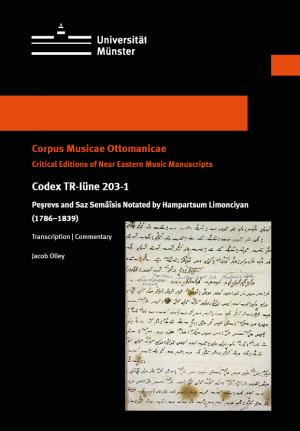
Codex TR-Iüne 203-1: Peşrevs and Saz Semâîsis Notated by Hampartsum Limonciyan (1786–1839): a. Transcription and b. Commentary
Keywords:
history of music, ethnomusicology, musical notation, Ottoman EmpireSynopsis
Shortly before 1812, a group of Armenians in the circle of Hampartsum Limonciyan (Hambarjum Limōnčean, 1768–1839) developed a new notation system. Based on the sign set of the historical Armenian khaz notation, an accent system, the signs were given new meanings and evolved from interval signs to pitch signs.
Until his death in 1839, Hampartsum Limonciyan himself transcribed numerous important works from the Ottoman instrumental repertoire according to the performance variants known to him and recorded them in the new notation system. According to tradition, the Codex TR-Iüne 203-1, which has been edited here, is one of only a few of these manuscripts that have survived.
Jacob Olley, who has carried out the scholarly edition of this collection of instrumental works, which is highly relevant for the study of historical music, with the greatest musicological expertise, provides music researchers and practitioners alike with a new insight into the Ottoman musical culture of the early 19th century. The edition, meticulously prepared from the original, is accompanied by a comprehensive introduction in which the editor's scholarly approach is explained and documented in detail. All editorial decisions are explained and documented in critical reports, which also contain further valuable information, e.g. on the concordances used.
Transcription: iii, 497 pages
Commentary: xxiv, 273 pages
Permalinks
URN: urn:nbn:de:hbz:6-22918565370
DOI: 10.17879/22918545622
ISBN
978-3-8405-0313-9
Language
English
Published
Series
Online ISSN
Categories
License

This work is licensed under a Creative Commons Attribution-ShareAlike 4.0 International License.