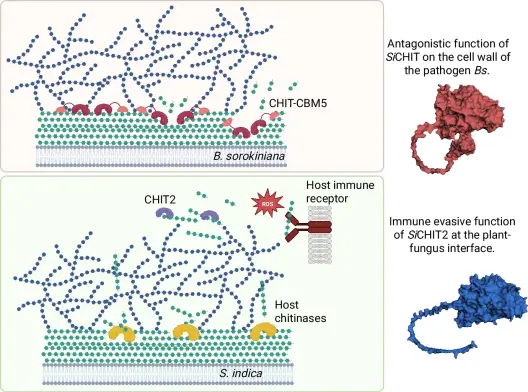
Paper accepted: Domain gain or loss in fungal chitinases drives ecological specialization toward antagonism or immune suppression.
Today, another paper based on the doctoral thesis of Ruben Eichfeld from Prof. Alga Zuccaro’s group at the University of Cologne was accepted in the journal Nature Communications. During his project, Ruben had visited our lab repeatedly to collaborate with Dr. Margareta Hellmann on the in depth characterization of the fungal chitinases he investigated. In the current paper, Ruben describes how these chitinases support the mutualistic interaction of a fungal endophyte with its host plant. The immune system of plants – like ours – has evolved ways to recognize chitin as a tell-tale signal for the presence of a fungus, and fungi are potential pathogens to be warded off by the immune system. However, some fungi are beneficial for plants, such as mycorrhiza and endophytes, i.e. fungi living inside plant tissues. These fungi need to evade recognition by the immune system; and at the same time, they often actively defend their own ecological niche by inhibiting other fungi, thus protecting the plant from fungal pathogens. Ruben and Margareta were now able to show that the antifungal activity of the endophyte is mediated by the substrate binding domain of a chitinase which increases the affinity of the enzyme to insoluble fungal cell wall chitin. The endophyte also possesses another chitinase which lacks the substrate binding domain, and this enzyme – but not the one with the extra domain – is involved in preventing the triggering of resistance reactions in the plant, while it has no antifungal activity. Apparently, the binding domain improves activity on insoluble polymeric substrates, but decreases activity on soluble oligomeric substrates. By degrading elicitor-active chitin oligomers produced by plant chitinases acting on the fungal cell wall chitin, the endophyte becomes invisible to the plant’s immune system. What a simple, elegant story! And as usual, it raises new questions, such as: How does the endophyte protect its own cell wall chitin from its own chitinase? How do the plant chitinases differ from the fungal ones? Questions to be addressed in future studies.