
Sacred Texts
The exhibits at the Bible Museum span four millennia; a selection of the most significant items will be on display from 8 May to 31 October in the special exhibition ‘Sacred Texts’. Early papyrus fragments, magnificently designed complete Bibles, archaeological finds, icons, figurines and sculptures tell the story of one of humanity’s most significant texts. These include objects relating to the history of the Bible, the textual history of the New Testament, and a selection of special individual items.
A clay tablet, made around 2,000 BC, is the Bible Museum’s oldest exhibit. It is inscribed in Sumerian cuneiform, praising the Mesopotamian goddess Inanna-Ishtar. The so-called ‘Editio Critica Maior’ (ECM) is the most recent exhibit and represents the long tradition of research aimed at determining the original text of the Greek New Testament. The Bible Museum’s sponsoring body, the Institute for New Testament Textual Research (INTF), is one of the most important international institutions in this field. Here, for example, the approximately 5,700 known Greek manuscripts containing parts of the New Testament are recorded, catalogued and researched.
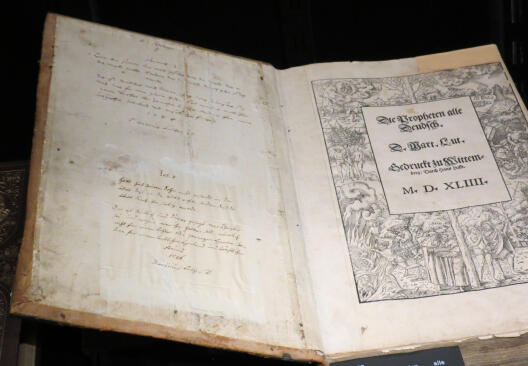
The exhibition, which features around 100 exhibits, includes a stamped brick from the construction of the Tower of Babel, a magnificent 15th-century cross icon, as well as original letters and a personal dedication by Martin Luther in a Bible edition from 1544/1545. It is open Tuesday to Sunday from 10 am to 6 pm, and until 10 pm on the second Friday of the month. Admission is free. An open guided tour takes place at 3 pm on Sundays, for which no booking is required. Individual guided tours for school groups or adults can be booked at bibelmuseum@uni-muenster.de.