Welcome to Thin Organic Films group
Group Leader: Prof. Dr. Harald Fuchs


Group Leader: Prof. Dr. Harald Fuchs
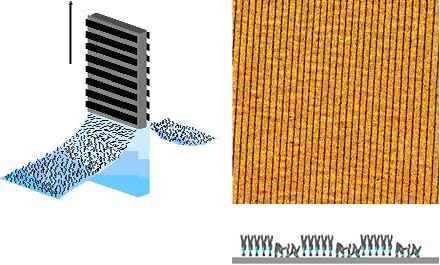
The control of the microscopic structure of organic materials on the micro- to nanometer scale can be achieved by cooperative and self-organization effects as also applied in biological systems. Organizing organic molecules into ordered structures can be achieved by the well known Langmuir-Blodgett (LB) technique as well as by the subtle self-assembly (SA) technique usually involving chemical bonds with the substrate. We are particularly interested in the possibility to construct monolayers system with controlled lateral structures, which can be realized by adjusting the balance of the different phases within the films (with one or more chemical components) thermodynamically and kinetically. The ordered molecules with active end groups can be further used for the specific adsorption of molecules, proteins and nanoparticles.
Scanning probe microscopy (SPM) became a powerful tool to characterize monofilms on the air/solid substrate interfaces. By applying SPM methods, we do not only obtain the information in topography and structure, but also measure the mechanical and electrostatic properties. In addition, scanning force microscopy (SFM) can be used to create local nanostructures in thin organic films.
The concepts of self-assembly and self-organization provide interesting routes towards surface patterning (from a few nanometers to micrometer in size) via bottom-up approaches. The patterning processes and the properties of the patterns formed (shape, size, function, etc.) can be adjusted by tailoring the properties of building blocks. We are particularly interested in the possibilities to construct ultrathin organic layer systems with controlled lateral structures, which can be realized by means of Langmuir Blodgett (LB) transfer and dip-coating. The goal is the development of new surface patterning methods based on bottom-up strategies. Further works will be focused on the organization of functional organic molecules such light emitting molecules, organic semiconductor as well as nanosized materials. Furthermore, in cooperation with theoretical groups, we are going to achieve a quantitative description of the spatial-temporal pattern formation during the dynamic processes thus to lay the basis for the development of strategies for the self-organized formation of more complex patterns.
Template directed self-assembly of nanomaterials and molecular complexes into functional systems can be realized by using heterogeneous patterned surfaces. The heterogeneous surface structures may be composed of different materials, different tailored molecules, but can also be composed of single component but with different molecular packing. We are on one side working on the heterogeneous surface functionalization by means of LB patterning, soft lithography and photo/e-beam lithography techniques; on the other side, we are interested in the mechanisms of molecular interactions - from liquid phase and gas phase - with pre-structured surfaces. We are particularly interested in the nucleation control through the pre-designed patterns and the surface modification with organic films, which provide the possibilities to control the growth of organic conductive/semiconductive materials thus improve their charge transport behaviors.
Connection of functional molecular complexes and nanomaterials with addressable microscopic structures is an important issue for applications in e.g. nanoelectronics. We started in the last three years to combine surface modification with SAMs, e-beam lithography, soft-lithography and template directed self-assembly for connecting nanoclusters, functional molecules or molecular aggregates with addressable microelectrodes. On this base, we are going to study the size effect on conductive polymers and the related gas-sensing activity.
Scanning probe microscopes (SPMs) became powerful tool to characterize molecular assemblies on different surfaces. By applying scanning force microscopy (SFM) methods, one does not only obtain the information in topography and structure, but also measure the mechanical and electrostatic properties. Using scanning tunneling microscopy (STM) we reveal molecular packing with high spatial resolution in monolayer and multilayer systems prepared under different environments. One special focus in the future work will be study of "On-Surface" chemical reactions under well controlled conditions.