BioComp - Biodiversity Exploratories



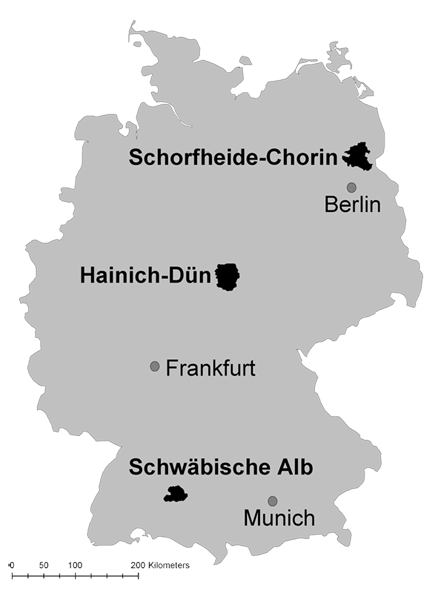
The Exploratories for functional biodiversity research or Biodiversity Exploratories are a German Science Foundation (DFG) funded research project with more than 30 collaborating research institutions.
Biodiversity and ecosystem research will be merged at a large scale and with a long-term perspective in three different regions in Germany: the "Exploratories" Biosphärenreservat Schorfheide-Chorin in Brandenburg, Nationalpark Hainich and surroundings in Thuringia and Biosphärengebiet Schwäbische Alb in Baden-Württemberg.
more information on the study areas and the experimental design are availabel on the homepage of the biodiversity exploratories
Project Titel Relating structural and compositional features of grassland canopies to diversity patterns and land use using spectroscopy
Subproject within the DFG Priority Programme 1374 "Biodiversity Exploratories"
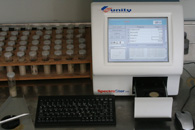 The contributing project BIOCOMP applies the method of near-infrared reflectance spectroscopy (NIRS) to determine multiple compositional features of aboveground biomass in grasslands. NIR analysis is an indirect non-destructive method that estimates the chemical component of interest by comparing spectra with known composition. The prediction of unknown samples is carried out with a calibration model that has to be developed with multivariate regression procedures. The application of this technique allows for easy, rapid and cheap measurements with high temporal and spatial replication. Within the framework of a multi-disciplinary project such as the Biodiversity Exploratories samples of other subgroups can be measured with the existing calibrations, which offers multiple opportunities of synthetic data analyses.
Funded by Deutsche Forschungsgemeinschaft (German Research Foundation) DFG
BioComp 2009-11
Duration March 2009 to February 2011
Funding 93,400 €
BioComp 2011-14
Duration March 2011 to February 2014
Funding 145.160 €
The Working Group Ecosystem Research participated as the contributing project BioComp during the project phase 2009-2011 in the exploratories. BioComp investigated compositional features of grassland vegetation and related them to diversity patterns and differences in land-use intensity.
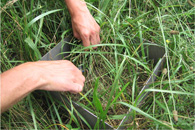 2009 and 2010, we sampled aboveground biomass of the 150 experimental plots in grasslands of all three exploratories. Based on the 2009 samples, NIRS calibration models were developed to predict carbon and nutrient (N, P, K, Ca, Mg) concentrations as well as fibre contents (NDF, ADF, ADL). These calibrations are currently used for the rapid and cheap measurement of unknown samples. Moreover, we developed a technique to measure low sample quantities maintaining the high prediction accuracy of standard NIRS measurements.
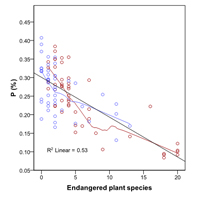 Nutrient concentrations in the aboveground biomass of the studied agricultural grasslands were proved to be good indicators for vascular plant species richness - particularly red list species - as well as land-use intensity. A key role could be attributed to the P supply. Fibre concentrarions were hardly related to species richness and - surprisingly - to land-use intensity. As a byproduct of our research on patterns of compositional features of biomass in relation to biodiverity and land-use intensity, we developed NIRS calibration models to predict Ellenberg indicator values. Particularly, the Ellenberg nitrogen value corresponded with the P concentration in the aboveground biomass suggesting to better call it "Ellenberg nutrient value". Thereby, we presented something like a "ground truth" of Ellenberg indicator values as they reflected the spectral characteristics of the biomass they were derived from.
Papers on the Results of BioComp are listed in the "Infothek".
Project Management: Prof. Dr. Norbert Hölzel, Dr. Till Kleinebecker
PhD Student / Contact Person: Dr. Valentin H. Klaus
The Working Group Ecosystem Research at the Institute of Landscape Ecology (University of Münster) participates as the contributing project BIOCOMP in the Biodiversity Exploratories. BIOCOMP investigates compositional features of grassland community biomass and explores relationships to diversity patterns, ecosystem processes and differences in land-use.
Hypotheses
The assessment of productivity and the chemical composition of grassland yield are of crucial importance for disentangling biodiversity patterns, but such data are rarely available particularly with respect to spatial patterns and temporal changes. In the previous project phase (2009-2011), we established the technique of near-nfrared reflectance spectroscopy (NIRS) to measure the chemical composition of biomass in a very rapid and cost effective way. Existing calibration models include the carbon concentration and the main plant nutrients (N, P, K, Ca, Mg) as well as various fractions of fibre such as neutral detergent fibre (NDF), acid detergent fibre (ADF) and lignin (ADL). In the current project phase, we will add prediction models of biomass δ15N and δ13C and use all these calibrations to generate a unique five year data set of various compositional features of aboveground biomass of all 150 experimental plots in grasslands. Besides our own research questions, elaborated calibration models can be used by other projects within the Biodiversity Exploratories for the quick and cheap assessment of the chemical composition as well as the nitrogen and carbon isotopic signals of grassland biomass, which will offer multiple possibilities for synergetic data analyses.
Project Management: Prof. Dr. Norbert Hölzel, Dr. Till Kleinebecker
PhD Student / Contact Person: Dr. Valentin H. Klaus
[31.05.2010] Der Uckermärkische Anzeiger berichtet über die Biodiversitäts-Exploratorien und die Aktivitäten der AG im Exploratorium Schorfheide. Artikel [pdf] Foto: MOZ.