
Can Machines Recognize Moral Arguments?
Modeling Moralizations with Large Language Models
Dr. Maria Becker
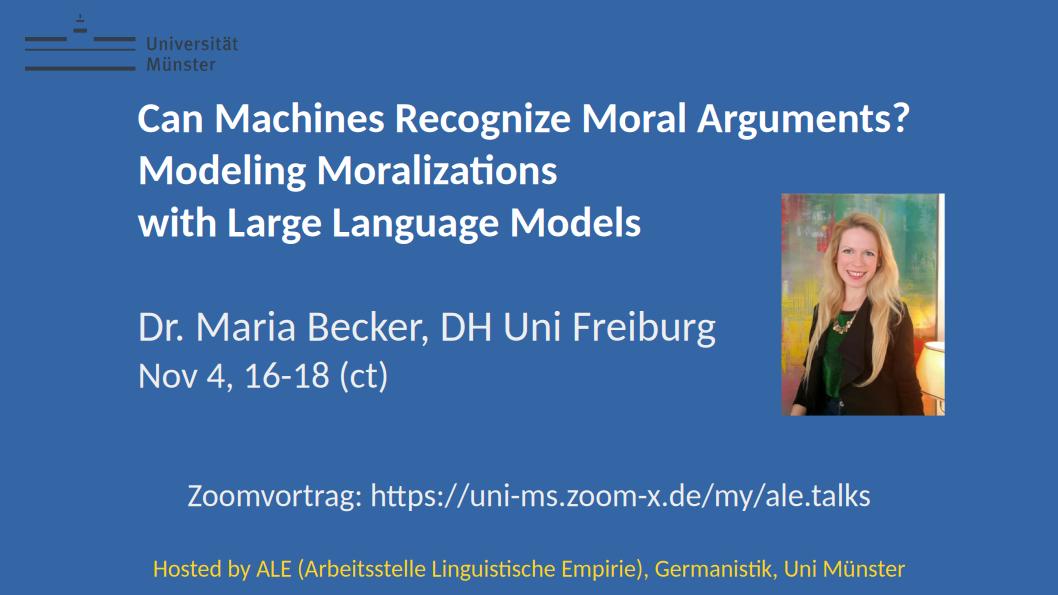
Moralizations – arguments in which moral values such as fairness, freedom or the avoidance of harm are invoked to justify a demand – are ubiquitous in public discourse, from parliamentary debates and newspaper commentary to online comments and court rulings. Because they appeal to values that seem beyond dispute, they are a powerful persuasive strategy. But they are also hard to pin down: demands often remain implicit, and the mere presence of moral vocabulary does not make a text moralizing. In this talk, I present an approach to identifying and analyzing moralizations with large language models (LLMs) such as GPT, Claude or LLaMA. I show how a linguistic concept is turned into something that can be annotated and measured, how we built a multilingual, multi-genre corpus of more than 11,000 annotated text passages, and how LLMs perform when asked to decide whether a text is moralizing. Comparing model and human judgments, I discuss where models agree with human annotators, where they systematically deviate, and what this reveals about subjectivity and implicitness in pragmatic phenomena. A central point is that methodological decisions, from how a concept is defined to how a model is instructed, shape the results at least as much as the choice of model. No prior knowledge of computational linguistics is required.
Kontakt