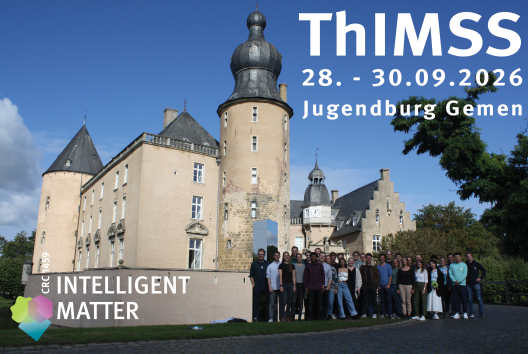
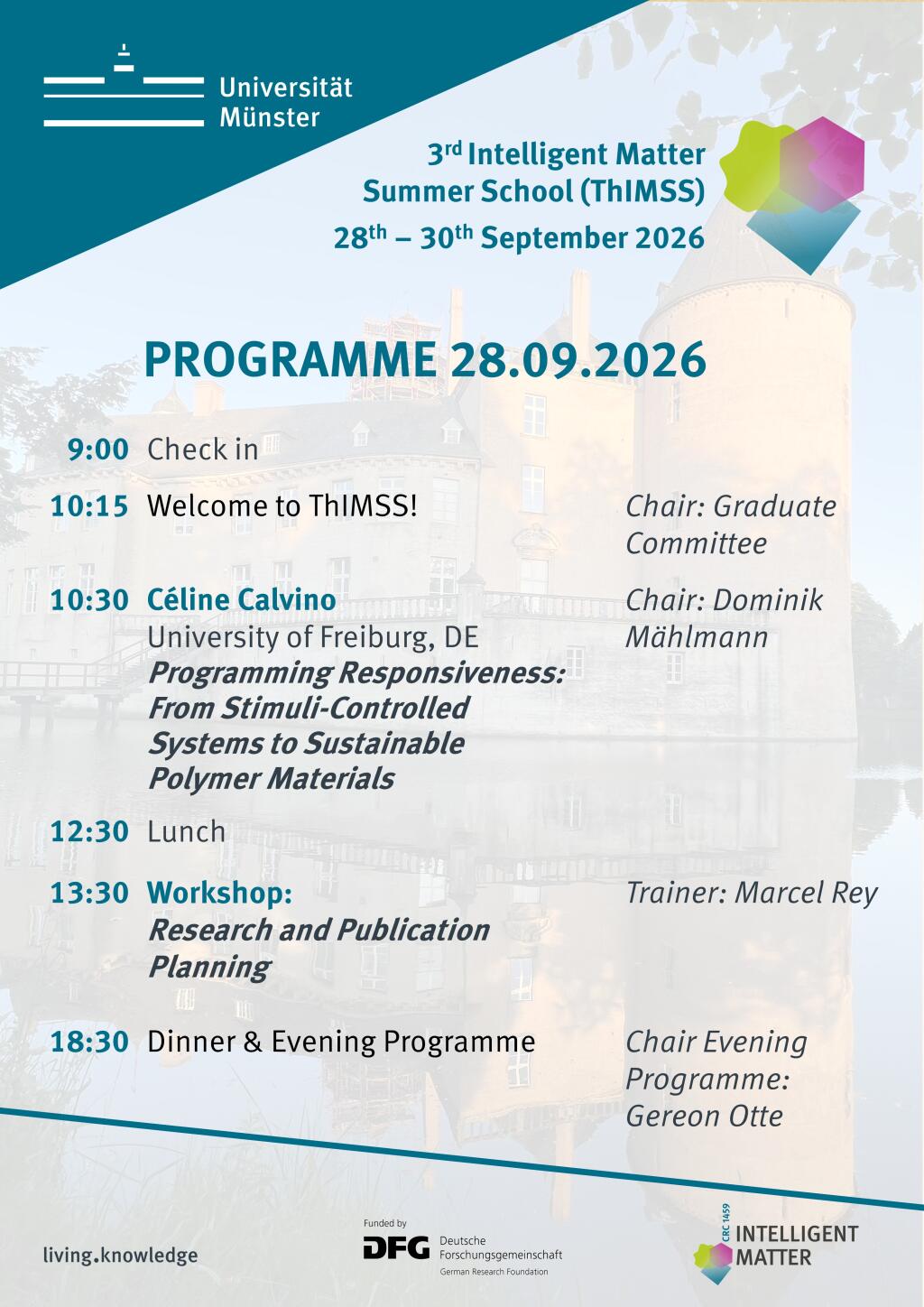
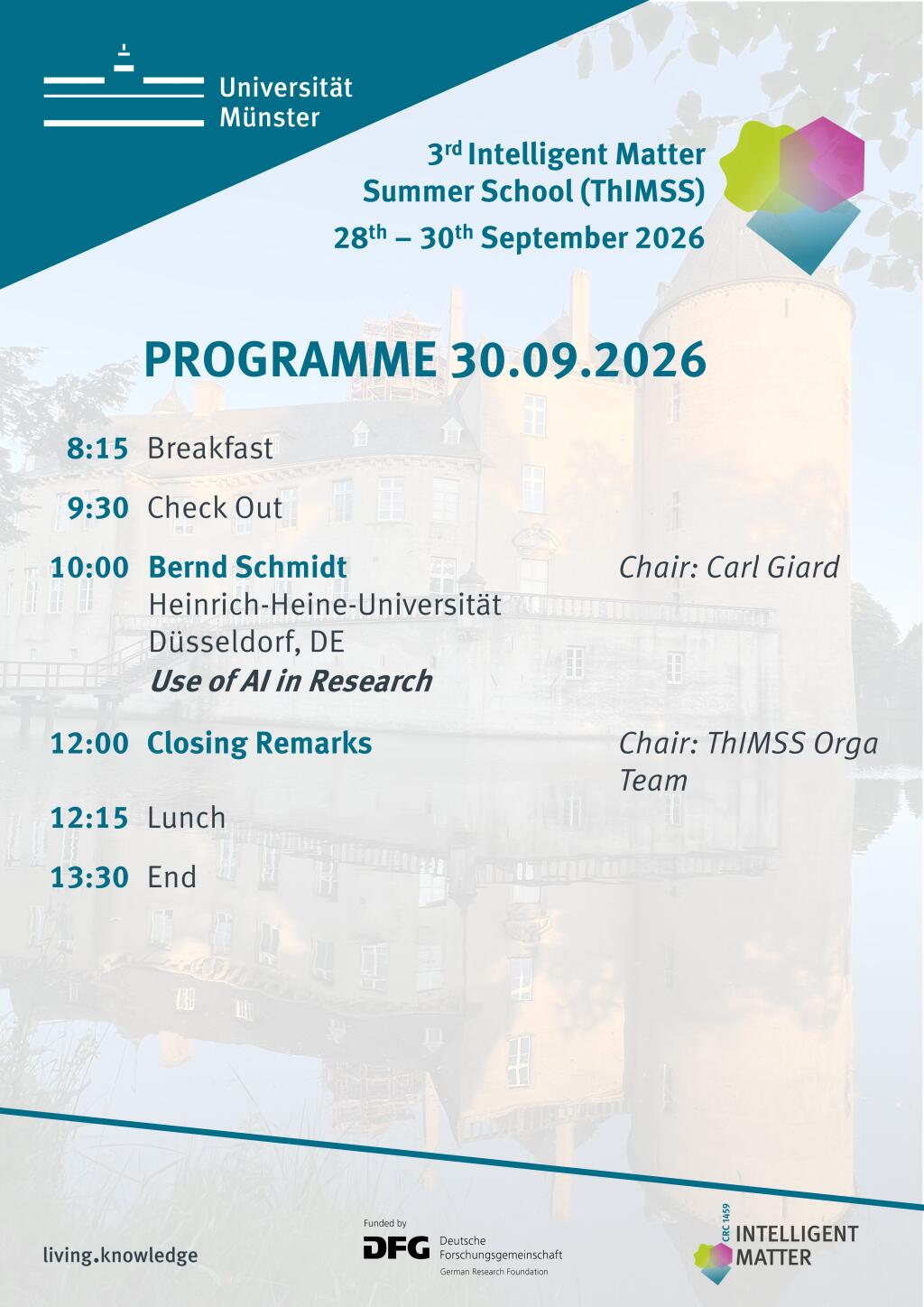
Dates: 28 – 30 September 2026 Venue: Jugendburg Gemen, Borken
The CRC 1459 Research Training Group invites all its members to the third edition of the Intelligent Matter Summer School (ThIMSS). Over three intensive days, participants will dive into cutting‑edge lectures spanning Chemistry, Physics, and Computer Science, complemented by two dedicated soft‑skill workshops designed to help you become a well‑rounded researcher.
Program highlights
Three expert talks in the core scientific disciplines
Two interactive soft‑skill workshops (choose the topics that best fit your development goals)
Evening entertainment to foster informal networking and unwind after the day’s sessions
We look forward to welcoming you to Gemen Castle for an inspiring blend of science, skill‑building, and collegial exchange.
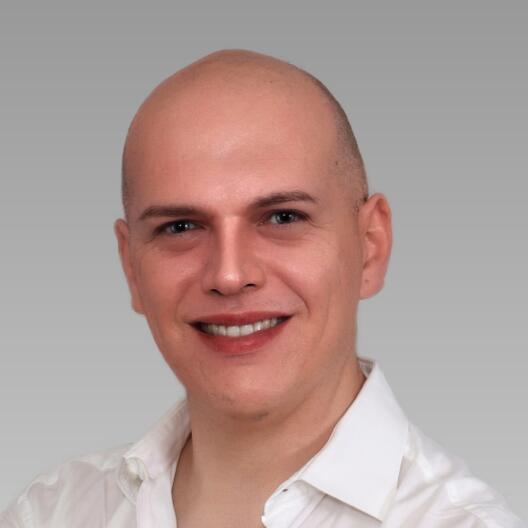
Ivo graduated in Nuclear Engineering in 2009 from the Polytechnic of Milan and obtained a doctoral degree in Physics in 2023 at the University of Stuttgart under the supervision of Prof. C. Bechinger. He then built a research career through postdoctoral experience at both ETH Zurich and the University of Oxford, supported by an ETH Fellowship and a Marie Curie Fellowship, respectively. Since 2020, he leads the group of Experimental Colloidal Physics at Heinrich-Heine University Düsseldorf, first as Junior Professor and later as Associate Professor. The scientific interest of his group lies in the field of soft condensed matter with a focus on bioactive materials (e.g. self-propelling particles, biological and bio-inspired interfaces, and functional liposomes).
Céline received her MS degree in Chemistry from the University of Fribourg, Switzerland, with a focus on organic synthesis, polymer chemistry, and materials science. She completed her master’s thesis at Asulab (The Swatch Group R&D Ltd), where she investigated the formation of homogeneous, durable anchor layers on watch components and the introduction of epilam (anti-spreading) effects using controlled polymerization via “grafting from” and “grafting to” approaches.
She remained in Fribourg to pursue her PhD in polymer chemistry and materials science at the Adolphe Merkle Institute. Her doctoral work focused on the design of chromogenic systems based on supramolecular interactions and their integration into polymeric materials to create functional mechanoresponsive systems. Céline then joined the Pritzker School of Molecular Engineering at the University of Chicago as a postdoctoral researcher, supported by a Swiss National Science Foundation Mobility Fellowship. Her research centered on dynamic covalent strategies for the functionalization of cellulose nanocrystals, alongside the development of melt-processing approaches to produce mechanically reinforced, sustainable nanocomposites.
In 2021, she was appointed Junior Group Leader and Principal Investigator at the University of Freiburg, Germany. Her research focuses on the design of stimuli-responsive polymer systems, with an emphasis on enabling recyclability and advancing sustainable polymer materials.
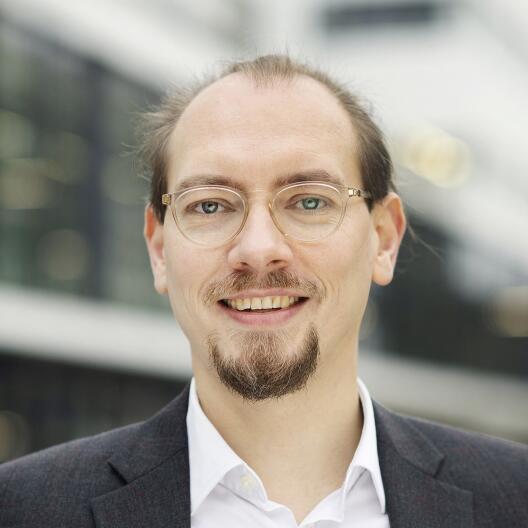
Bernd is a distinguished chemist who began his academic journey at the Freie Universität (FU) Berlin, where he studied chemistry. As a student researcher, he expanded his research horizons at the Institute for Molecular Science in Okazaki, Japan. In 2013, Dr. Schmidt earned his PhD at FU Berlin, where he was part of the Fluorine Chemistry Research Training Group. Following his doctoral work, he completed postdoctoral research at Humboldt University in Berlin and the University of Tokyo.
In 2018, Bernd joined Heinrich Heine University Düsseldorf (HHU), where he leads a junior research group. His academic and research excellence has earned him several prestigious awards and distinctions, including: Heisenberg Programme of the German Research Foundation (DFG) (since 2024), Dr. Otto Röhm Memorial Foundation Award (2022), Member of the "Junge Kolleg," North Rhine-Westphalian Academy of Sciences, Humanities and the Arts (since 2020), where he also serves as an elected representative, Humboldt Research Fellowship (2013), Feodor Lynen Research Fellowship (2014–2016), Short-term and long-Term Research Scholarships, and Japan Society for the Promotion of Science (JSPS).
Bernd researches simple organic building blocks that arrange themselves into well-defined, complex supermolecules within a short time. This process of association of individual molecules into superordinate structures is of great importance in nature but also in
many other areas. In contrast to metal-containing networks, individual pores are formed in organic molecules. It is hoped that the very light porous compounds can be used to bind gases such as carbon dioxide. Dr. Schmidt's research group is working specifically on ultrahydrophobic pores made of fluorinated building blocks. In addition, the group is working on supramolecular systems that can be controlled by external stimuli such as light and ultrasound.