

“Germans are much less tolerant of Muslims”
Survey on religious plurality in Europe shows delicate results in terms of integration politics

The Selection of the Countries
The selection of the five countries was based on the varying degrees of religious plurality: the sociologists selected Germany due to the large number of Muslims and because the conflicts about mosques and headscarves are on the rise. As there are much fewer Muslims in East Germany than in the West, the two parts of the country were investigated separately. The researchers brought in Portugal as a contrast as religious plurality is less pronounced there. They were interested in secular France due to the discussions about the burka ban and the social tensions between young Muslims and the majority society. The Netherlands came to the fore because their image of a tolerant society has been shaken ever since the assassination of Islam critic Theo van Gogh. The researchers assumed that Denmark’s relationship with Islam has changed due to the cartoon controversy.
More Results from the Study on Religious Plurality
Is Islam misogynous, fanatic and prone to violence?
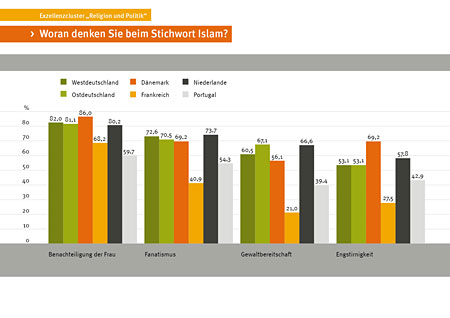
The respondents’ image of Islam is equally negative in all five countries. For instance, some 80 per cent of the population of all nations think of discrimination against women when hearing the word “Islam”. Approximately 70 per cent associate fanatism with Islam, some 60 per cent proneness to violence, a little more than half of them bigotry. The criticism is much more moderate in France only.
Is Islam peaceful and tolerant?
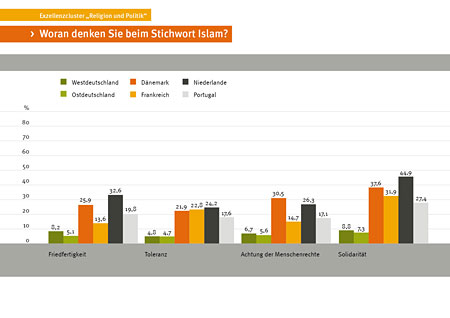
If the respondents are given positive attributes to choose from, a clear difference between Germany and the other countries emerges. Less than 5 per cent of Germans ascribe tolerance to Islam, whereas more than 20 per cent of the populations in Denmark, France and the Netherlands do so. Only 5 to 8 per cent of Germans attribute peaceableness and respect for human rights to Islam. This evaluation is also negative in the other countries; the agreement with this statement, however, amounts to a maximum of 30 per cent.
Should Islam adapt to the West?
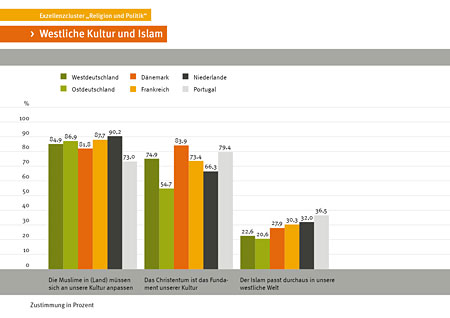
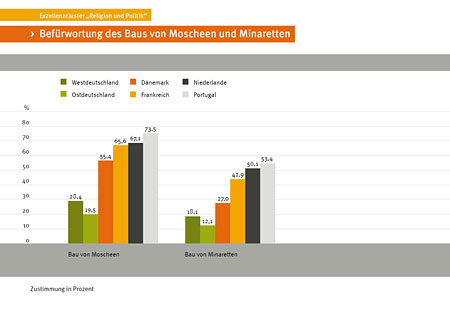
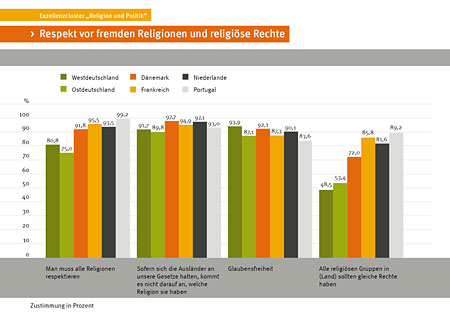
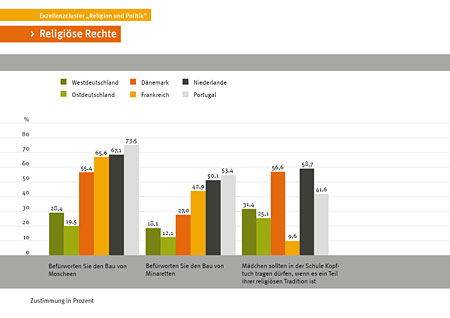
Although the European neighbouring countries concede more rights to the Muslims as the Germans do, as regards the building of mosques for example, they also demand a higher degree of cultural adaptation. Significantly more than 80 per cent in all of the five countries agree with the statement “that the Muslims have to adapt to our culture”.
Christianity as cultural basis?
The Germans agree with their neighbours in that they consider Christianity to be the basis of their culture. Some 70 per cent take this view, the share only being lower in de-churched East Germany. A minority of approx. 20 per cent believes that Islam is suitable for the Western world. In France, too, the agreement does not exceed a mere 30 per cent. So the Christian character of culture is beyond dispute for the people in Germany, the Netherlands, France and Denmark.
Threatened by foreign cultures?
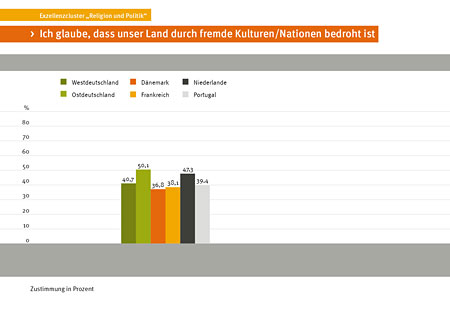
The question whether one’s own country is threatened by foreign cultures is affirmed by two fifths in West Germany. In East Germany, half of the respondents agree. The feeling of being threatened by foreign cultures in West Germany is about as strong as it is in Denmark, France and in the Netherlands; in East Germany, it is above the average level of the neighbouring countries investigated.
Does religious plurality produce conflict or cultural enrichment?
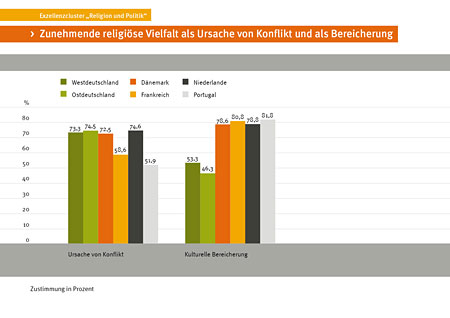
More than 70 per cent of respondents in West and East Germany, in Denmark and the Netherlands are convinced that the increasing plurality of religious groups is a source of conflict; in France, only 59 per cent think so. In West Germany, just over 50 per cent are willing to agree to the statement that religious plurality is culturally enriching; in the East, the share of those who think so is even a little less than that. In the other countries, however, this share amounts to around 80 per cent. Hence, tensions arising from the fact that followers of different religious beliefs live together are regarded similarly in all countries. However, openness towards foreign religions and cultures is much higher in France, Denmark, the Netherlands and also in Portugal.
And what do the people think about Jews, Buddhists and Hindus?
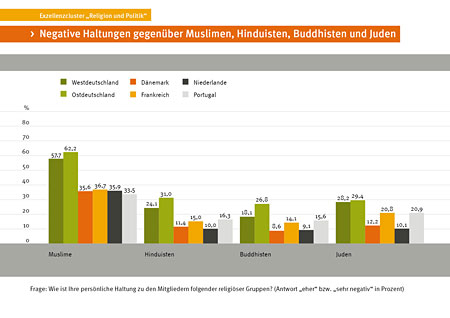
As to the attitude towards Jews, Buddhists and Hindus, the German population at first glance seems to take up a more open-minded stance than it does towards Muslims. Its majority has a positive attitude towards followers of these three religions. Still, the differences compared to Denmark, France and the Netherlands are again considerable, amounting to 15 to 20 percentage points. The stance on Muslims in all countries is more negative than on Buddhists, Hindus or Jews. In Germany, however, the general opinion is noticeably more critical. (vvm)
Photos
Download the English version of the slides of the survey results as a pdf-file.