
Focal areas of research
The research profile of psychology at the University of Münster centers on the individual: from the biology of single individuals to individuals in social groups. Its research spans basic research, application-oriented research grounded in basic science, and transfer research. The profile comprises one central research focus and four further focus areas:
- Individualisation in Dynamic Human Systems, the most extensively developed focus area with the topics individuals in social contexts, personality research, cognition research, emotion research, inter- and intraindividual variability, health and well-being, and linguistic adaptation processes
- Further research focus areas: Individual and Social Perspectives on Societal Challenges; AI-based Prediction and Explanation of Human Experiences, Behavior and Neurocognition; evidence-based, profession-oriented concepts in educational contexts; Open Science and Trust in Science
All focus areas are closely tied to the University of Münster's strategically important research fields, in particular the profile area Individualisation and the impact areas Healthy Individuals, Dynamic Societies, and Conceptual Foundations & Emerging Technologies. In the spirit of the scientist-practitioner model and research-based teaching, they are also directly linked to teaching and transfer. Many topics are pursued jointly with sport and exercise science within Faculty 7.
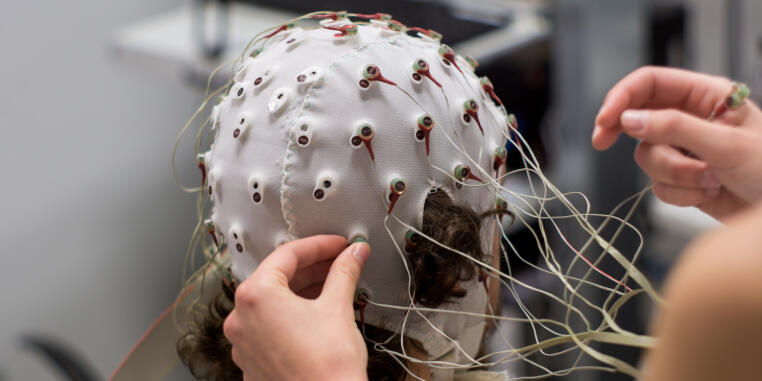
The methodological approaches are broad and multi-method, ranging from experimental setups using brain imaging and stimulation techniques, virtual reality, video-based behavioral observation and ecological momentary assessment to (neuro)computational modeling, longitudinal panel studies and qualitative methods. Research is supported by excellent infrastructures, including the Joint Institute for Individualisation in a Changing Environment (JICE), the Otto Creutzfeldt Center for Cognitive and Behavioral Neuroscience (OCC), the Münster Center for Open Science (MüCOS), the Center for Social Skills (CeSoS), and the psychotherapy outpatient clinics for children and adolescents and for adults.
Individualisation in Dynamic Human Systems
Psychology in Münster plays a major role in the University of Münster's profile area Individualisation (impact area Healthy Individuals) and, together with sport and exercise science, has taken a leading role in shaping its content and strategy and within the JICE. Individuals are the central unit of analysis in psychology. Neurocognitive, behavioral, social-science and educational-science approaches are integrated to understand individuals as dynamic systems and to study individual differences across levels of analysis, from neural processes to social relationships. The aim is to sharpen existing strengths in the areas of dynamic social, motor and neurocognitive systems as well as mental and physical health, and to expand them further in interdisciplinary collaborative projects, including with other faculties such as biology and medicine. Seven topics are at the center of this focus area:
Individuals in social contexts
How do individuals choose one another, how does the interplay of different individuals in social relationships work, and how does individuality develop in social contexts? These questions are addressed by an interdisciplinary field of research that analyzes the principles and mechanisms of individuality in social contexts across species. To this end, concepts and methods from psychology and biology are integrated and complemented by perspectives from movement science, economics, computer science and philosophy. This research is conducted in close cooperation with Bielefeld University, in particular within the JICE.
Personality research
Personality research in Münster holds an internationally leading position in the field of personality science. It is currently being placed on a broader footing through the integration of biological, medical and philosophical approaches, for example by systematically linking personality psychology with behavioral-biology research on animal personality and through conceptual work on the foundations of personality research. A further current focus is the computational modeling of personality differences based on language.
Cognition research
A central topic of cognition research in Münster is episodic memory, understood as a constructive process shaped by the individual. Psychology, neuroscience, computer science and philosophy collaborate in an integrative program combining experimental approaches, formal modeling and conceptual analysis. The focus is on how episodic remembering is shaped by individual factors: the reconstruction of past events does not follow general principles alone but is systematically modulated by differences between individuals. Variability is treated not as noise but as a phenomenon worth explaining in its own right. A distinctive Münster contribution concerns the interplay of individual factors and social dynamics.
Emotion research
Emotion research addresses the interplay of social and intraindividual processes in the development of emotion awareness and emotion regulation in childhood, with the aim of describing, explaining and optimizing this development. Differences in emotional states and processes are essential components of individuality and, at the same time, have important consequences for individual life courses and mental health.
Inter- and intraindividual variability
The variability of human experience and behavior is a central topic across the behavioral, social, neuro-, movement and educational sciences. In Münster, wide-ranging expertise on intra- and interindividual dynamics is being integrated into a cross-disciplinary focus: assessing and understanding variability across individuals, contexts and levels of analysis. This includes questions of standardization versus heterogenization of individual and situational variability in behavioral neuroscience research (among others at the OCC) as well as the integrative conceptualization and measurement of variability across modalities, time scales and species (among others within the JICE).
Health and well-being
Promoting, maintaining and restoring mental and physical health and well-being for children, adolescents and adults, particularly in times of crisis, is a goal of high societal relevance. Psychology in Münster combines internationally recognized research expertise on various facets of health and well-being and on evidence-based methods of promoting them.
Focal points include the foundations of mental disorders (including depression, eating disorders and ADHD) and the determinants of successful psychotherapy, including transdiagnostic and individualized treatment approaches across the lifespan. Further topics are individual and contextual conditions of well-being in private, school, student and working life, the maintenance of mental health and cognitive functioning into old age, and the effects of profound environmental change and societal challenges on mental health. In addition, trajectories of mental health are modeled statistically, and basic-science approaches are translated into clinical and therapeutic application.
Linguistic adaptation processes
Language connects and divides at the same time. In a globalized, migration-shaped and digitalized world, linguistic adaptation is a central mechanism of human communication: it enables understanding across cultural boundaries, reflects social relationships and drives language change. Psychology studies these adaptation processes together with linguistics and other disciplines and is actively involved in structured, interdisciplinary doctoral training at the interface of linguistics, psychology, cognition and society.
Further research focus areas
Four further research focus areas take up current societal and technological developments:
Individual and Social Perspectives on Societal Challenges
Several research initiatives in psychology place the role of the individual in describing, explaining and coping with societal challenges at their center. These include projects on well-being, attitudes and socially relevant behavior in the context of migration and integration, social cohesion and belonging, the COVID-19 pandemic, the war in Ukraine, and political elections and democracy. The widely cited findings, communicated broadly to the public, show that major societal challenges can only be understood and addressed if individual experience and behavior are taken into account and linked to collective phenomena.
Psychology contributes this expertise to the University of Münster's impact area Dynamic Societies and, at the interface of the profile areas Religion and Society and Dynamics of Social Plurality, complements the university's research profile with an empirical, social- and behavioral-science approach.
AI-based Prediction and Explanation of Human Experiences, Behavior and Neurocognition
Explaining and predicting human experience and behavior are central goals of psychology. This focus area addresses neural, cognitive and social-behavioral dynamics between humans, technology and the environment, bringing together psychological, neurocognitive, medical and technological expertise. Topics range from the stability and plasticity of memory and cognition, adaptive predictive processes in natural contexts, cortical oscillations, olfaction and multisensory integration to memory and perceptual processes, social judgments and interactions. A methodological focus lies on AI techniques such as machine learning, deep learning and generative AI. Psychology thereby strengthens the university's emerging field Interdisciplinary Computing and AI and is involved in establishing the university's AI center, the Center for Data Science and Complexity (CDSC).
Two topics are at the center:
- In AI-based prediction and explanation of cognition and behavior, research investigates how neural, cognitive and motor systems form and adapt expectations and control actions in realistic situations. Using experimental methods, AI-based modeling, virtual and mixed reality and human-technology interaction, researchers model, for example, action intentions, visual memory, communication, judgments, decisions, learning trajectories, personality change, mental disorders and motor processes. This provides a basis for AI programs that predict behavior or cognitive states, uncover new mechanisms and make findings usable for personalized applications, for instance in training or therapy.
- In human-AI interaction, research examines how trust and transparency shape the acceptance and effective use of AI. Trust is assessed using explicit and implicit methods, for example when AI and users learn from each other in bidirectional interactions; virtual and augmented reality systems make the state of the AI directly experienceable, and behavioral and physiological data provide insight into processes of understanding and trust. Further projects address how older adults engage with AI.
Evidence-based, profession-oriented concepts in educational contexts
Educational research in psychology investigates how learners acquire subject-specific and cross-curricular competencies and how teachers and educational-psychology professionals acquire professional competencies across all areas of the education system, from early childhood through primary, secondary and tertiary education to non-formal and informal educational contexts. Questions of comprehensive education consider the individual from a physical, cognitive and social perspective across the age span. One focus lies on the foundations of comprehensive education, such as self- and emotion regulation, motivation and procrastination, assessment-based support and task design, and pedagogical attitudes and professional demands. Research on higher education advances concepts of research-based, situated and problem-based learning.
A further focus concerns processes of transferring and implementing evidence-based concepts into different educational settings: exploratory design research develops and evaluates innovative (digital) concepts in view of the transformation of the educational landscape, for example video-based portals and professional development modules for teacher education and training. Transfer research examines the conditions under which implementation succeeds, so that teaching and learning concepts are used sustainably and effectively by others. Educational research at the University of Münster is a member of the Leibniz Education Research Network (LERN). This membership rests substantially on psychology's interdisciplinary, multi-site research collaborations.
Open Science and Trust in Science
Open science concerns the entire research cycle, from the transparent derivation of research questions to the documentation of materials, analyses and data through to the publication and communication of results. In doing so, it addresses the transparency and reliability of research. Psychology in Münster has for years been at the forefront of developing innovative open science concepts, incorporating them into research practice and research-related regulations, and offering practicable solutions for a wide range of contexts. These activities are underpinned by metascientific research on the practices, conditions and consequences of open research, including replication research.
The Münster Center for Open Science (MüCOS), founded from within psychology, professionalizes the university's open science support structures, connects them across faculties and accompanies the development of a university-wide open science strategy. In view of growing science skepticism, research on the transparency and replicability of scientific findings is, moreover, linked with science communication research on trust in science. Open science activities are closely intertwined with transfer (including citizen science and science communication) and teaching (evidence-based teaching, open science as course content, workshops for early career researchers).