

New Open Access Publication on Generative AI and Disinformation
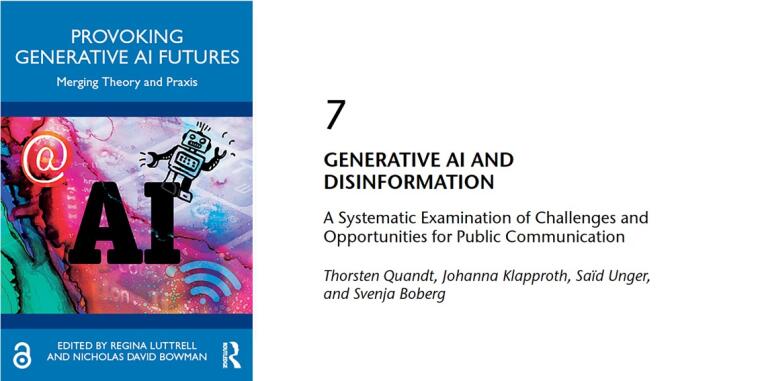
A new book chapter by Thorsten Quandt, Johanna Klapproth, Saïd Unger and Svenja Boberg titled Generative AI and Disinformation: A Systematic Examination of Challenges and Opportunities for Public Communication has been published in the edited volume Provoking Generative AI Futures: Merging Theory and Praxis, edited by Regina Luttrell and Nicholas David Bowman.
The chapter examines the growing role of Generative AI (GenAI) in the context of disinformation and public communication. Using the five dimensions of Dark Participation (actors, reasons, targets, audiences, and processes) as an analytical framework, the contribution explores how GenAI simultaneously creates new opportunities for communication and resilience while also enabling the large-scale production and dissemination of misleading or malicious content.
Drawing on recent empirical developments, the chapter analyzes how GenAI reshapes the mechanisms, motives, and societal impacts of disinformation across all dimensions of Dark Participation. At the same time, it highlights the potential of GenAI to support educational initiatives, journalism, and counter-disinformation strategies, and proposes a research agenda aimed at strengthening societal resilience.
The edited volume brings together scholars and practitioners to discuss current developments, ethical questions, and future perspectives of generative AI in media and communication research and practice. The publication is available open access.
Reference:
Quandt, T., Klapproth, J., Unger, S., Boberg, S. (2026). Generative AI and Disinformation: A Systematic Examination of Challenges and Opportunities for Public Communication. In R. Luttrell & N. D. Bowman (Eds.), Provoking Generative AI Futures. Merging Theory and Praxis (pp. 117-134). Doi: 10.4324/9781003487623. Taylor & Francis.