

PD Dr. Roman Liepelt (Akad. Rat)Institute of Psychology Fliednerstraße 21 D-48149 Münster Phone: +49 (0)251/83-34171 Fax: +49 (0)251/83-34180 Email: roman.liepelt@uni-muenster.de → Website |
 |
Research Areas
1. Joint Action
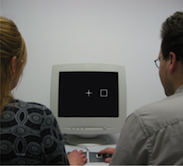 The ability to coordinate our actions with other individuals is crucial for our success as individuals and in social interactions. Watching two persons engaged in dancing, for example, requires a remarkable ability to coordinate their actions to reach a common goal. We are interested in the cognitive and neural mechanisms involved in action coordination when two people share a task. We investigate these questions with behavioral experiments and functional magnetic resonance imaging (fMRI). The ability to coordinate our actions with other individuals is crucial for our success as individuals and in social interactions. Watching two persons engaged in dancing, for example, requires a remarkable ability to coordinate their actions to reach a common goal. We are interested in the cognitive and neural mechanisms involved in action coordination when two people share a task. We investigate these questions with behavioral experiments and functional magnetic resonance imaging (fMRI). |
| Figure 1: Experimental setting in a Joint Go-NoGo condition. |
2. Automatic Imitation
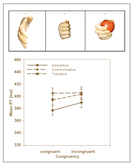 I am also interested in the cortical and cognitive mechanisms that are involved in the inhibition of imitative response tendencies. In particular I investigate conditions under which the observation of biological movements leads to an activation of an internal motor representations. Especially the anterior fronto median cortex (aFMC) and the right temporo-parietal junction (TPJ) area might play a crucial role in the inhibition of imitative behavior. Methodologically I use functional MRI and behavioral methods to investigate these research issues. I am also interested in the cortical and cognitive mechanisms that are involved in the inhibition of imitative response tendencies. In particular I investigate conditions under which the observation of biological movements leads to an activation of an internal motor representations. Especially the anterior fronto median cortex (aFMC) and the right temporo-parietal junction (TPJ) area might play a crucial role in the inhibition of imitative behavior. Methodologically I use functional MRI and behavioral methods to investigate these research issues. |
| Figure 2: Experimental design showing a non-human agent performing actions in three different categories (upper panel left - right: communicative, intransitive, transitive movements). Mean reaction times (RTs) in milliseconds (ms) with error bars representing standard errors of the mean as a function of observed gesture type (communicative, intransitive and transitive movements) and congruency (congruent and incongruent) for the non-human agent condition (lower panel). |
3. Dual-task research
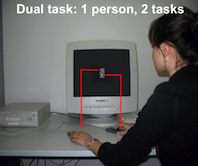 A different research focus is the investigation of executive processes that are required to coordinate the processing stages in dual tasks. It has often been assumed that executive processes control the temporal scheduling of potentially interfering processing stages. As a result of this scheduling, dual-task costs, e.g., an increase in processing time or errors during the simultaneous processing of two tasks compared to the processing of single tasks, can be observed. However, some recent results indicate that dual-task costs may disappear after prolonged dual-task practice. One main goal of this project is to specify the nature of the learning processes leading to the disappearance of dual-task costs in the PRP paradigm. What exactly is learned during repeated dual-task performance? That is, which kind of executive knowledge enables participants to perform the tasks without any dual-task costs? A different research focus is the investigation of executive processes that are required to coordinate the processing stages in dual tasks. It has often been assumed that executive processes control the temporal scheduling of potentially interfering processing stages. As a result of this scheduling, dual-task costs, e.g., an increase in processing time or errors during the simultaneous processing of two tasks compared to the processing of single tasks, can be observed. However, some recent results indicate that dual-task costs may disappear after prolonged dual-task practice. One main goal of this project is to specify the nature of the learning processes leading to the disappearance of dual-task costs in the PRP paradigm. What exactly is learned during repeated dual-task performance? That is, which kind of executive knowledge enables participants to perform the tasks without any dual-task costs? |
| Figure 3. Shows the design of a Dual-task condition where one person has to respond to two tasks, with the index and middle finger of the left hand to the upper number stimulus (Task 1) and with the right index and middle finger to the lower number stimulus (Task 2). |
Selected Publications
1. Joint action
1. Liepelt, R., Stenzel, A., & Lappe, M. (2012). Specifying social cognitive processes with a social dual-task paradigm. Frontiers in Human Neuroscience, 6:86. doi:10.3389/fnhum.2012.00086.
2. Dolk, T., Liepelt, R., Villringer, A., Prinz, W., & Ragert, P. (2012). Morphometric gray matter differences of the medial frontal cortex influence the social Simon effect. NeuroImage, 61, 1249–1254.
3. Liepelt, R., Wenke, D., Fischer, R. (2012). Effects of Feature Integration in a Hands-Crossed Version of the Social Simon Paradigm. Psychological Research, 76, 1-5.
4. Liepelt, R., & Prinz, W. (2011). How two share two tasks: evidence of a Social Psychological Refractory Period effect. Experimental Brain Research, 211, 387-396.
5. Dolk, T., Hommel, B., Colzato, L.S., Schütz-Bosbach, S., Prinz, W., & Liepelt, R. (2011). How social is the social Simon effect? Frontiers in Psychology, 2:84. doi: 10.3389/fpsyg.2011.00084
6. Vlainic, E., Liepelt, R., Colzato, L. S., Prinz, W., & Hommel, B. (2010). The virtual co-actor: the Social Simon effect does not rely on online feedback from the other. Frontiers in Psychology, 1:208. doi: 10.3389/fpsyg.2010.00208
2. Automatic Imitation
1. Beisert, M., Zmyj, N., Liepelt, R., Jung, F., Prinz, W., & Daum, M. (2012). Rethinking ‘Rational Imitation’ in 14-Month-Old Infants: A Perceptual Distraction Approach. PLoS ONE, 7(3): e32563. doi:10.1371/journal.pone.0032563.
2. Cross, E., Liepelt, R., Hamilton, A.F., Parkinson, J., Ramsey, R., Stadler, W., & Prinz, W. (2011). Robotic movement preferentially engages the action observation network. Human Brain Mapping.
3. Liepelt, R., Prinz, W., & Brass, M. (2010). When do we simulate non-human agents? Dissociating communicative and non-communicative actions. Cognition, 115, 426-434.
4. Liepelt, R., Ullsperger, M., Obst, K., Spengler, S., von Cramon, D. Y., & Brass, M. (2009). Contextual movement constraints of others modulate motor preparation in the observer. Neuropsychologia, 47, 268-275.
5. Liepelt, R., von Cramon, D. Y., & Brass, M. (2008). How do we infer others' goals from non-stereotypic actions? The outcome of context-sensitive inferential processing in right inferior parietal and posterior temporal cortex. NeuroImage, 43, 784-792.
6. Liepelt, R., von Cramon, D. Y., & Brass, M. (2008). What is matched in direct matching? Intention attribution modulates motor priming. Journal of Experimental Psychology: Human Perception and Performance, 34, 578-591.
3. Dual-task research
1. Liepelt, R., Strobach, T., Frensch, P., & Schubert, T. (2011). Improved Inter-task Coordination Skills after extensive Dual-task Practice. Quarterly Journal of Experimental Psychology, 64, 1251-1272.
2. Liepelt, R., Fischer, R., Frensch, P. A., & Schubert, T. (2011). Practice-related reduction of dual-task costs under conditions of a manual-pedal response combination. Journal of Cognitive Psychology, 23, 29-44.
Academic CV
| 1998 | Internship at the Max Planck Institute for Brain Research Frankfurt, Germany |
| 2000-2001 | Research Assistant at the Institute of Zoology, Department of Neurobiology, Johannes Gutenberg University Mainz, Germany |
| 2001-2005 | Research Scientist at the Institute of Psychology, Humboldt University Berlin, Germany |
| 2005-2007 | Research Scientist at the MPI of Cognitive Neuroscience, Leipzig (Dept. Neurology, D.Y. von Cramon), Germany |
| 2007-2010 | Research Scientist at the MPI of Cognitive Neuroscience, Leipzig (Dept. Psychology, W. Prinz), Germany |
| Since 2010 | Junior Group Leader: "Neurocognition of Joint Action" at the Westfälische Wilhelms-University, Münster (Dept. Psychology, M. Lappe), Germany |