

New Research Project Investigates AI-Assisted Recognition of Historical Inscriptions
(06.11.2026) How can artificial intelligence (AI) help researchers analyse historical inscriptions and preserve them for the future? This question is at the heart of the new research project 'EpiPalaeo' at the Department of Communication (IfK) at the University of Münster. The pilot study is led by Junior Professor Dr Jakob Jünger and conducted in cooperation with the Heidelberg Academy of Sciences and Humanities and the Academy of Sciences and Literature | Mainz.
Historical inscriptions from the Middle Ages and the early modern period provide valuable insights into past societies and their forms of communication. However, their scholarly analysis often presents particular challenges: Different scripts, a wide variety of objects bearing inscriptions, and ongoing deterioration in some cases make deciphering and documenting these historical sources difficult. Until now, the systematic documentation of such inscriptions has required extensive specialist expertise.
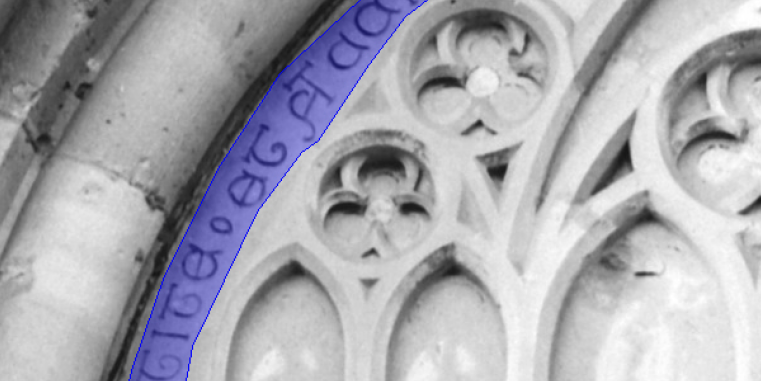
This is precisely where the 'EpiPalaeo' research project comes in. Its central aim is to investigate the extent to which artificial intelligence can support the recognition and analysis of historical inscriptions. To this end, the research team is developing AI models designed to automatically segment, classify and recognise inscriptions in images.
The project is based on an extensive collection of images featuring inscriptions from the Middle Ages and the early modern period. This collection is characterised in particular by its wide variety of scripts and objects. The researchers systematically annotate the images to develop the AI models and evaluate their performance. In doing so, they investigate the extent to which automated methods can facilitate the deciphering of historical inscriptions and contribute to their long-term preservation.
The pilot study aims to establish important foundations for digital epigraphic palaeography and the automated transcription of historical inscriptions, known as Epigraphic Text Recognition. By combining artificial intelligence methods with research questions in historical communication studies, the project opens up new perspectives for the digital analysis of historical sources.
In addition to project leader Junior Professor Dr Jakob Jünger, Luana Moraes Costa (University of Münster) and Patrick D. Brookshire (Academy of Sciences and Literature | Mainz) are involved in conducting the study. The research team is supported by student assistants Amelie Stolz, Annabell Jendrilek, Emma Grimm, Josefine von Puttkamer and Philipp Baranyai.
Funded by the Heidelberg Academy of Sciences and Humanities, the research project runs from September 2026 to March 2027 and is being conducted jointly by the University of Münster, the Heidelberg Academy of Sciences and Humanities and the Academy of Sciences and Literature | Mainz.
Contact person public relations:
Dr. Stephan Völlmicke
Telefon: +49 251 83-23006
Telefax: +49 251 83-21310 (Geschäftszimmer IfK)