
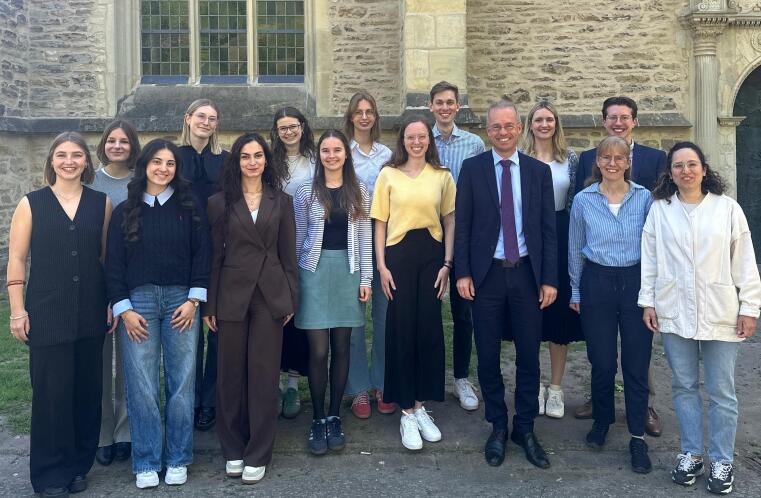
Inaugural speech for the Jean-Monnet-Professorship

On April 16, 2026, Prof. Dr. Gernot Sydow, M.A., launched the new lecture series “EU‑Recht als Teil unserer Rechtsordnung – Perspektiven aus Forschung, Politik und Praxis” which is being held as part of his Jean Monnet Professorship, funded by the European Union. Under the guiding principle “Changing the way we teach EU Law: Teaching EU Law as an integral part of one’s national legal order,” all activities taking place within the framework of the Jean Monnet Professorship in the areas of teaching, academic exchange, and science communication aim to foster a new understanding that EU law no longer exists as a separate field of law alongside national law, but is increasingly inextricably intertwined with it. This idea forms the core of the event series: the profound interpenetration of national law by EU law is to be made tangible not only in research, but above all in legal studies and in everyday professional practice.

Prof. Sydow’s opening lecture was titled “European Comparative Law – Ideen zu einem produktiven Umgang mit der Vielfalt europäischer Rechtskulturen.” In it, he outlined that while—naturally—the same EU law applies in all member states, these identical legal norms are applied, understood, and interpreted in very different ways. If one looks, for example, at European law textbooks from the various member states, it is striking that the same material is structured and prioritized quite differently. While in Germany the various forms of EU action—i.e., regulations, directives, etc.—are the focus of academic analysis and didactic presentation of the material, French textbooks center on the action for annulment before the European Court of Justice as the primary legal remedy. Against this backdrop, the focus in Germany is on the conditions under which a Union legal act is lawful, whereas in France, the emphasis is on the grounds on which an EU measure can be challenged and, consequently, what the typical errors and grounds for annulment of an EU measure are. This list of examples could be extended indefinitely, precisely because in Western Europe, little attention is paid to what is taking place in the smaller European discursive spheres—be it Hungarian, Finnish, or Bulgarian European law—and how European law is conceived there in the context of the respective national legal traditions.

Professor Sydow then argued that this diagnosis of diversity should no longer be viewed solely as a shortcoming and a problem for the uniform validity and application of EU law in Europe. Instead, he called for this diversity to be examined academically, systematically explored using the tools of comparative law, and made explicitly visible in the first place. This could not only contribute to a better mutual understanding of a Europe characterized by unity in diversity, but also serve as a source of innovative solutions when it is found that another legal system has found a significantly more effective solution to a European legal problem than one’s own legal culture. For—and with this, Professor Sydow brought the discussion full circle to the motto of the Jean Monnet Professorship—the initial diagnosis that EU law and national law are now inextricably intertwined cannot be changed—and for good reason! However, the result of this process—which is in itself important and desirable—of integrating European law into national legal thinking is precisely a certain diversity, which should not be lamented but rather put to productive use. Just as traveling, studying, and working in other EU countries contribute to cross-border networking and European integration on a small scale, academic and legal-policy curiosity regarding the understanding of the same legal system in other member states can also make an important contribution to the practical functioning of a united Europe.

The lecture was followed by an intense and lively discussion. Professor Sydow also extended a direct invitation to the next lecture in this series, which will take place on May 7th. On that occasion, Prof. Dr. Thomas Groß, a legal scholar at the University of Osnabrück and a local politician in Osnabrück, will speak on “Verantwortungsstrukturen der EU-Verbundverwaltung zwischen EU, Bund, Ländern und Kommunen”. 

Research

Since 2015, Gernot Sydow has held the Chair of European Administrative Law at the University of Münster. He has served as a visiting professor at the University of Pamplona (Universidad de Navarra) and the University of Lyon (Université Jean Moulin Lyon III), and regularly teaches at the German-Turkish University in Istanbul.

Gernot Sydow conducts research on German and European public law, primarily from a comparative law perspective, as well as on the historical foundations of law. The research projects of his doctoral candidates are predominantly comparative in nature and are often supervised by him in Cotutelle with foreign partner faculties. He regularly facilitates research stays in Münster for young foreign scholars as part of their doctoral studies or even for the duration of their entire doctoral program.

News

Textbook on Constitutional Law in Turkish Translation

On February 26, 2026, Prof. Dr. Gernot Sydow presented the Turkish translation of an innovative textbook on constitutional law at Istanbul University. The original German edition, “Deutsches und europäisches Verfassungsrecht I – Prinzipien, Institutionen, Verfahren” by Gernot Sydow and Fabian Wittreck, is published by Beck-Verlag and is now in its 4th edition. The University of Münster’s Faculty of Law has been teaching constitutional law using this approach, which links German and European law, since 2017.

The Cassin Competition Moves into the Next Round

The René Cassin European Human Rights Moot Court Competition is the oldest French-language competition on the European Convention on Human Rights (ECHR). We are pleased to announce that it will enter a new round next winter semester. Further information can be found here.

Recent Publications

  • Kommentierung des Art. 21 GG, in: Frauke Brosius-Gersdorf (Hg.), Dreier – Grundgesetz-Kommentar, Band 2, Mohr Siebeck, 4. Auflage 2026 (im Druck).
  • Comparative European Law. Plädoyer für eine rechtsvergleichende Methodik in der Europarechtswissenschaft, in: JZ 2026, 227 – 235 (gemeinsam mit Vanessa Ritter).
  • Future-Proofing in Public Law, Nomos, Baden-Baden 2026 (260 Seiten; gemeinsame Herausgeberschaft mit Nicole Koblenz und Nicolas Otto).
  • Alman ve Avrupa Anayasa Hukuku, On İki Levha Yayıncılık A.Ş., Istanbul 2025 (türkische Übersetzung des gemeinsam mit Fabian Wittreck verfassten Lehrbuchs Deutsches und Europäisches Verfassungsrecht I – Prinzipien, Institutionen, Verfahren, C. H. Beck, 4. Aufl. 2024).

Contact information

Prof. Dr. Gernot Sydow, M.A.

Institute for International and Comparative Public Law

Universitätsstr. 14-16, 48143 Münster

Room JUR 209

Gernot.Sydow@uni-muenster.de

Sekretariat: Felicitas Scholz

Institute for International and Comparative Public Law

Universitätsstr. 14-16, 48143 Münster

Room JUR 208a

fscholz@uni-muenster.de

Tel.: +49 251 83 2 17 50

Consultation hours: Monday, Wednesday, and Friday, 8:30 a.m. – 2:20 p.m. Outside of these hours, please send general inquiries by email.