P.A.C. Immunity

University of Münsters iGEM Team presents this year's project: 

P.A.C. Immunity - PROTECT AND CAPTURE - The Immune Biosensor for Crop Plants

"We develop modular and minimally invasive, protease-responsive immune switches. By introducing precise insertions into the natural immune receptors of crop plants, we can equip our plants to fight off pathogens on their own. Instead of a wildfire, crop pathogen defense becomes a subtle, almost invisible trait."

P.A.C. Immunity
Abbildung KI-generiert

Feeding a growing population under the pressure of climate change is one of the defining challenges
of our century. Rising temperatures and shifting ecosystems are creating new niches for crop
pathogens, while drought, heat stress, and depleted soils weaken the natural resilience of plants,
leaving them increasingly vulnerable to infection. The consequences are already visible: crop
pathogens are responsible for up to 30 % of global yield losses annually, threatening food security,
increasing economic instability, and driving a growing dependence on chemical pesticides, with serious
implications for soil health and biodiversity.

These challenges create an urgent need for fundamentally new solutions. Rather than relying on
external inputs to protect crops, a promising alternative is to strengthen the plant’s own immune
system. By introducing minimal, precise insertions into the natural immune receptors of crop plants,
we can equip our plants to fight off pathogens on their own. Instead of a wildfire, crop pathogen
defense becomes a subtle, almost invisible trait.

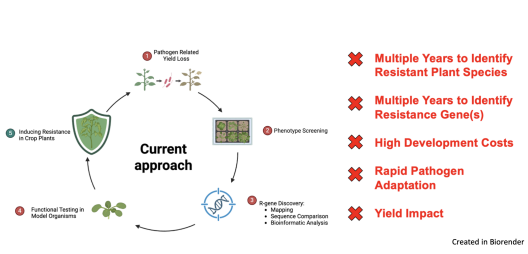
Conventionally, the search for a resistant variety begins once the damage is already done and farmers
are suffering tremendous yield loss. Despite its success, the conventional approach to crop protection
remains slow, costly, and reactive. Often including the search for a resistant plant species and the
corresponding resistance gene(s), with the end goal of implementing these foreign genes into crop
plants. To achieve this, rigorous screening of germplasm collections and wild species is needed.
Followed by genetic mapping, screening, and functionality assays of possible resistance genes (Fig. 1).
Getting to this point takes years and tremendous funding, and only then is it revealed whether the
effort was worth it. Resistance is frequently mediated by the constitutive expression of single major
resistance genes, presenting a constant energy drain. Moreover, in agricultural monocultures, the high
evolutionary pressure tends to promote rapid pathogen adaptation, typically within a few years.

As such, conventional resistance genes often do not provide durable resistance. Furthermore,
constitutive defense actions come at a fitness cost, potentially impacting yield. A trade-off that has
long been deemed necessary. However, recent advances in plant immunology have opened new
possibilities for engineering designer immune receptors that function as molecular switches, triggering
rapid and localized immune responses. We build on the same proven foundation.

“We don’t search for resistance genes, we print them.”

Figure 1: Simplified model of the current approach to induce pathogen resistance via resistance genes.
© iGEM Münster

Our mission is to break this vicious cycle. We strive for modular, broad-spectrum resistance, not once it’s too late, but ahead of time. To achieve this, we focus on conserved virulence factors of pathogens. Many crop pathogens across kingdoms express conserved proteases as key virulence factors in plant cells.

Hereby, conserved proteases are deployed on two levels:

  1.  Agriculturally relevant RNA viruses (such as poty-, seco-, and closteroviruses) express virus-encoded proteases that process polyproteins to properly assemble new viruses.

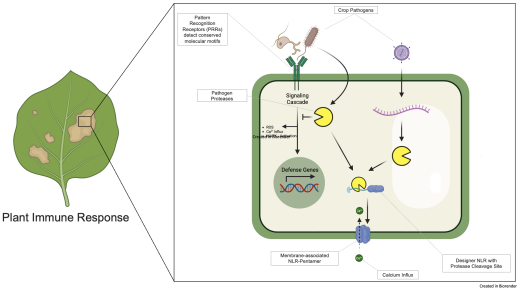
  2.  Bacteria and fungi are detected by Pattern Recognition Receptors (PRRs) via conserved molecular motifs, such as flagellin and chitin. To mask their presence, proteases are deployed that disrupt signaling cascades at key levers. This grants the pathogen its most valuable resource: Time to multiply. As such, the most effective treatment is an early warning system.

Plant nucleotide-binding leucine-rich repeat receptors (NLRs) regulate immunity and cell death. Often occurring in pairs, many primary NLRs recognize a specific effector and activate a secondary RPW8 domain-containing “helper” NLR, such as the Arabidopsis NRG1.1 protein. When activated, secondary NLRs oligomerize and form a selective calcium ion channel, irreversibly inducing an immune reaction, visible as a hypersensitive reaction (HR).

Prior studies have demonstrated that a single nucleotide substitution in the AtNRG1.1 gene can generate an autoactive NLR form. As the functionality relies on negatively charged N-terminal residues, the autoactivity can be masked by fusing an uncharged peptide (blocking linker) to the N-terminus.

When the N-terminal blocking linker contains a protease-specific cleavage site, this minimal setup becomes a designer immune receptor. Specific cleavage by a pathogen protease reveals the functional N-terminus, subsequently inducing an immune response. As the only variance in this setup is the cleavage site, it becomes a “print-on-demand system” that can be updated, if necessary. Not by searching for an entirely new gene, but by simply switching the site of interest (Fig. 2).

The functionality and modularity of this framework were successfully demonstrated, conferring broad-spectrum resistance against multiple potyviruses in the model organism (Nicotiana tabacum), as well as in soybean field tests.


Figure 2: Mechanism of hypersensitive response induction by engineered protease-sensitive NLR receptors.
© iGEM Münster

P.A.C. Immunity

- PROTECT AND CAPTURE Immunity – The immune biosensor for crop plants

The concept of using conserved pathogen protease activities as triggers for immune receptor activation builds on recent advances in plant immune engineering. Our goal is to test whether protease-responsive designer immune receptors can be used as a modular principle for the recognition of agriculturally relevant pathogens from different biological kingdoms.

More specifically, we develop modular and minimally invasive, protease-responsive immune switches.

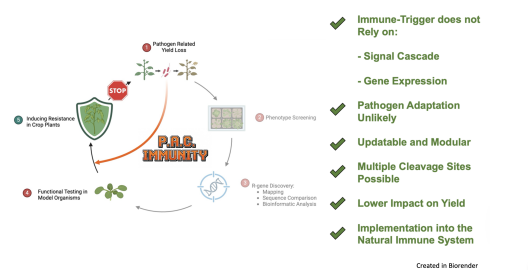
In this way, a single, specific cleavage by conserved pathogen proteases can trigger a rapid and localized immune response. Rather than relying on gene expression or a multi-step signaling cascade, this approach focuses on direct activation of immune signaling.

We hypothesize that such a system could enable precise immune activation while reducing some of the limitations associated with conventional resistance strategies, such as delayed response, rapid pathogen adaptation, or fitness costs due to constitutive defense gene expression and activity.

Our Goals:

  1. With the use of generative AI-mediated diffusion and docking analyses, we engineer and test custom immuno-receptors that aim to detect specific conserved proteases of various crop pathogens across biological kingdoms.
  2. Real-world crop development is most functional under homologous genes and, therefore, in a naturally regulated gene environment. Using orthologous genes of AtNRG1.1, we precisely design and test a minimal and functional architecture for crop plants that can be optimized over time and is more compliant with regulations.
  3. Deploying generative AI models, we investigate potential cleavage peptides for conserved fungal proteases with not yet known cleavage sites. Further, we aim to develop a bioinformatic pipeline that maintains the core principle of the AtNRG1.1 biosensor, however, activated by a structural trigger. While speculative, it potentially opens the scope from conserved proteases to other effectors.

To test this concept, we established a stepwise proof-of-concept pipeline. First, we evaluate candidate protease cleavage peptides using co-expression in E. coli and FRET-based assays in planta. Cleavage sites that demonstrate robust and specific processing are then incorporated into concrete NLR designs and evaluated for their ability to induce precise immune reactions against pathogen proteases in the model organism (N. benthamiana).


Figure 3: Optimized approach to generate pathogen-resistant plants using PAC immunity biosensors.
© iGEM Münster

With our precise implementation in the natural immune system, we develop molecular on-demand switches that serve as an early warning system and pathogen death trap at once. Avoiding pressure from pathogens without the cost of constitutively expressed resistance genes, P.A.C. Immunity biosensors allow the plant to focus all its energy on crop development and earn the farmer the best bang for his buck.

For questions, insights, and references, please contact igem@uni-muenster.de