
Items on Loan from the Bible Museum for the New St Paul’s Museum
The Paulus Museum in Münster recently opened with a special exhibition on the life and work of the Apostle Paul. This means that, following the closure of the Cathedral Treasury in 2017, some of the most significant items from the cathedral’s collection can once again be viewed. The Bible Museum is also contributing to open dialogue and cross-cultural discourse on Christian history and narratives with a number of items on loan.
The oldest exhibit is a papyrus fragment from the second century, the ‘Acta Pauli et Theclae’. This non-canonical text is not only the first to describe Paul’s appearance, but also illustrates how the interpretation of biblical writings and other historical sources has changed over the millennia.
Among the most important of these sources is the so-called ‘Codex Vaticanus’, a Greek manuscript from the fourth century AD. The tradition of the Christmas story is presented using the Bible Museum’s facsimile. Scholars at the Institute for New Testament Textual Research (INTF), the organisation behind the Bible Museum, have demonstrated that alterations to the original manuscript changed the passage “Glory to God in the highest, and on earth peace among those with whom he is pleased” from Luke 2:14, which had implications for its theological meaning.
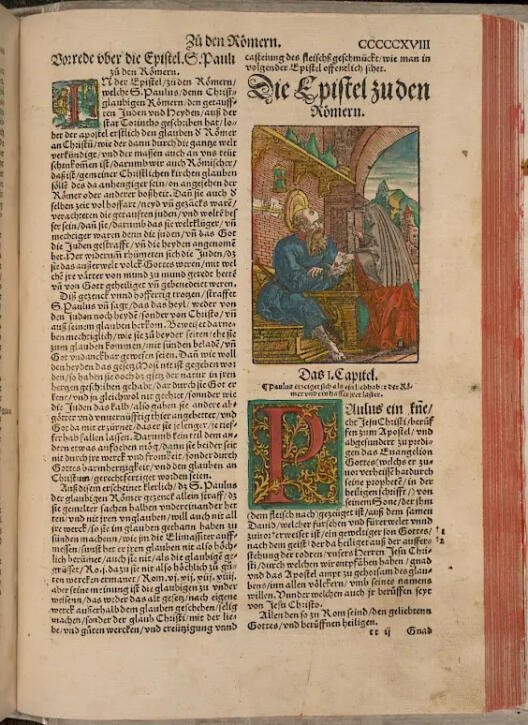
The ‘Dietenberger Bible’ from 1534 is the first High German complete Bible – that is, comprising both the Old and New Testaments – and was published even before Martin Luther’s complete Bible. Johann Dietenberger is regarded as one of Luther’s greatest opponents. The professor of theology in Mainz and prior of the Dominicans in Frankfurt intended his translation to be a counter-Bible to the Protestant Luther Bible, yet he used the latter in part as the basis for his Catholic edition. Well into the 18th century, the ‘Dietenberger Bible’ was the most widely circulated Bible amongst German Catholics; in total, there were over 60 editions.
The items on loan from the Bible Museum are not limited to texts. Gustave Doré’s (1832–1883) illustrated Bible, first published in French in 1866 with 230 illustrations, is also currently on display at the Paulus Museum on Alter Steinweg. Doré’s illustrations – and, above all, his choice of motifs – represent something entirely new in the history of Bible illustration. Doré favoured dramatic stories, and crowd scenes and battle scenes are a frequent feature. Oriental-style magnificent architecture, ornate robes and opulent palaces are also far more common than the barren landscapes of the Holy Land. In this way, the French painter shaped entire generations and their visual perceptions of the stories of the Holy Scriptures.
The exhibition ‘I am going – but where to?’ is on display until 30 May 2027 at the Paulus Museum in Münster, Alter Steinweg 3, Monday to Saturday from 12 noon to 6 pm. Admission is free. Further information can be found at www.paulusmuseum.de.