


Sample 4: Written – printed – Academic Writing – Humanities – W2A-010
Teelucksingh, Jerome (2010). The Lost Gospel: Christianity and Blacks in North America. Newcastle upon Tyne: Cambridge Scholars.
Reproduced by permission of Jerome Teelucksingh.
<#>
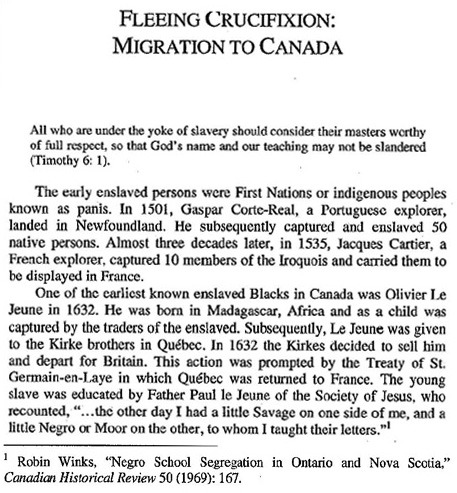
<#>All who are under the yoke of slavery should consider their masters worthy of full respect, so that God's name and our teaching may not be slandered.
(Timothy 6:1)
<#>The early enslaved persons were First Nations or indigenous peoples known as
<#>One of the earliest known enslaved Blacks in Canada was Olivier Le Jeune in 1632. <#>He was born in Madagascar, Africa and as a child was captured by the traders of the enslaved. <#>Subsequently, Le Jeune was given to the Kirke brothers in Québec. <#>In 1632 the Kirkes decided to sell him and depart for Britain. <#>This action was prompted by the Treaty of St. Germain-en-Laye in which Québec was returned to France. <#>The young slave was educated by Father Paul le Jeune of the Society of Jesus, who recounted, "...the other day I had a little Savage on one side of me, and a little Negro or Moor on the other, to whom I taught their letters."
Markup symbols
| <#> | text unit markers (sentences) |
| heading | |
| bold text | |
… |
paragraph |
... |
Quotations |
| small capitals | |
| extra corpus text | |
| footnotes | |
| é (e.g. Québec) | é (e.g. Québec) |
| words or phrases discussed in the text | |
| references to footnotes | |
| superscript | |
| italics |