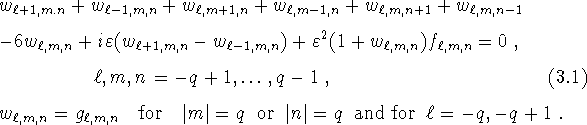
The numerical solution of the initial value problems (2.1) - (2.2) and (2.5) can efficiently and conveniently be done by a finite difference method.
In view of our stability result (see previous section) this suggestions itsself, but it has been used already in [9].
We simply use the usual five point discretization on the grid
 where
where  and
and 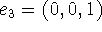 and
and  . Then, the finite difference approximation to (2.1) - (2.2) reads (the superscript j is omitted)
The boundary conditions in (3.1) assume that the field can be measured everywhere on each of the faces of  .
The values of
.
The values of  for
for  have to be computed from the field in
  by numerical differentiation. (3.1) is solved in a recursive way, i.e. if w in known on the levels
  ,
,  we compute it for
  by (3.1). In order to preserve stability we have to filter out the frequencies greater than
  at each stage of this process. This can be done by doing a 2D FFT on each matrix
 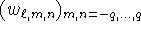 as soon as it is computed, zeroing all the entries with
 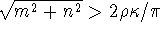 , followed by a 2D inverse FFT. The total operator count for solving (2.1) - (2.2) once is O
  . For details see [16]. (2.5) is solved exactly in the same way.