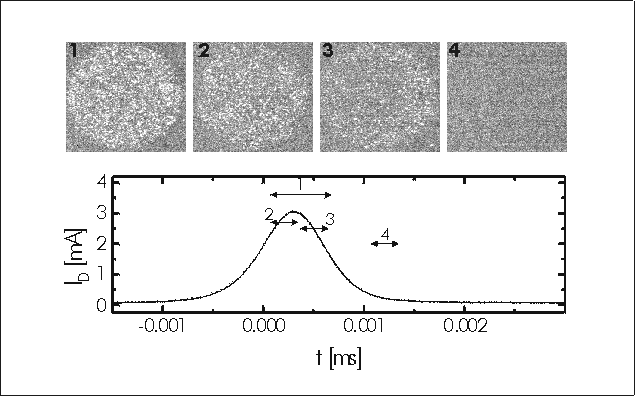
An ignition of a discharge in the planar discharge gap under consideration (experimental setup here) establishes a stationary and spatial homogeneous discharge which can be identified as a Townsend discharge. By variation of control parameters (either supply voltage U0 or resistivity of the semiconductor cathode) the Townsend state can be destabilized. Depending on parameters this can either lead to spatiotemporal filamentary patterns or a spatial homogeneous oscillation. Some features of this oscillation are presented below.
More details can be found in:
Nonlinear Interaction of Homogeneously Oscillating Domains in a Planar Gas Discharge System,
C. Strümpel, Yu.A. Astrov, and H.-G. Purwins,
Phys. Rev. E 62, 4889-4897 (2000)
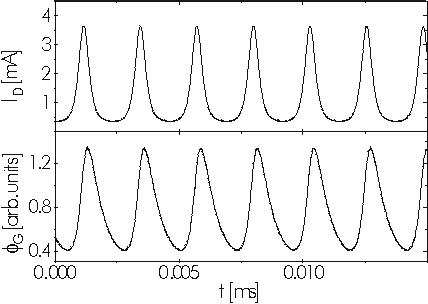
The exact frequency and amplitude of the homogeneous ocillation depends on the control parameters. In general the frequency lies in the range between 100 and 600 kHz while the amplitude lies between 1 and 4 mA. An example of a typical time series of the global discharge current ID and of the intensity of light emission fG from the discharge in the state of a homogeneously oscillating gas discharge is presented below.
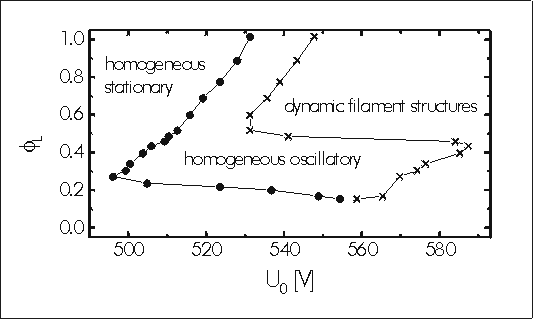
Below, the domain of existence of the homogeneous oscillation in the paramter space of the main control paramters is shown. In the figure, U0 denotes the supply voltage and fL denotes the intensity of the irradiation of the semiconductor cathode in normalized units.