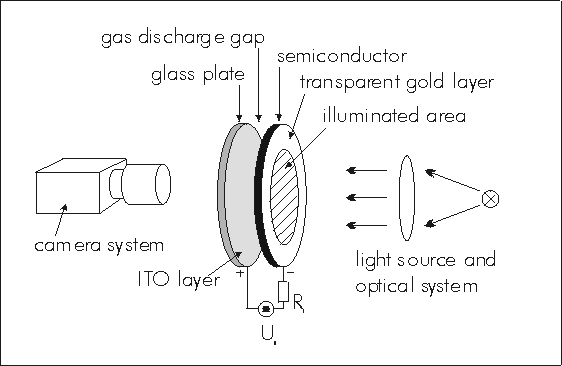
The gas discharge system is a planar system with a discharge gap of the order of 0.5 mm and a lateral extension of up to 30 mm. The cathode consist of semiinsulating gallium arsenide (1.5 mm thick) with a low resistivity of about 10-8 (Wcm)-1. The counter electrode consists of transparent metallic indium tin oxide which allows visual observation of the lateral distribution of the dischrge glow with an appropriate camera system. The conductivity of the cathode can be increased by irradiation with visible light which excites electrons to the conduction band. The gas gap is filled with nitrogen (pressure between 20 and 100 hPa). The ignition voltage depends on the gas pressure. Its is about 300 V in the Paschen minimum. Just after the ignition voltage is reached, an homogeneous and stationary Townsend discharge is established in the device. This state can be subsequently destabilized by the variation of control parameters.
Experimental results: