

Bestes studentisches Poster auf der GeoMed-Konferenz 2026
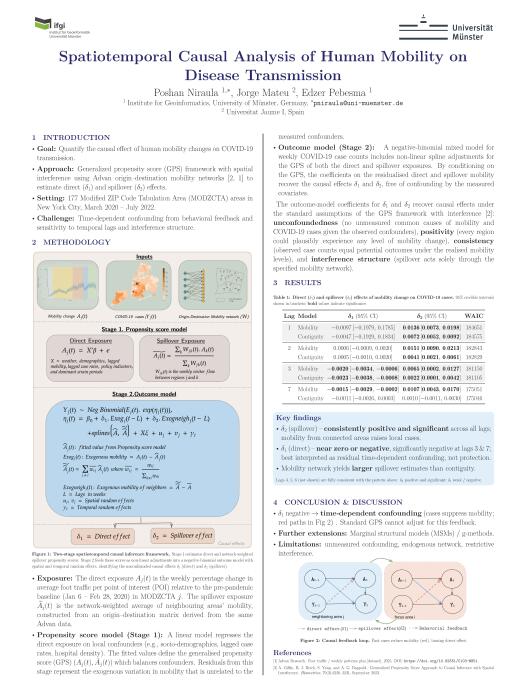
Auf der kürzlich in Pamplona, Spanien, abgehaltenen „GeoMed“-Konferenz 2026 wurde der Preis für das beste studentische Poster an Poshan Niraula für sein Poster mit dem Titel „Spatiotemporal Causal Analysis of Human Mobility on Disease Transmission“ verliehen. Die Arbeit entstand in Zusammenarbeit mit Jorge Mateu und Edzer Pebesma.
Die Arbeit kombiniert Methoden der räumlich-zeitlichen Modellierung mit epidemiologischen Daten zu COVID-19, um die Auswirkungen von Mobilitätsveränderungen auf die COVID-19-Übertragung zu ermitteln.
Summary:
The study aimed to quantify the causal effect of human mobility on the weekly COVID-19 case rates across the 177 Modified Zip Code Tabulation Areas (MODZCTA) of New York City. We deployed generalized propensity score (GPS) framework [1] with spatial interference using Advan origin–destination mobility dataset [2] to estimate:
- direct effect: the effect of mobility change within a focal MODZCTA and
- spillover effect: the effect of mobility change in other MODZCTAs, weighted by the volume of movement between them.
Across all the fitted models, the spillover effect was consistently more pronounced and statistically significant compared to the direct effects. In several instances the direct effect was also negative, which we interpret as residual time-dependent confounding, rather than protective effect of mobility. We aim to improve on this research by relaxing the unmeasured confounding assumption, and explicitly accounting for the time-dependent confounding.
[1] Giffin, A., Reich, B. J., Yang, S., \& Rappold, A. G. (2023). Generalized propensity score approach to causal inference with spatial interference. Biometrics, 79(3), 2220-2231.
[2] Advan Research. Foot traffic / weekly patterns plus [dataset], 2025. DOI: https://doi.org/10.82551/C103-N851.