Ancient and Byzantine Weights from Tire Museum including one Islamic Dirham
Abstract:
This article focuses on the balance
weights housed in the Tire Museum, a local museum in Western
Anatolia. The collection consists of 63
weights made of lead and bronze (including one glass weight).
Some of these are dated to the Hellenistic period, while others
belong to the Roman and Byzantine periods. Since Ephesus is the
closest archaeological site to Tire, it is possible that a
significant portion of the weights may have originated from or
been used in Ephesus.
Key words:
Tire, ancient weights, Byzantine weights, Ephesus, libra / litra
Zusammenfassung:
In diesem Artikel werden die Marktgewichte im
Tire-Museum, einem lokalen Museum in Westanatolien, behandelt.
Die Sammlung umfasst 63 Gewichte aus Blei und Bronze
(einschließlich eines Glasgewichts). Ein Teil davon wird der
hellenistischen Zeit, ein anderer Teil der römischen und
byzantinischen Epoche zugeordnet. Da Ephesos die nächstgelegene
antike Stätte zu Tire ist, kann angenommen werden, dass ein
bedeutender Teil der Gewichte aus Ephesos stammt oder dort
verwendet wurde.
Introduction
Tire (Tyhra, Theira) is
a district of İzmir, located approximately 80 km (about 60
minutes) southeast of İzmir and about 40 km (30 minutes)
northeast of Ephesus. Besides Ephesus, in its vicinity, there
are sites such as Smyrna, Sardis, Philadelphia, and Hierapolis.
So, the location of the Tire Museum is surrounded by numerous
ancient sites, and the weights acquired may have originated from
these sites or their vicinity. Since the Tire Museum is a rather
small, local museum, it is reasonable to assume that its
archaeological artifacts mostly originate from the nearby area.
Otherwise, most such objects would be expected to end up in
larger museums through purchase or confiscation. Based on an
examination of the museum’s records, we can say – in the context
of this article – that there is no precise information about the
provenance of the weights; the records merely note who brought
them in and the date. In any case, an artifact found at an
archaeological site and brought to the museum could create legal
problems for the person who found it, because under Turkish law,
it is not permissible to sell an object found at a registered
archaeological site to a museum. Therefore, it is unrealistic to
expect accurate information from those who brought the objects
in. It is also possible to encounter vague or dubious
explanations such as »I found it in my field« or »I found it on
the road«. All of this makes determining the exact origin of
archaeological finds particularly challenging. Even so, the aim
of this article is to introduce the balance weights of this
local museum’s collection[1].
In this study, 63 balance weights will be studied, 13 of which
are from the Hellenistic period and were produced according to
the Greek system based on the mna. Since none of the weights
bear an ethnic, it is difficult to attribute them to a specific
city; however, considering that Tire was located very close to
Ephesus, it would be reasonable to attribute most of them to
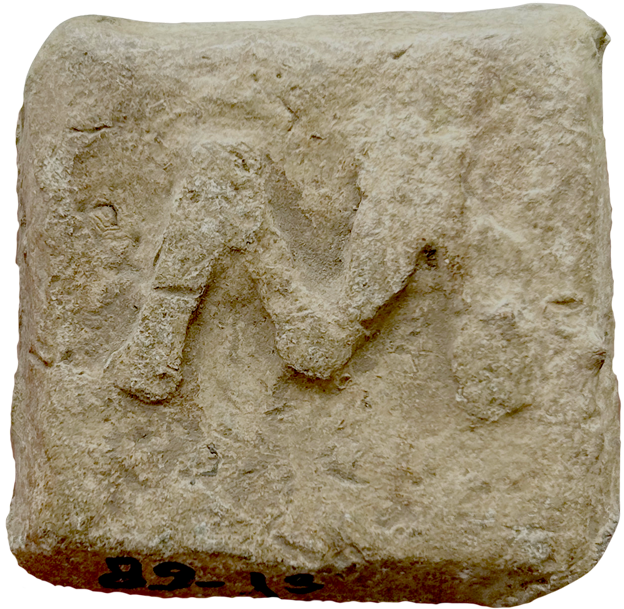
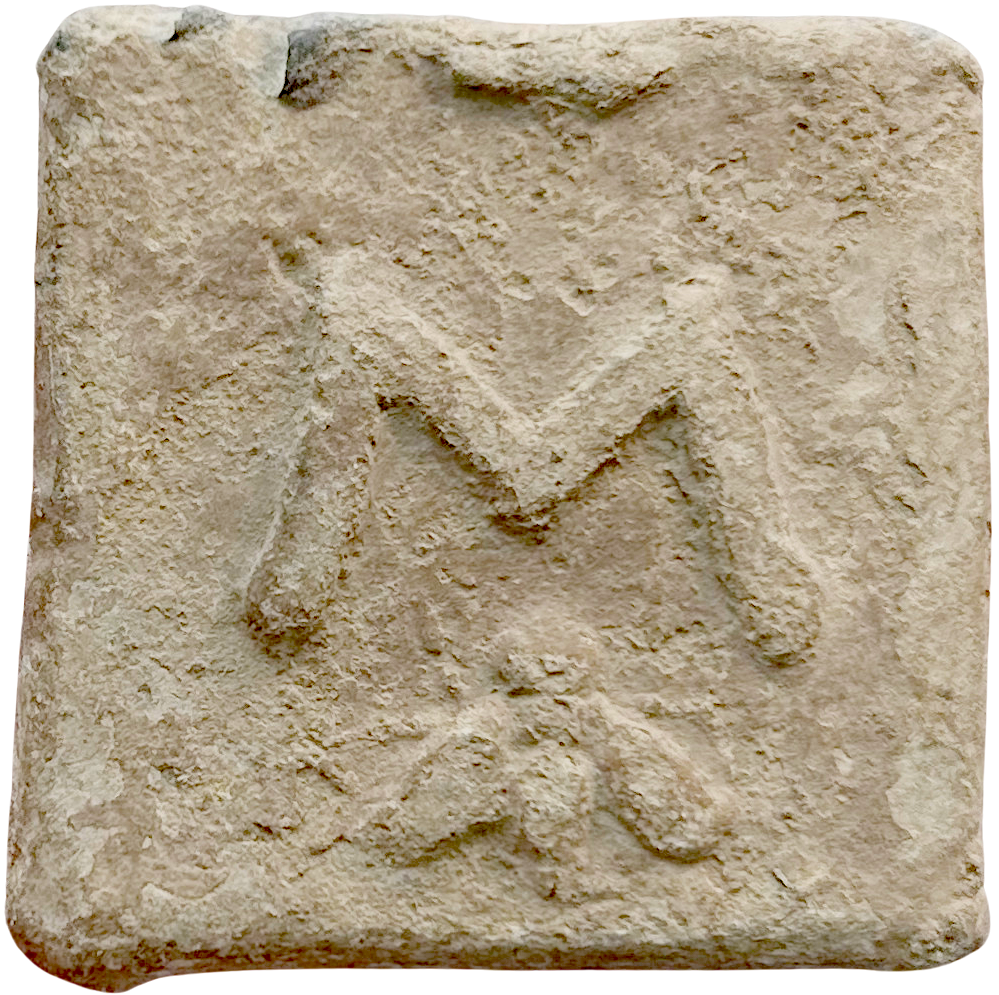
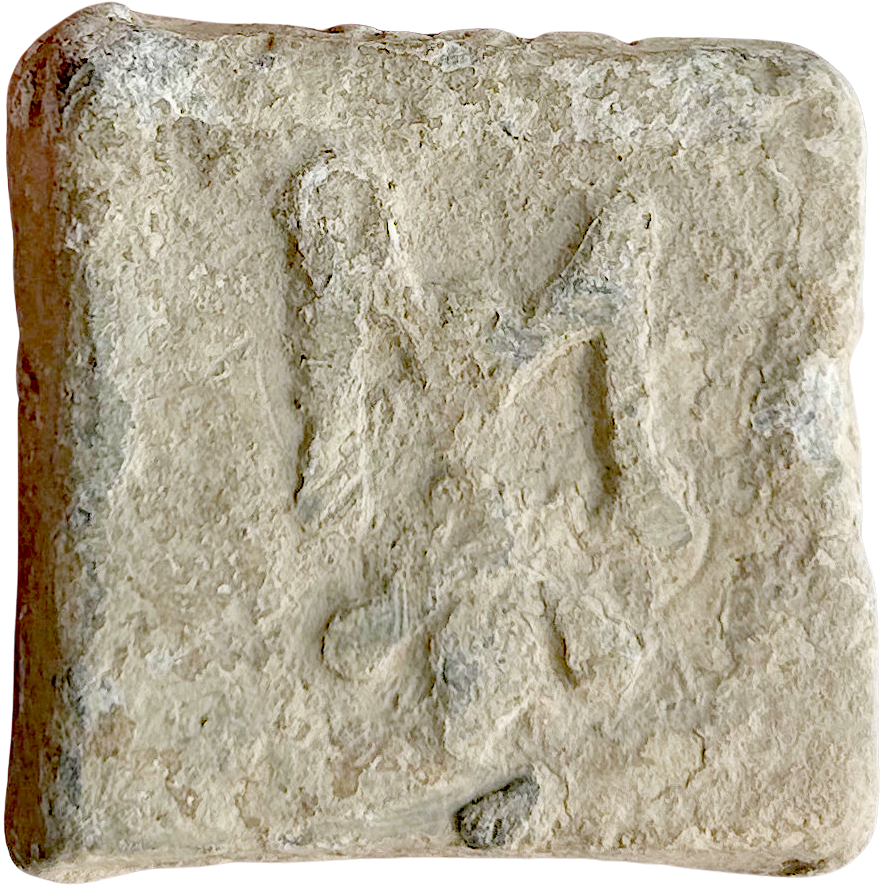
Ephesus. Moreover, the presence of the bee symbol on three of
the weights (nos. 1–3) is a sufficient reason to
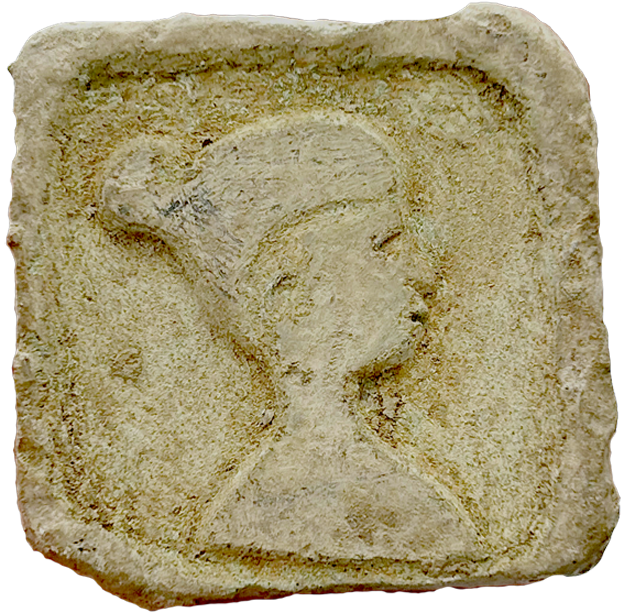
attribute them to Ephesus. The female bust on the reverse side
of the first weight (no. 1) does not conform to the
standards of Hellenistic weight design and displays a rather odd
style, suggesting the bust was made much later, perhaps in
modern times.
Since all the weights in
this group bear unit marks, there is no problem in identifying
their units. However, the two weights marked as hektemorion (nos.
8 and 9) should be treated with caution regarding
their unit attributions, as their actual weights fall
significantly below the theoretical standard. Some of the
weights (nos. 14–28) produced according to the Roman
system based on the libra – Including those from the Late Roman
period – are dated to the Roman Imperial period. Indeed, the
spherical forms of the first four (nos. 14–17) are
consistent with this dating. Among others, the six-libra weight
(no. 18) is particularly interesting and is a rare
specimen. This weight was produced under the responsibility and
supervision of a certain eirerarchos named Marcus Aurelius
Clarus. Similarly, the names Marcianus and »Neopoios« appear on
some other weights in this group.
About half of the
weights examined in this article are Byzantine, produced in
various units ranging from one uncia to eight keratia. One
particularly interesting piece (no. 60) is made of glass
and represents a semissis (half of a solidus). It is in notably
good condition compared to similar examples. The name Droserios,
which appears on this weight – thought to have been produced in
Constantinople – is also encountered on other glass weights held
in the collection of the Berlin State Museums[2]
and in other collections[3].
The cup-shaped weights
at the end of the catalog (nos. 61–62) are dated mainly
to the 10th–14th centuries; thus, we have
dated them to the Middle or Late Byzantine period. The very last
weight (no. 63), considering both its quincunx motif of
five bird’s-eye designs and its weight, appears to be Islamic,
likely based on the two-dirham unit. Based on its weight, it can
be suggested that it was produced and used within a broad time
span from the 13th to the 17th centuries.
I would also like to
touch upon the issue of dating. Nos. 1–13 are based on
the mna system and are dated to the Hellenistic period; the
depictions or unit marks on them indicate this. They are
arranged from the largest to the smallest unit. The next group (nos.
14–29) is based on the libra system, and these weights are
also arranged from the largest to the smallest unit. Based on an
assessment that takes into account their form, unit, and in some
cases the inscriptions on the reverse, a flexible dating such as
the Roman Imperial period has been preferred, rather than giving
a precise date. The doubly truncated flattened-sphere weights (nos.
14–16) are placed at the beginning of the section titled
»Weights in the Roman System«, as they represent the earliest
examples; at this point, form becomes important in dating. The
weights in the second half of the catalogue (nos. 30–62),
while still within the libra system, belong to the standard of
coin control weights – that is, based on the nomisma. Since
these weights remained in use for a long time, precise dating is
difficult. They are generally dated to the Late Roman and Early
Byzantine periods, as is also the case in this catalogue (except
nos. 61–62 since they date to the middle Byzantine
period). In the catalogue arrangement, the metrological system
and, when necessary, the form (as it is significant for dating)
were prioritized over the type of metal.
Civic Weights in Greek System Based on
Mna
1) Inv. no. 89-13
(fig. 1). Lead, 520 g, 60 x 62 x 15 mm. Mna. Square in form
with slightly rounded corners. On the top, large M in relief
which stands for μνᾶ, and a faint image of a bee below; on the
bottom female bust, hair in a back bun r., in relief within
raised frame. The female bust on the reverse seems a modern
addition and not part of the original piece. The original weight
must have decreased as a result of modifications carried out
when the frame was created. Therefore, its original weight must
have been over 550 g. We know that especially in the Late
Hellenistic period, the weight of the mna increased over time
and reached approximately 600 grams. It may belong to Ephesus
or, more generally, to one of the Ionian cities. It dates to the
Hellenistic period. Unpublished.
2) Inv. no. 2003-4
(fig. 2). Lead, 510 g, 55 x 57 x 15 mm. Mna. Square in form
with slightly raised edges on the top and bottom. On the top,
large M which stands for μνᾶ; and bee below; all in relief. The
bottom is blank. It dates to the Hellenistic period. Published[4].
3) Inv. no. 95-18
(fig. 3). Lead, 480 g, 62 x 63 x 15 mm. Mna. Square in form
with slightly raised edges. On the top, large M which stands for
μνᾶ; and bee below; all in relief. The bottom is blank. It dates
to the Hellenistic period. Published[5].
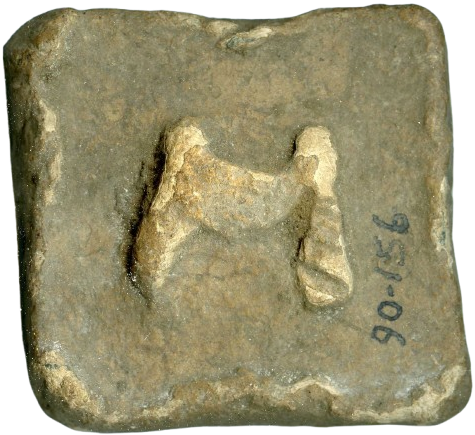
4) Inv. no. 90-156
(fig. 4). Lead, 435 g, 63 x 63 x 11 mm. Mna. Square in form
with slightly raised edges and corners are folded inwards. On
the top, large M in relief, which stands for μνᾶ. The bottom is
blank. It dates to the Hellenistic period. Unpublished.
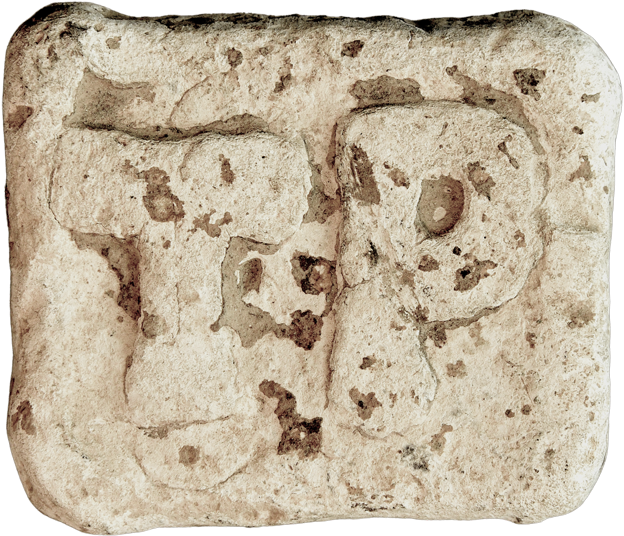
5) Inv. no. 2003-95
(fig. 5). Lead, 155.35 g, 45 x 48 x 9 mm. Triton (mna of
466.05 g). Square in form with slightly raised edges and rounded
corners. On the top, ΤΡ in relief which stands for τρίτον; the
bottom is blank. It dates to the Hellenistic period.
Unpublished.
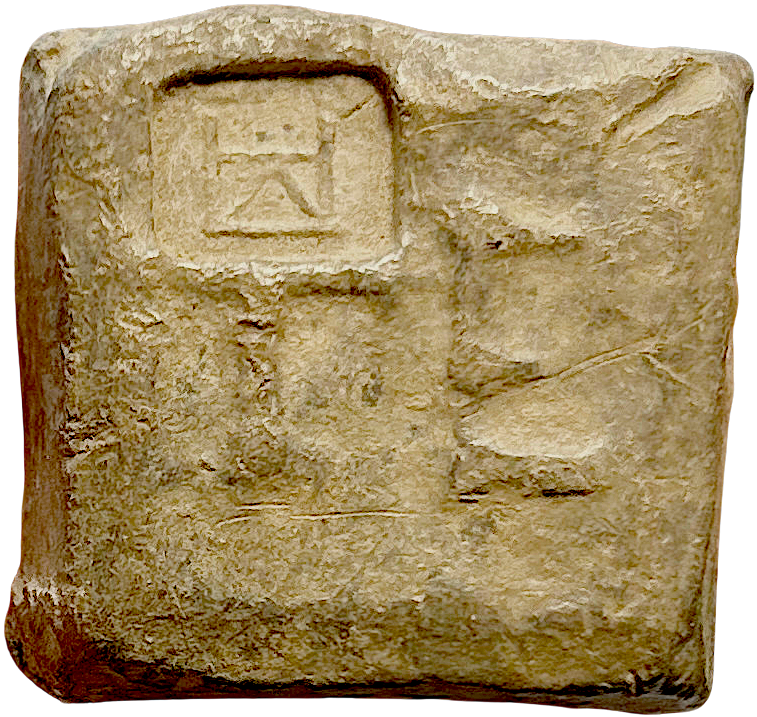
6) Inv. no. 91-22
(fig. 6). Lead, 119.10 g, 35 x 35 x 10 mm. Tetarton (mna of
476.4 g). Square in form. On the top, ΤΕ in relief which stands
for τέταρτον; monogram in
square stamp on the upper left corner. Although the monogram
consists of the letters Π, Η, and Μ (with one or two additional
letters possibly added through conjecture), it is not easy to
find out its full form. At the very least, in order to avoid
being misleading, it would be more appropriate to present the
monogram as it appears. The bottom is blank. It dates to the
Hellenistic period. Unpublished.
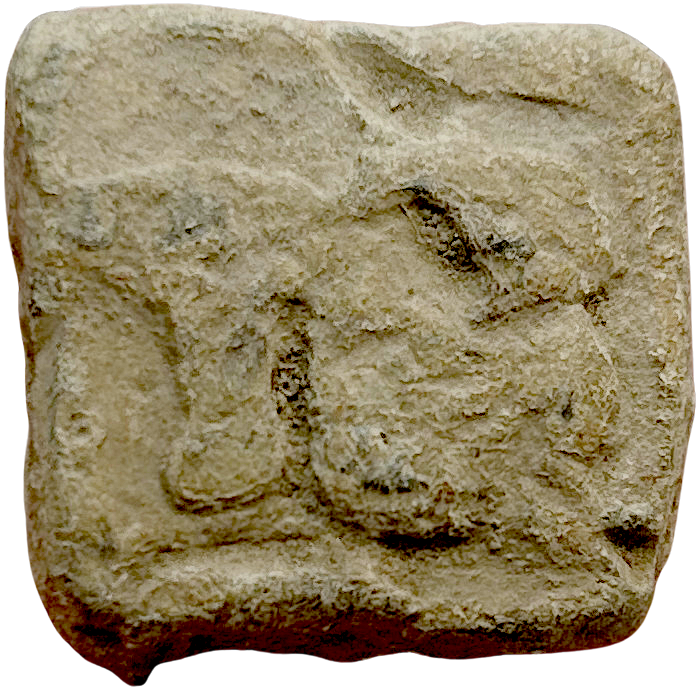
7) Inv. no. 91-218
(fig. 7). Lead, 116.15 g, 32 x 34 x 12 mm. Tetarton (mna of
464.6). Square in form with slightly raised edges. On the top,
ΤΕ in relief which stands for for τέταρτον. The bottom is blank.
It dates to the Hellenistic period. Unpublished.
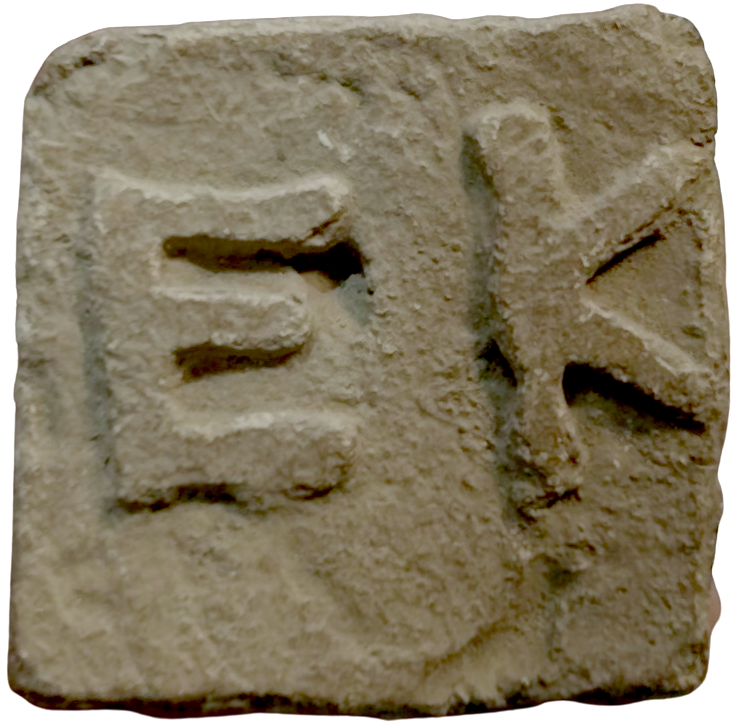
8) Inv. no. 89-458
(fig. 8). Lead, 31.0 g, 35 x 35 x 3 mm. Uncertain unit or
hektemorion? Square in form. On the top, ΕΚ in relief which may
stand for ἑκτημόριον[6].
but its mass doesn’t correspond to it. The bottom is blank. It
dates to the Hellenistic period. Unpublished.
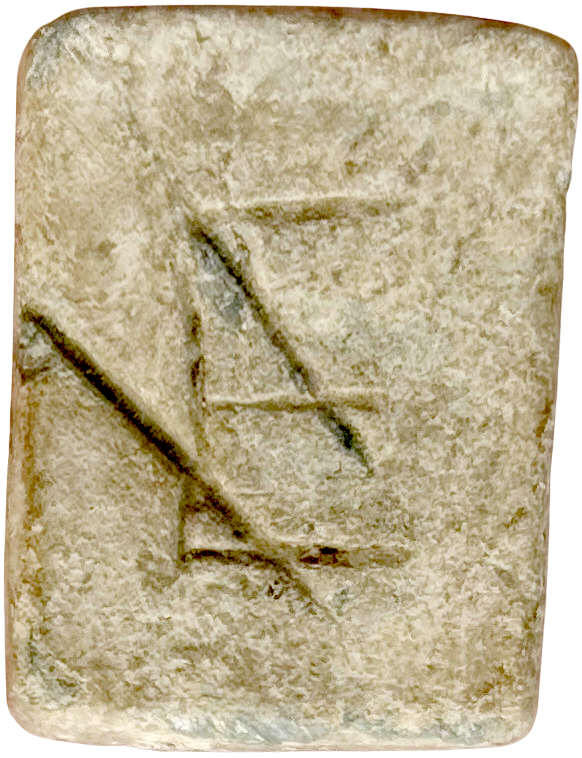
9) Inv. no. 91-26
(fig. 9). Lead, 55.75 g, 23 x 30 x 8 mm. Hektemorion (mna of
334.5 g, too low for this unit.) Rectangular in form. On the
top, engraved with Ε which stands for ἑκτημόριον;
two deep diagonal scratches on the Ε, possibly applied to
indicate cancellation. Indeed, its weight does not conform to
the ⅙ mina standard, being significantly lower than expected.
The bottom is blank. It dates to the Hellenistic period.
Unpublished.
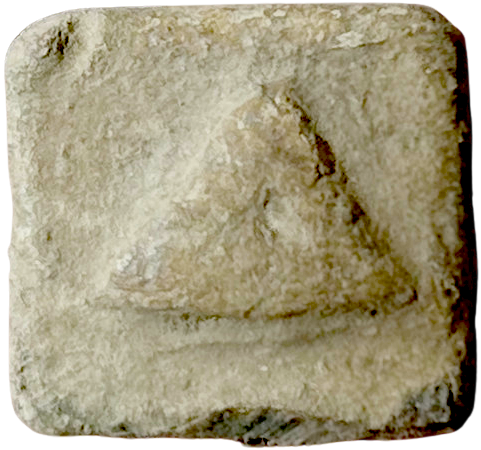
10) Inv. no. 2003-5
(fig. 10). Lead, 42.30 g, 25 x 26 x 5 mm. Decadrachm (drachm
of 4.23 g)[7].
Square in form with slightly rounded corners. On the top, Δ in
relief which stands for dέκα. The bottom is blank. It dates to
the Hellenistic period. Unpublished.
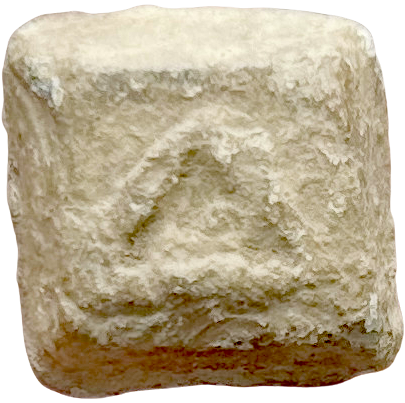
11) Inv. no. 92-185
(fig. 11). Lead, 39.60 g, 23 x 25 x 10 mm. Decadrachm
(drachm of 3.96 g). Square in form with beveled edges. On the
top, Δ in relief which stands for dέκα. The bottom is blank. It
dates to the Hellenistic period. Unpublished.
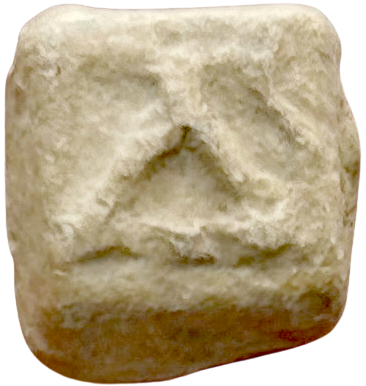
12) Inv. no. 92-67
(fig. 12). Lead, 39.30 g, 23 x 24 x 9 mm. Decadrachm (drachm
of 3.93 g). Square in form with beveled edges. On the top, Δ in
relief which stands for dέκα. The bottom is blank. It dates to
the Hellenistic period. Unpublished.
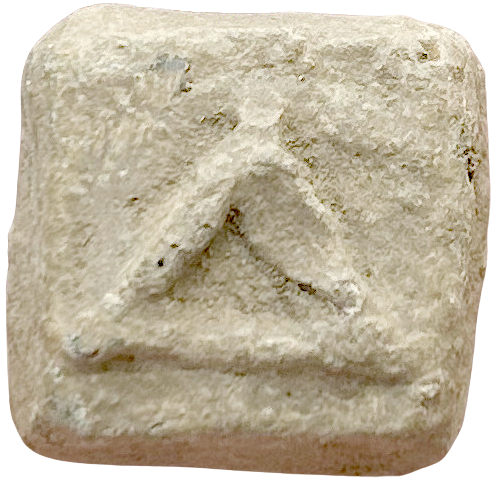
13) Inv. no. 94-112
(fig. 13). Lead, 37.30 g, 22 x 22 x 10 mm. Decadrachm
(drachm of 3.73 g). Square in form with beveled edges. On the
top, Δ in relief which stands for dέκα. The bottom is blank. It
dates to the Hellenistic period. Unpublished.
Weights in the Roman System Based on
the Libra (including Byzantine weights)
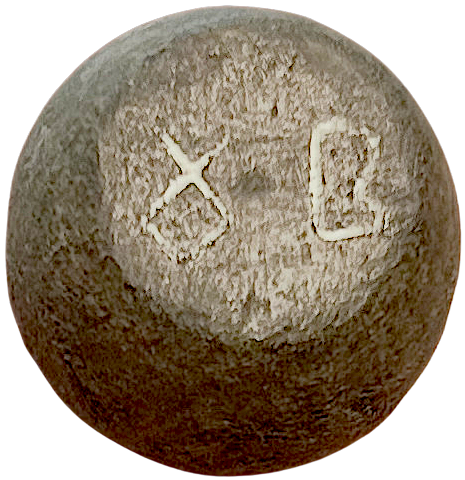
14) Inv. no. 89-536
(fig. 14). AE 51.90 g, 23 x 18 mm. Two unciae (uncia of
25.95 g). Flattened sphere doubly truncated in form. Centring
points on the top and bottom. Silver inlaid on the top with the
denominational mark
ȣ B. The
bottom is blank. It dates to the 3rd–5th
century AD. Unpublished.
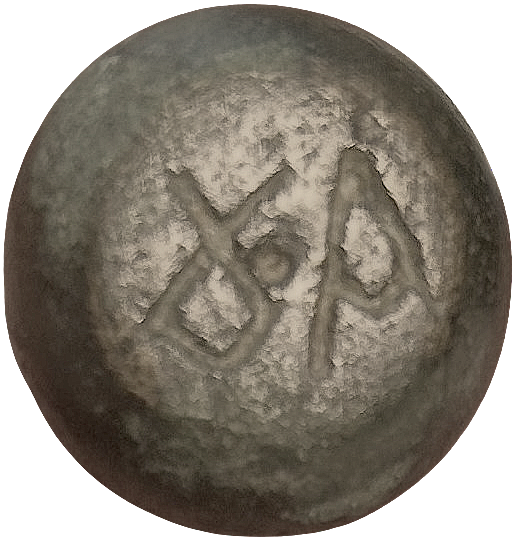
15) Inv. no. 2017-432
(fig. 15). AE 26.3 g, 17 x 15 mm. One uncia. Flattened
sphere doubly truncated in form. Centring points on the top and
bottom. Engraved on the top with the denominational mark
ȣ A, may be inlaid but
inlay is missing or not inlaid.
The bottom is blank. It dates to the 3rd–5th
century AD. Unpublished.
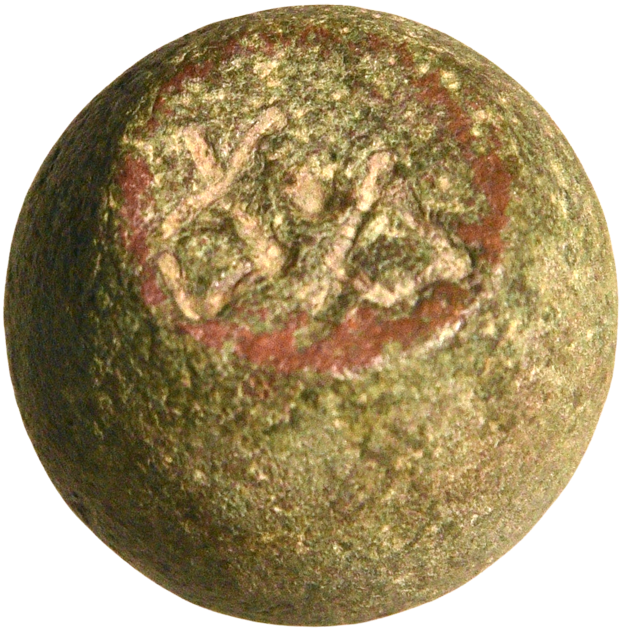
16) Inv. no. 2017-434
(fig. 16). AE 25.8 g, 15 x 14 mm. One uncia. Flattened
sphere doubly truncated in form. Centring points on the top and
bottom. Inlaid (?). on the top with the denominational mark
ȣ A. In fact,
due to the slightly deep
engraving, it gives the impression of being inlaid; however,
since there are no visible traces of inlay, we cannot be
certainThe bottom is blank. It dates to the 3rd–5th
century AD. Unpublished.
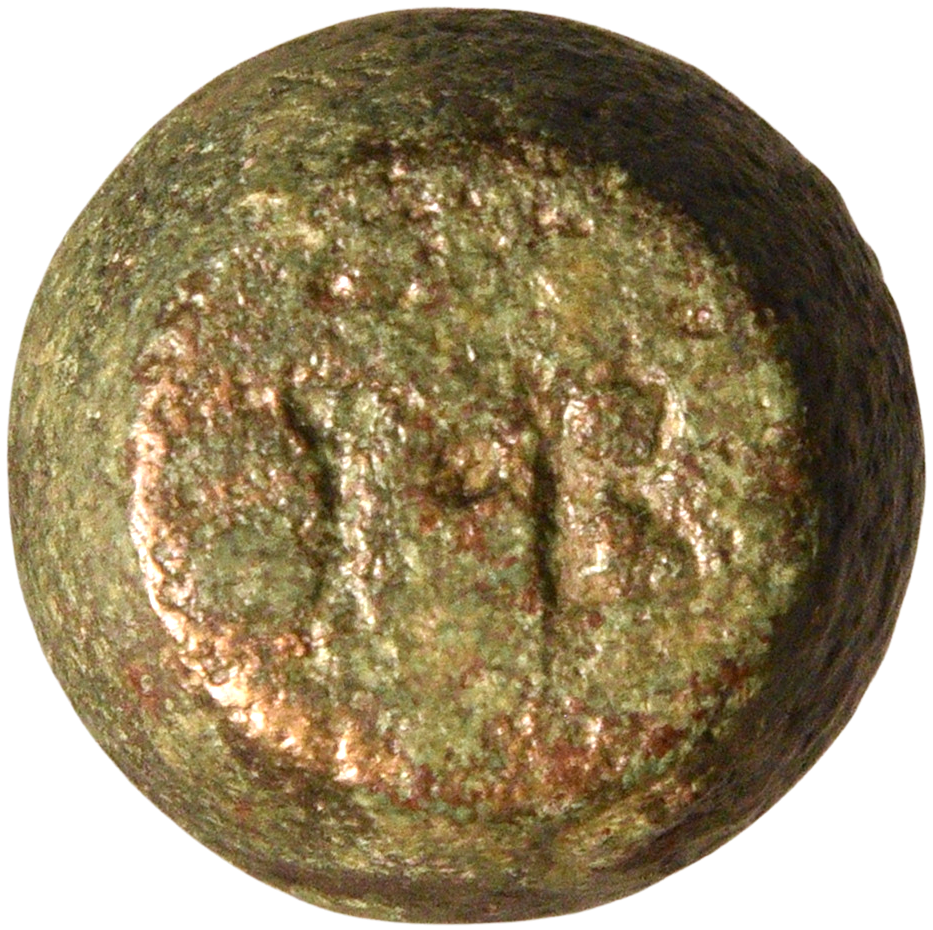
17) Inv. no. 2017-429
(fig. 17). AE 13.2 g, 12 x 12 mm. Twelve grammata (gramma of
1.1 g). Flattened sphere doubly truncated in form. Centring
points on the top and bottom. Engraved on the top with the
denominational mark Ι Β.
The bottom is blank. It dates
to the 3rd–5th century
AD. Unpublished.
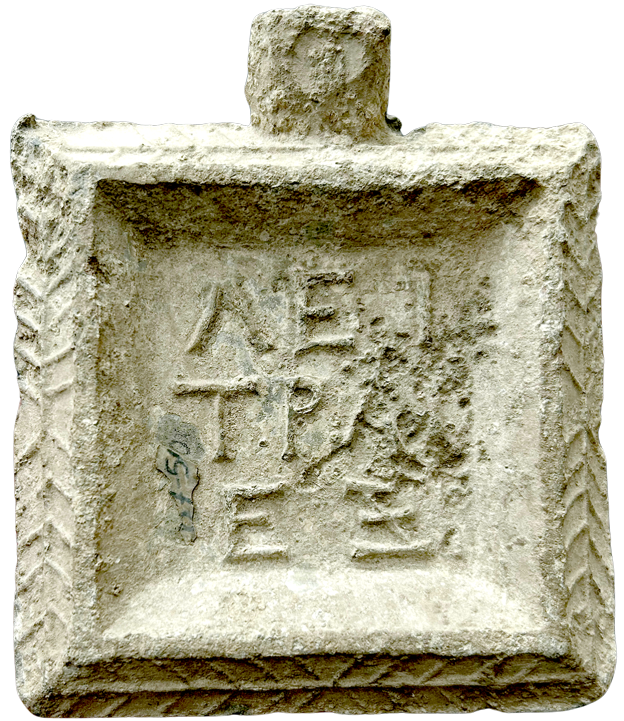
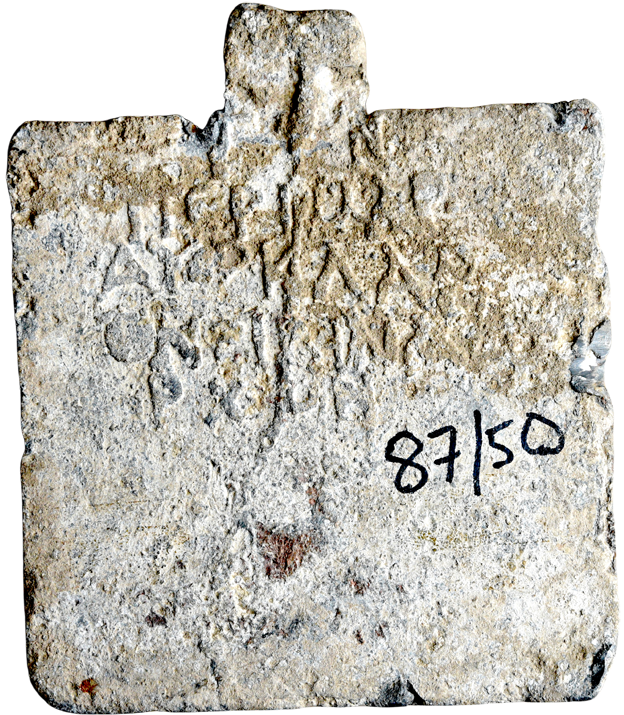
18) Inv. no. 87-50 (fig. 18). Lead, 2108.1 g, 125 x 125 x 15 mm. Six Italic heavy librae (libra of 351.35 g). Square in form with raised and beveled edges and a handle at the top; herringbone pattern on the edges. Six librae. On the top, ΛΕΙ / ΤΡΑΙ / ΕΞ which stands for six (= ἕξ) librae. It may be a heavy libra italike. The stamp on the handle of the weight shows a standing male figure facing left, holding an object in his right hand, and with his left arm hanging down. On the bottom, inscription in five lines:
T[Ω]N / ΠEΡI MAΡ / AΥΡKΛΑΡ / ΟΝΕΙΡΗΝΑ / ΡΧ[Ω]Ν
Τ[ῶ]ν Περὶ Μαρ[κον] Αὐρ[ηλιον] Κλάρον εἰρήναρχ[ω]ν

19) Inv. no. 79-24
(fig. 19). Lead, 320 g, 63 x 65 x 10 mm. One libra. Square
in form with raised edges; handle is broken. On the top, Inside,
ΛΕΙ / ΤΡΑ in relief. The bottom is blank but bears blow marks.
It dates to the Roman Imperial period. Unpublished.
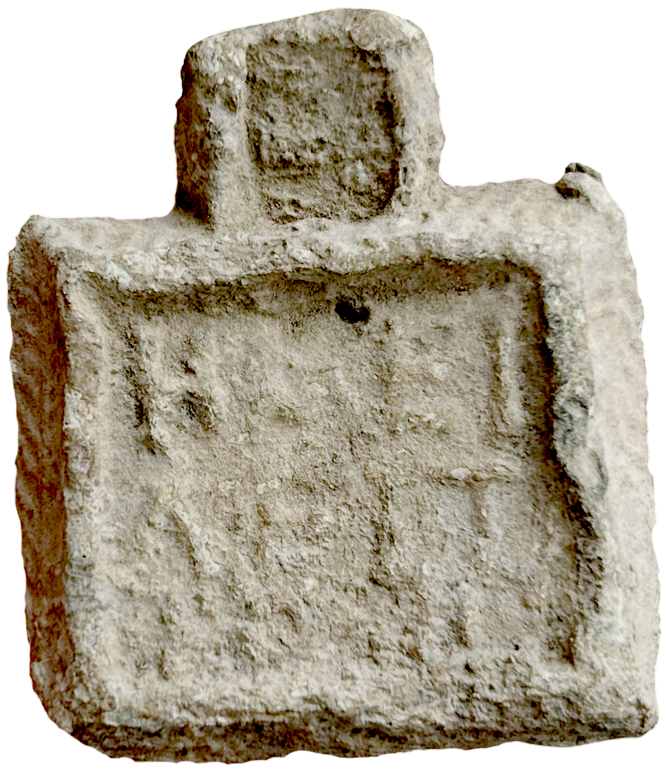
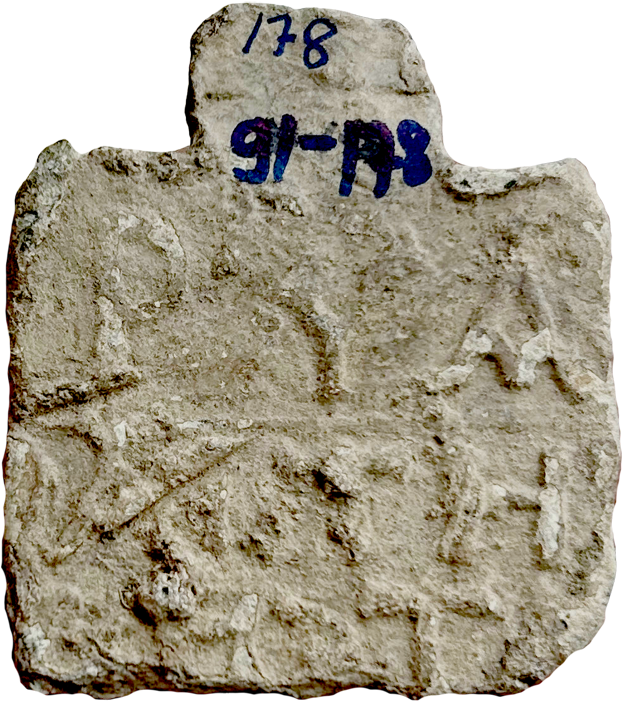
20) Inv. no. 91-178
(fig. 20). Lead, 228.20 g, 50 x 54 x 10 mm (+ handle 17 mm).
½ libra (libra of 456.4 g). Square in form with raised and
beveled edges and handle above. On the top, ΗΜΕΙ / ΛΕΙΤ / ΡΟΝ in
three lines and in relief. Stamp on handle but illegible. On the
bottom, ΡΥΑ / ΑΤΗ / Η[.]Τ in three lines and in relief. It dates
to the Roman Imperial period. Unpublished.
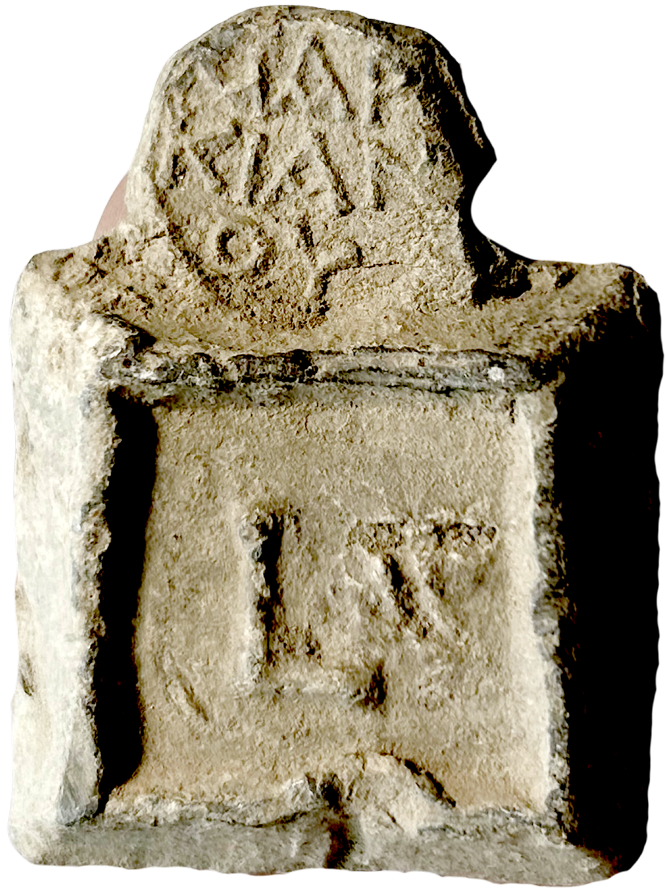
21) Inv. no. 2003-7
(fig. 21). Lead, 97.10 g, 39 x 37 x 9 mm (except handle).
Three unciae (uncia of 32.36 g, too heavy for this unit). Square
in form with raised and beveled edges and handle above. On the
top, reversed Γ in relief. On the handle, ΜΑΡ/ΚΙΑΝ/ΟΥ. The
bottom is blank. It gives a certain Marcianus as magistrate. It
dates to the Roman Imperial period. Unpublished.
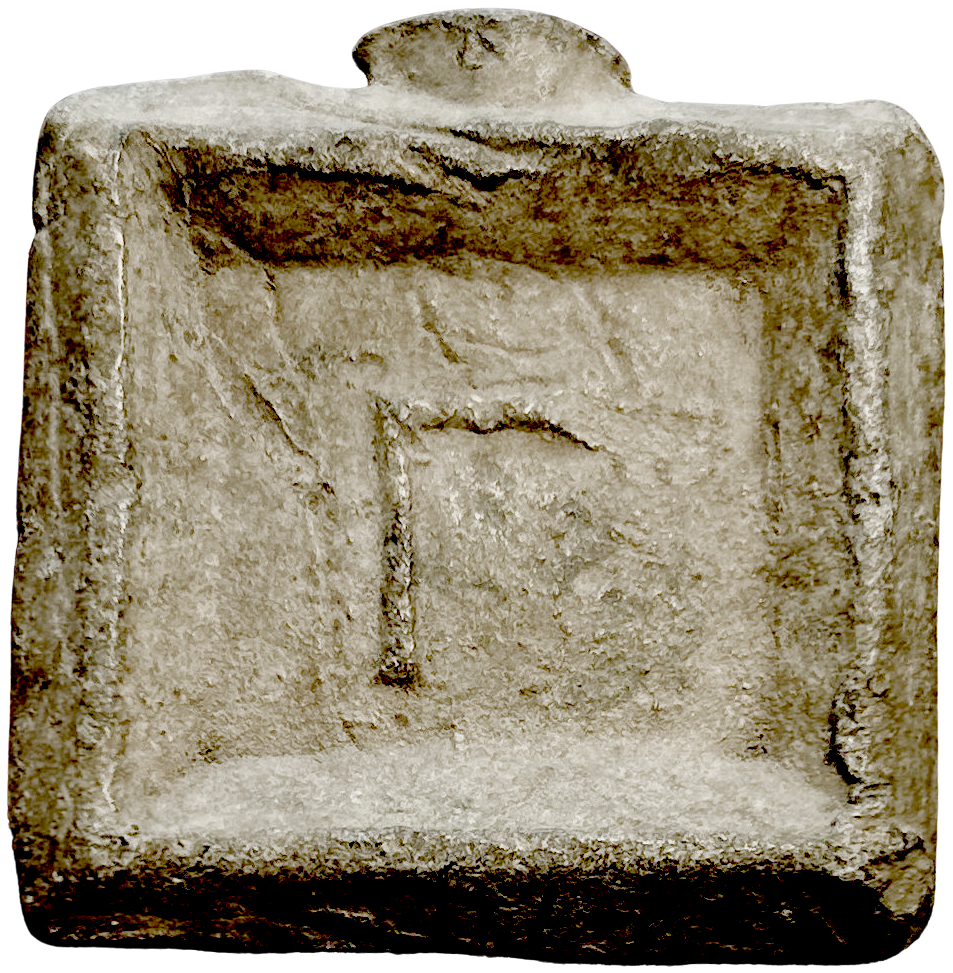
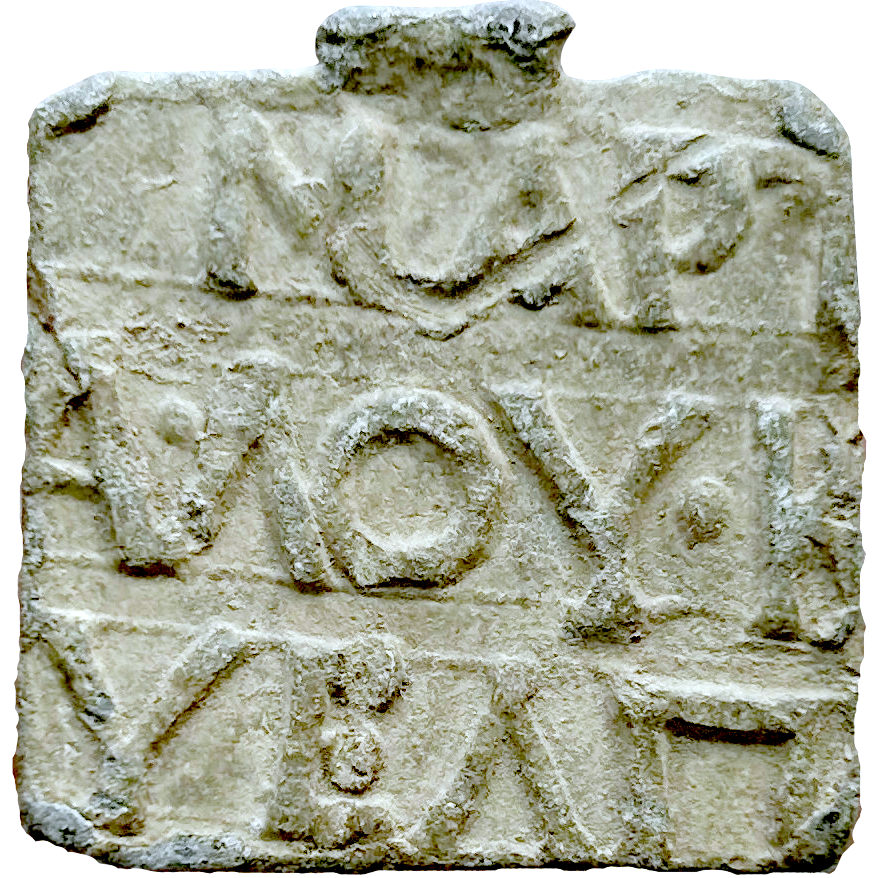
22) Inv. no. 274
(fig. 22). Lead, 82.30 g, 44 x 46 x 7 mm. Three unciae
(uncia of 27.43). Square in form with raised and beveled edges
and handle above. On the top, Γ in relief. On the bottom, Μ∙ΑΡΤ
/ Α∙ΛΟΥ∙Κ / Υ∙ΕΛΠ in three lines and in relief. It dates to the
Roman Imperial period. Unpublished.
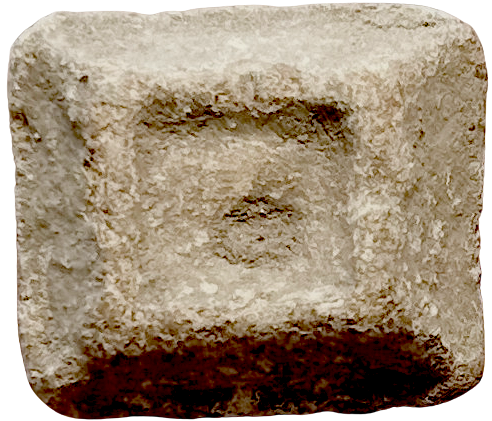
23) Inv. no. 2003-9
(fig. 23). Lead, 28.10 g, 22 x 23 x 8 mm. One uncia. Square
in form with raised and beveled edges. On the top, a faint Α in
relief. The bottom is blank. It dates to the Roman Imperial
period. Unpublished.
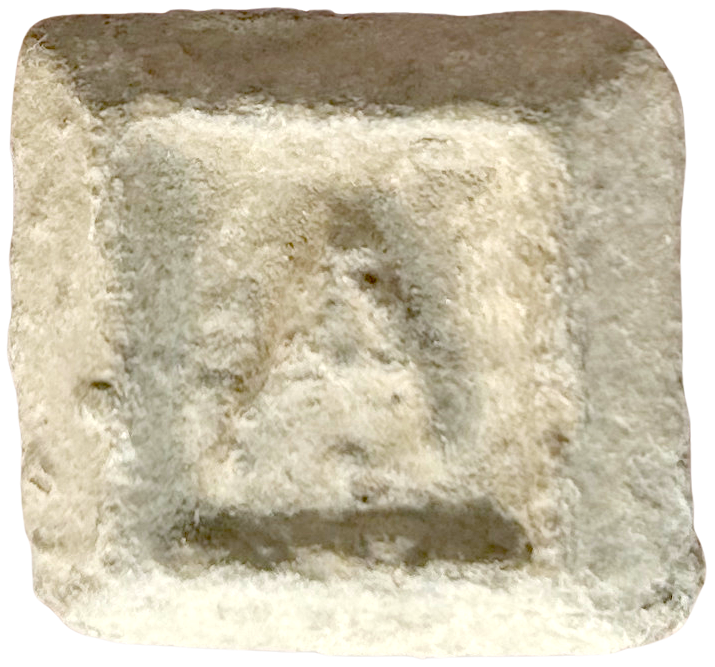
24) Inv. no. 91-179
(fig. 24). Lead, 25.90 g, 27 x 28 x 5 mm. One uncia. Square
in form with raised and beveled edges. On the top, Α in relief.
The bottom is blank. It dates to the Roman Imperial period.
Unpublished.
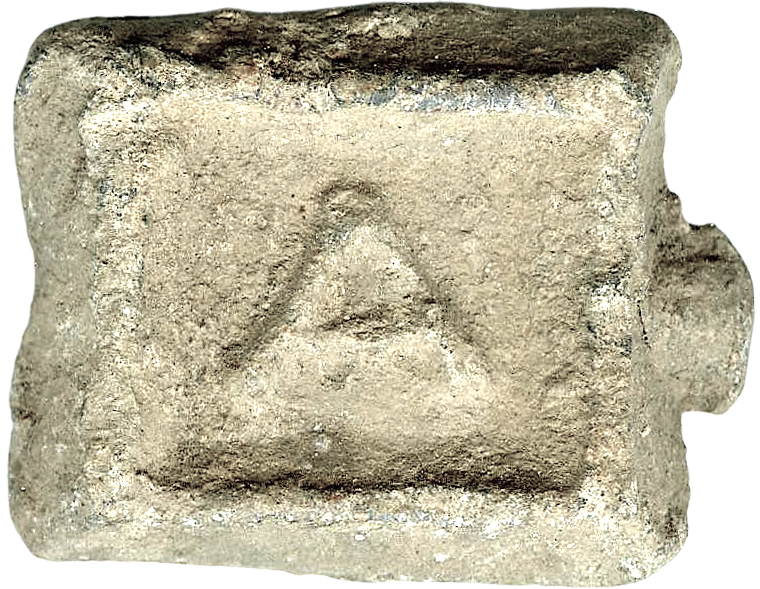
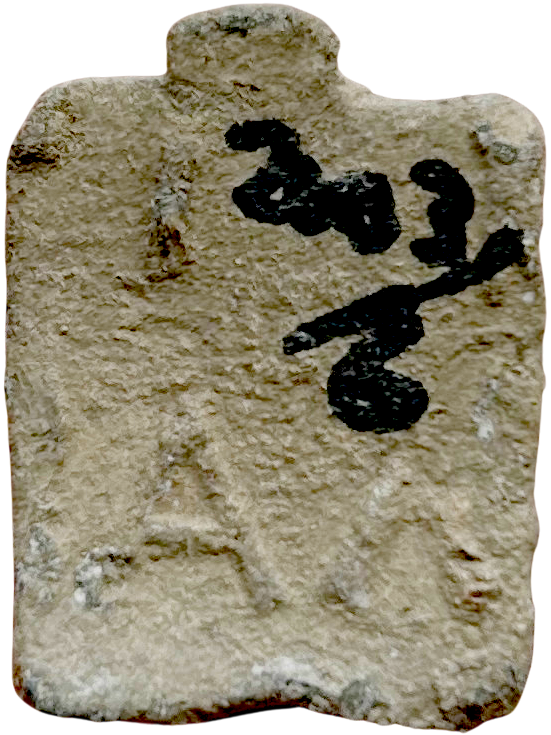
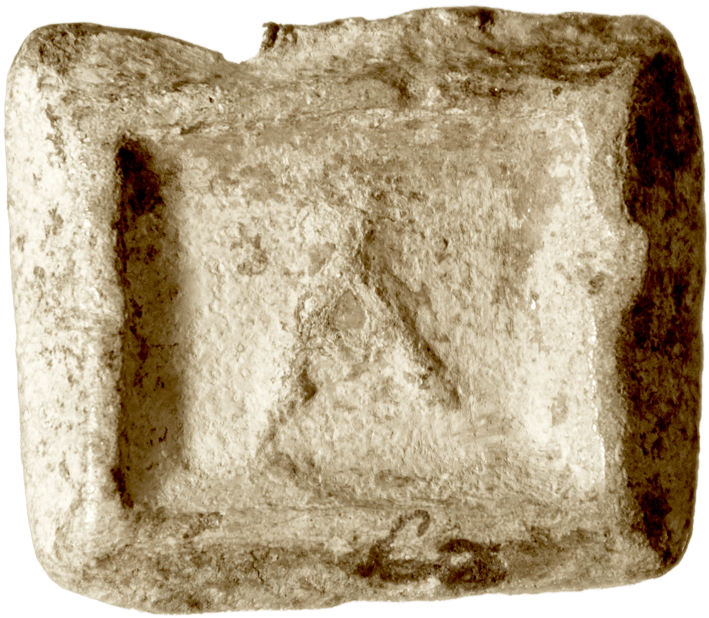
25) Inv. no. 2003-6
(fig. 25). Lead, 24.55 g, 25 x 33 x 5 mm (inc. handle). One
uncia. Square in form with raised and beveled edges and handle
above. On the top, a rotated Α in relief. On the bottom, Ι[..] /
ΑΛ in relief. It dates to the Roman Imperial period.
Unpublished.
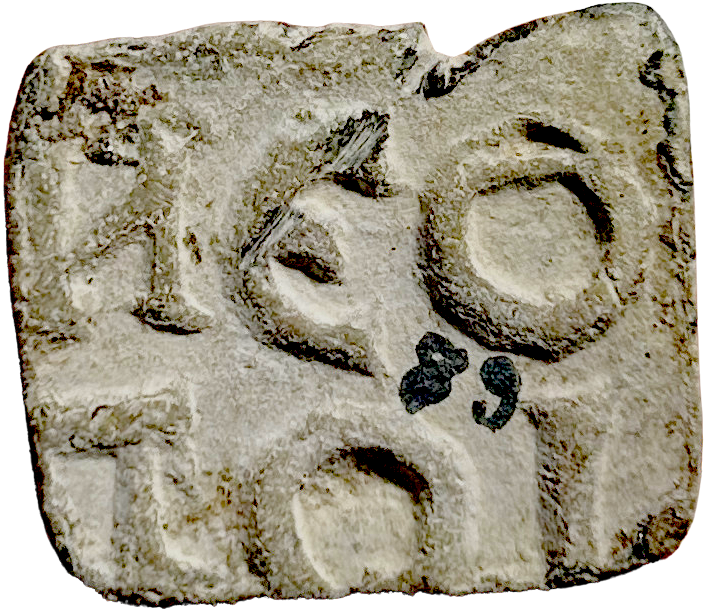
26) Inv. no. 2017-303
(fig. 26). Lead, 23.2 g, 31 x 26 x 5 mm. One uncia. Square
in form with raised and bevelled edges. On the top, Α in relief.
On the bottom, ΝЄΟ / ΠΟΙ
in two lines and in relief. It may be the name of a certain
Neopoios served as magistrate responsible for market. It dates
to the Roman Imperial period. Unpublished.
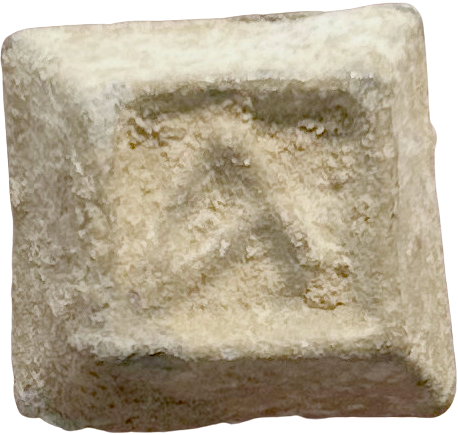
27) Inv. no. 2003-10
(fig. 27). Lead, 27.70 g, 22 x 21 x 8 mm. One uncia. Square
in form with beveled and raised edges. On the top, Α with
oblique crossbar in relief. The bottom is blank. It dates to the
Roman Imperial period.
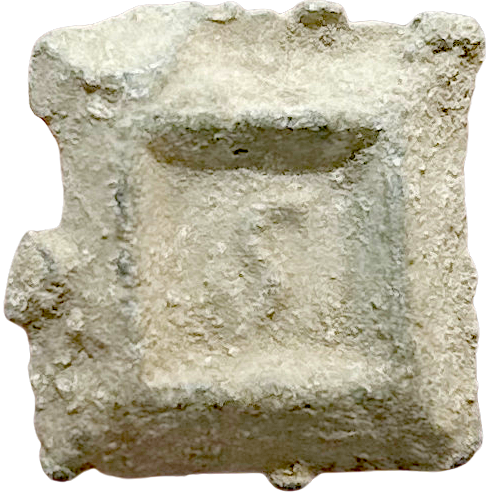
28) Inv. no. 92-187
(fig. 28). Lead, 12.75 g, 24 x 24 x 4 mm. ½ uncia (uncia of
25.5 g) Square in form with raised and beveled edges. Small
break on the edge. On the top, S in relief which stands for
semis. The bottom is blank. It dates to the Roman Imperial
period. Unpublished.
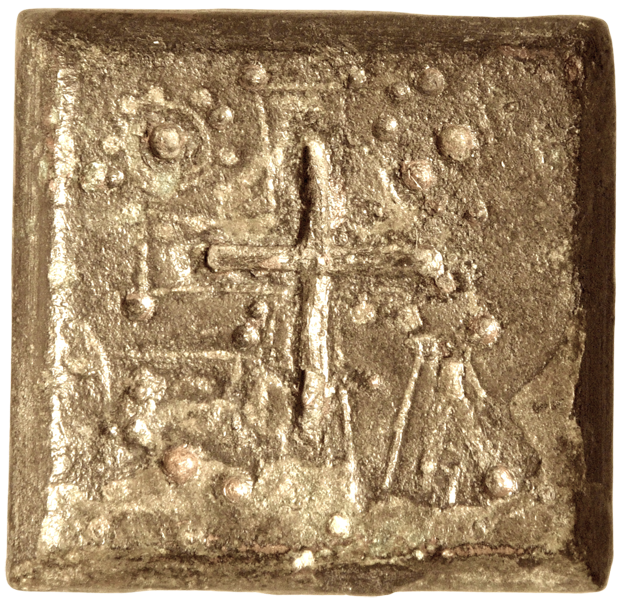
29) Inv. no. 2017-189
(fig. 29). AE 26.2 g, 23 x 23 x 5 mm. One uncia. Square in
form with beveled edges; engraved and punched on the top with
Latin cross flanked by the denominational mark Γο Α, originally
inlaid but inlay is missing; in the upper left and right
corners, circular motifs of punched dots. It dates to the 4th–6th
century AD. Unpublished.
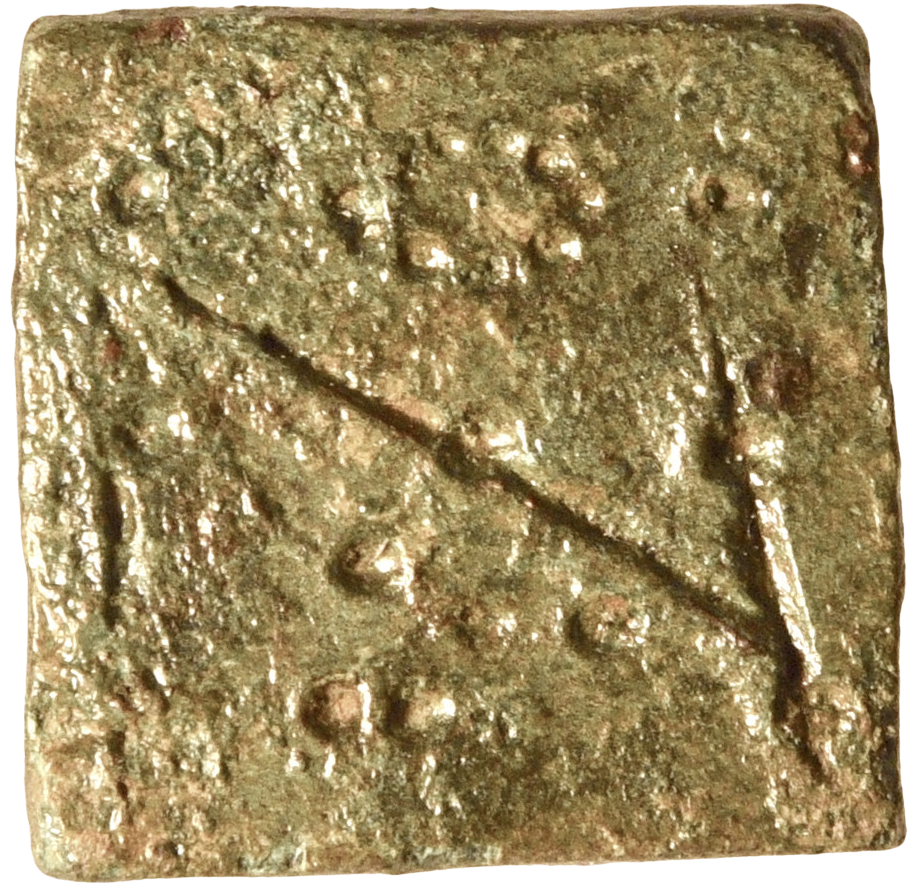
30) Inv. no. 2017-170
(fig. 30). AE 4.50 g, 13 x 13 x 2 mm. One nomisma. Square in
form with plain profile; engraved and punched on the top with
the denominational mark Ν ο; a few punched dots below. The
bottom is blank. It dates to the 4th–7th
century AD. Unpublished.
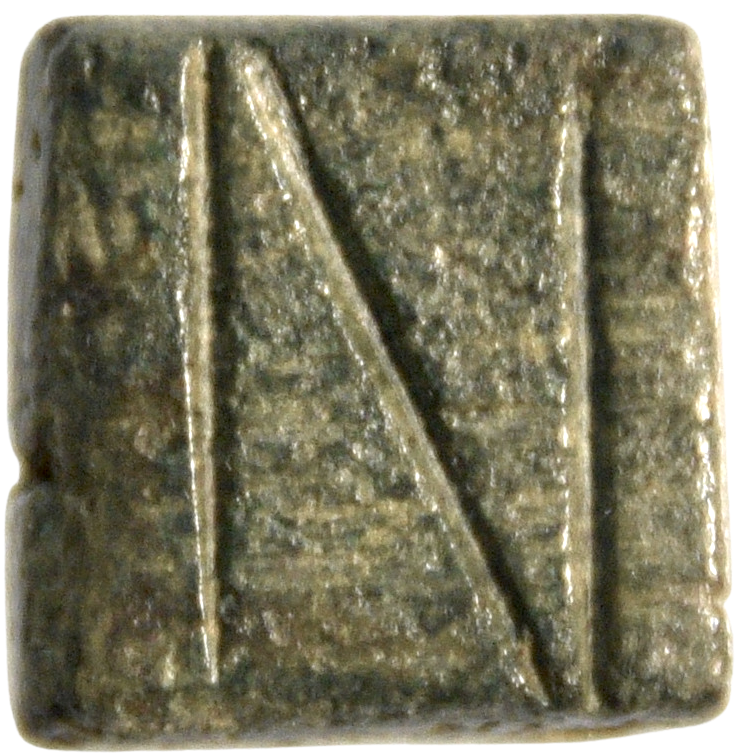
31) Inv. no.
2017-171 (fig. 31). AE 4.5 g, 15 x 15 x 3 mm. One
nomisma. Square in form with plain profile; engraved on the top
with the denominational mark Ν. The bottom is blank. It dates to
the 4th–7th century
AD. Unpublished.
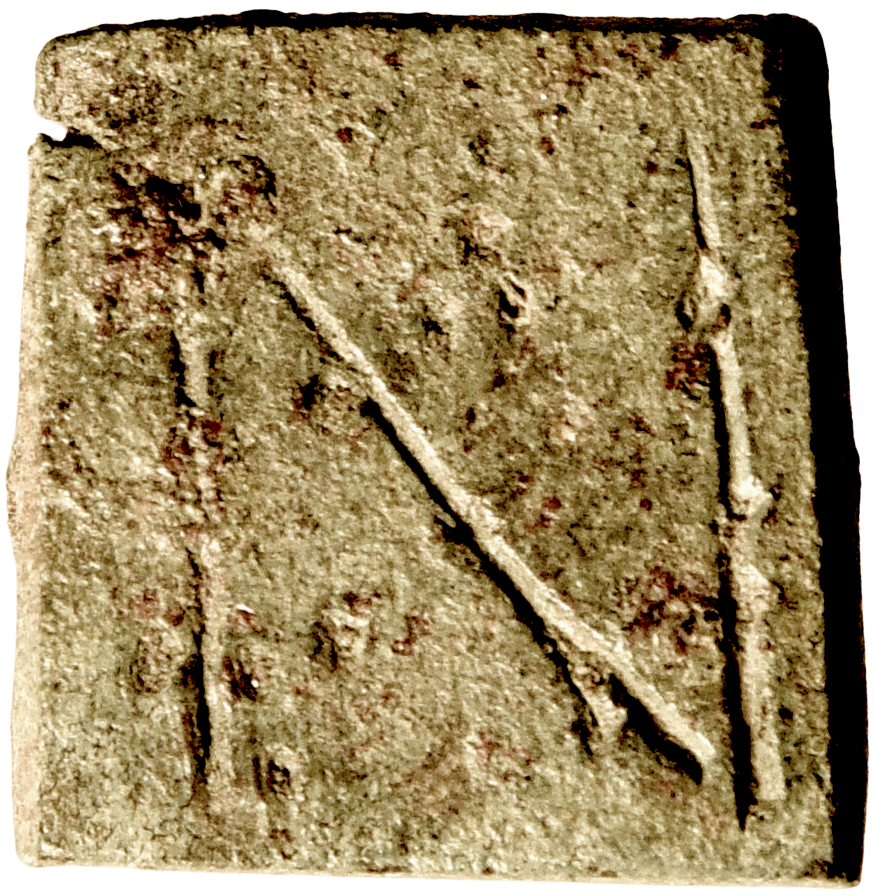
32) Inv. no. 2017-200
(fig. 32). AE 4.5 g, 13 x 13 x 3 mm. One nomisma. Square in
form with plain edges; engraved and punched on the top with the
denominational mark Ν; three-dot motifs in angles. The bottom is
blank. It dates to the 4th–7th
century AD. Unpublished.
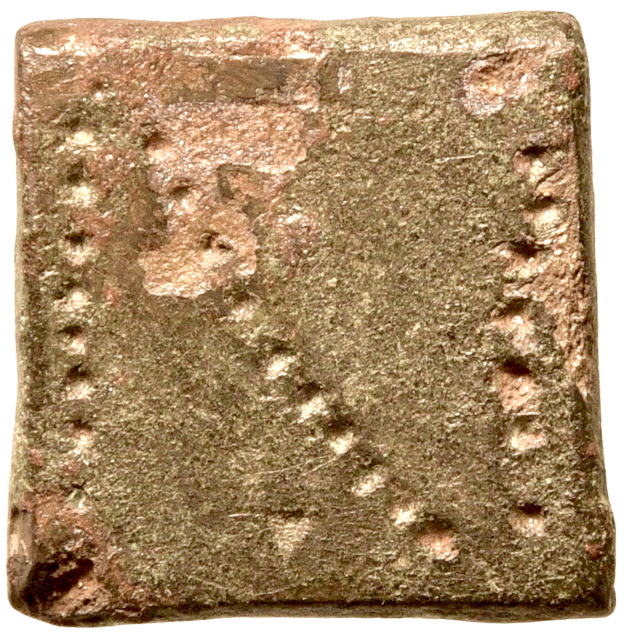
33) Inv. no. 2017-197
(fig. 33). AE 4.40 g, 13 x 14 x 3 mm. One nomisma. Square in
form with plain edges; punched on the top with the
denominational mark Ν. The bottom is blank. It dates to the 4th–7th
century AD. Unpublished.
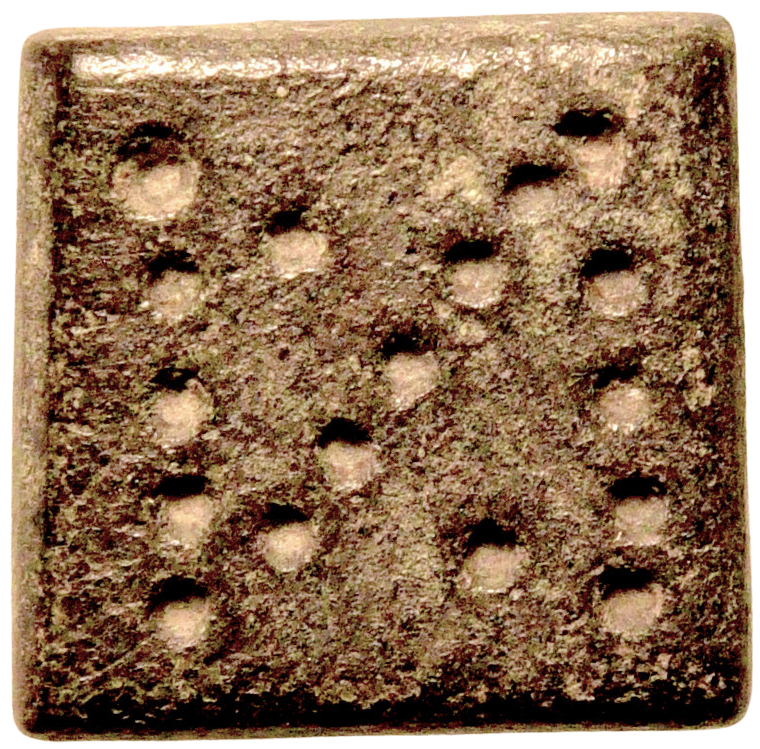
34) Inv. no. 2017-183
(fig. 34). AE 4.4 g, 11 x 11 x 3 mm. One nomisma. Square in
form with plain profile; punched on the top with the
denominational mark Ν; two dots in angles. The bottom is blank.
It dates to the 4th–7th century
AD.
Unpublished.

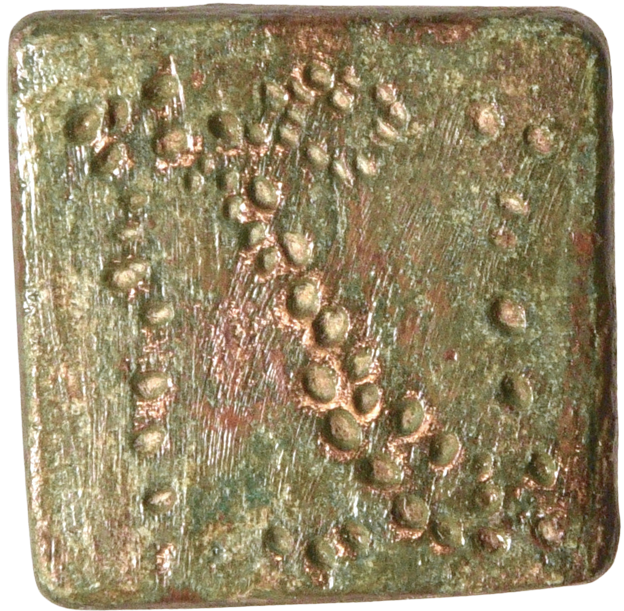
35) Inv.
no. 2017-172
(fig. 35). AE 4.4 g, 13 x 12 x 2 mm. One nomisma. Square in
form with plain profile; engraved and punched on the top with
the denominational mark Ν. The bottom is blank. It dates to the
4th–7th century
AD. Unpublished.
36) Inv. no. 2017-175
(fig. 36). AE 4.4 g, 13 x 13 x 2 mm. One nomisma. Square in
form with plain profile; engraved and punched on the top with
the denominational mark Ν ο; three dots below. The bottom is
blank. It dates to the 4th–7th
century AD. Unpublished.
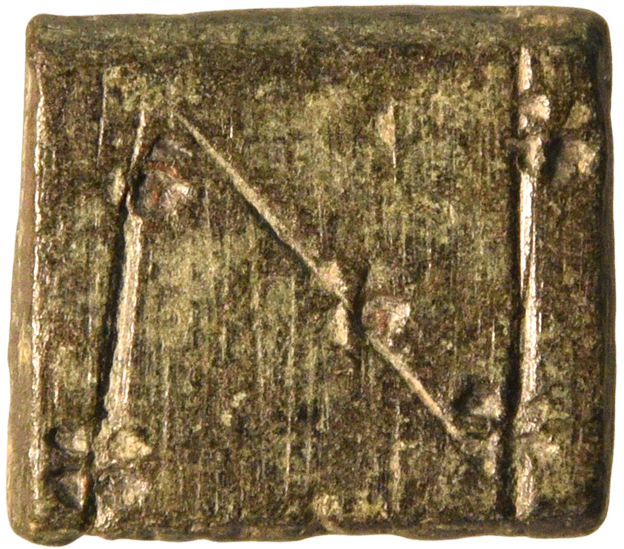
37) Inv. no. 2017-168
(fig. 37). AE 4.3 g, 18 x 13 x 2 mm. One nomisma. Square in
form with plain profile; engraved and punched on the top with
the denominational mark Ν. The bottom is blank. It dates to the
4th–7th century AD. Unpublished.
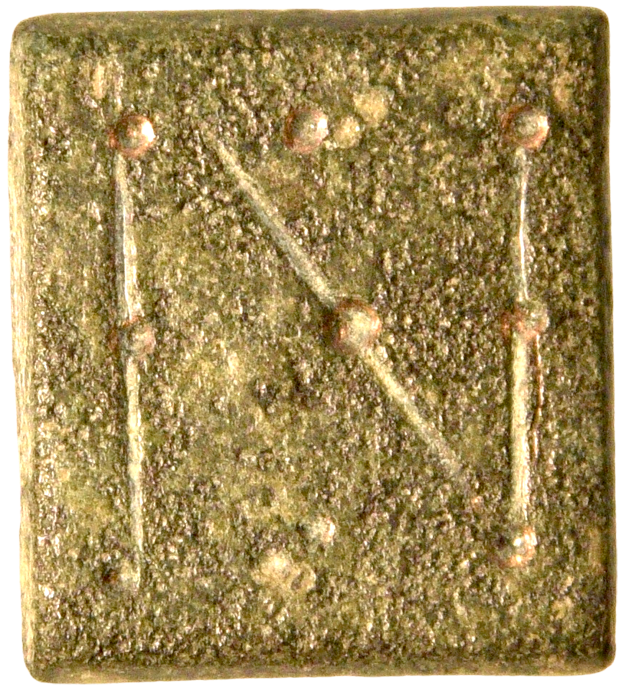
38) Inv. no. 2017-194
(fig. 38). AE 4.25 g, 14 x 13 x 3 mm. One nomisma. Square in
form with plain profile; engraved and punched on the top with
the denominational mark Ν; two dot-motifs in angles. The bottom
is blank. It dates to the 4th–7th
century AD. Unpublished.
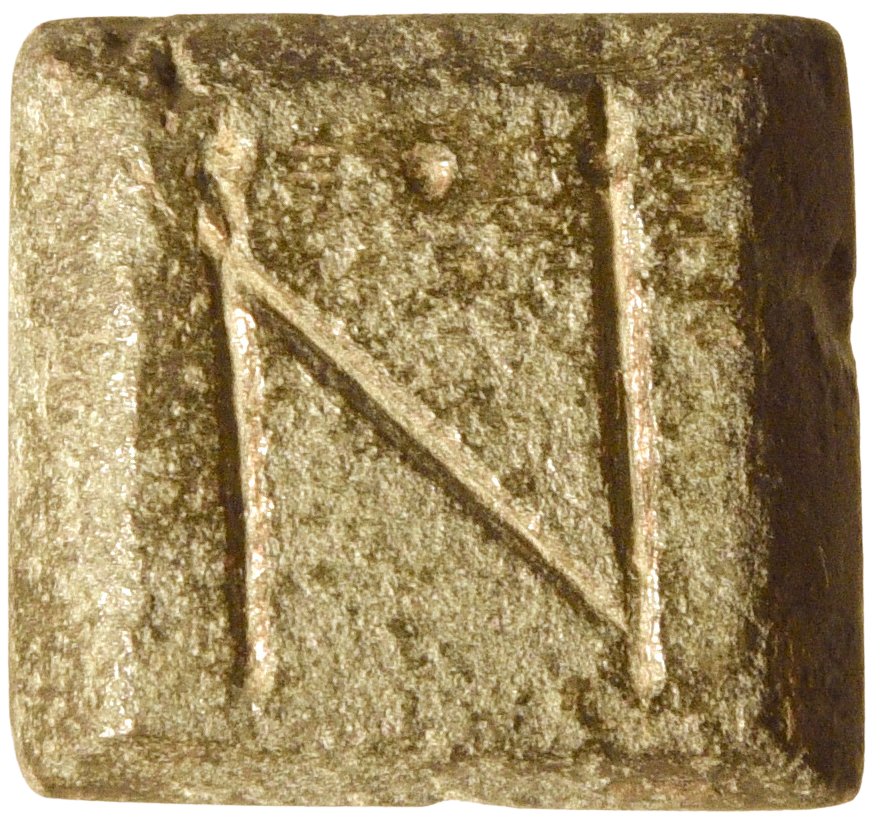
39) Inv. no. 2017-187
(fig. 39). AE 4.2 g, 13 x 13 x 2 mm. One nomisma. Square in
form with beveled edges; engraved and punched on the top with
the denominational mark Ν; one dot in angle. The bottom is
blank. It dates to the 4th–7th
century AD. Unpublished.
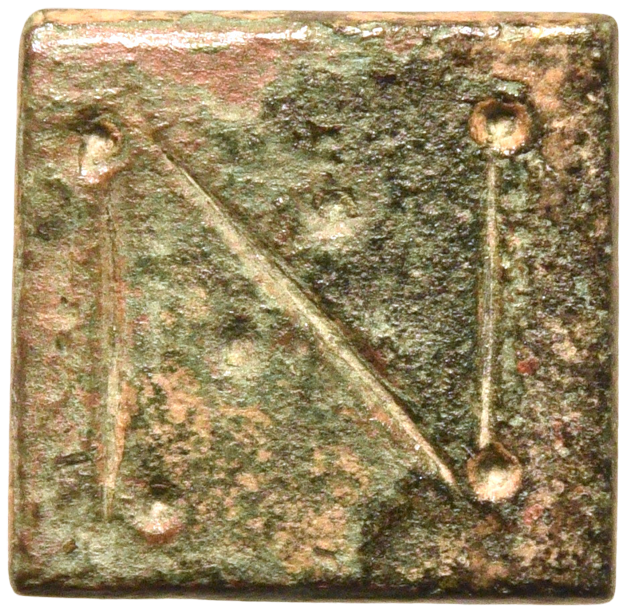
40) Inv. no. 2017-174
(fig. 40). AE 4.1 g, 13 x 13 x 2 mm. One nomisma. Square in
form with plain profile; engraved and punched on the top with
the denominational mark Ν; two dots in angles. The bottom is
blank. It dates to the 4th–7th
century AD. Unpublished.
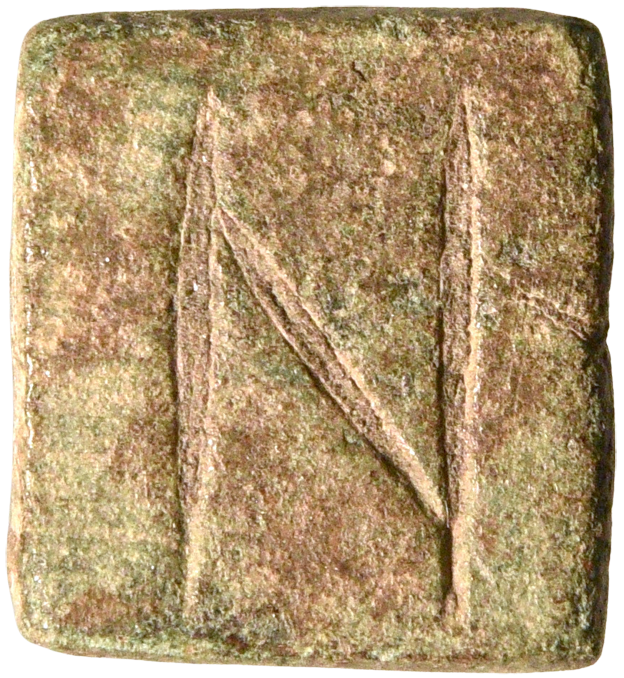
41) Inv. no. 2017-198
(fig. 41). AE 4.1 g, 13 x 14 x 2 mm. One nomisma. Square in
form with plain edges; engraved on the top with the
denominational mark Ν. The bottom is blank. It dates to the 4th–7th
century AD. Unpublished.
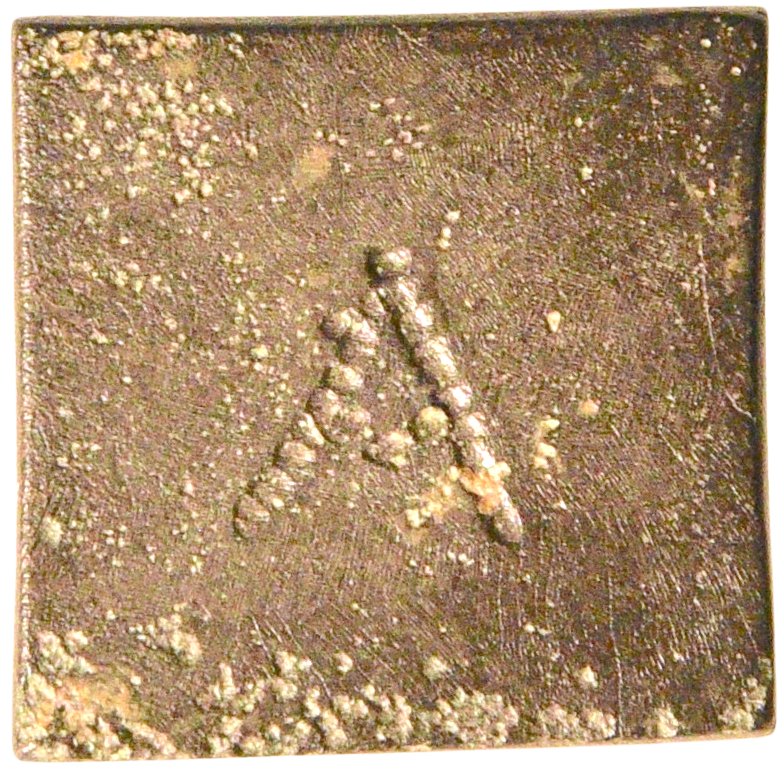
42) Inv. no. 2017-181
(fig. 42). AE 4.1 g, 12 x 12 x 2 mm. One nomisma. Square in
form with plain profile; punched on the top with the
denominational mark Ν. The bottom is blank. It dates to the 4th–7th
century AD. Unpublished.
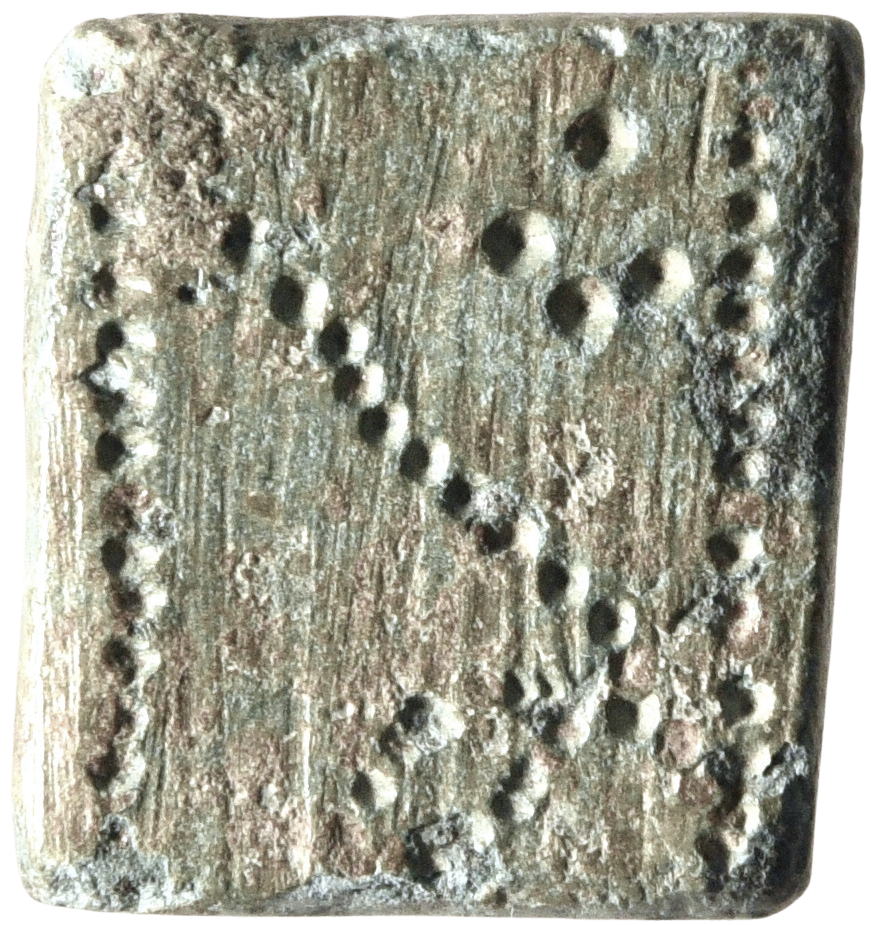
43) Inv. no. 2017-195
(fig. 43). AE 4.0 g, 13 x 14 x 2 mm. One nomisma. Square in
form with plain profile; punched on the top with the
denominational mark Ν; two dots motifs in angles. The bottom is
blank. It dates to the 4th–7th
century AD. Unpublished.
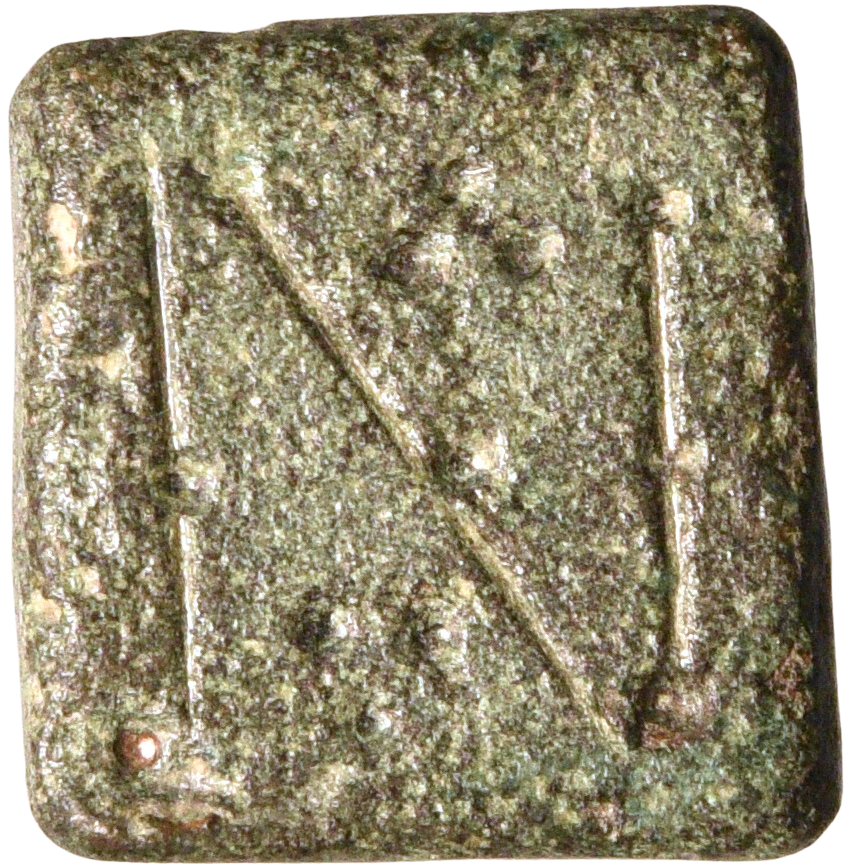
44) Inv. no. 2017-182
(fig. 44). AE 4.0 g, 12 x 13 x 2 mm. One nomisma. Square in
form with plain profile; engraved and punched on the top with
the denominational mark Ν ο; three dots below. The bottom is
blank. It dates to the 4th–7th
century AD. Unpublished.
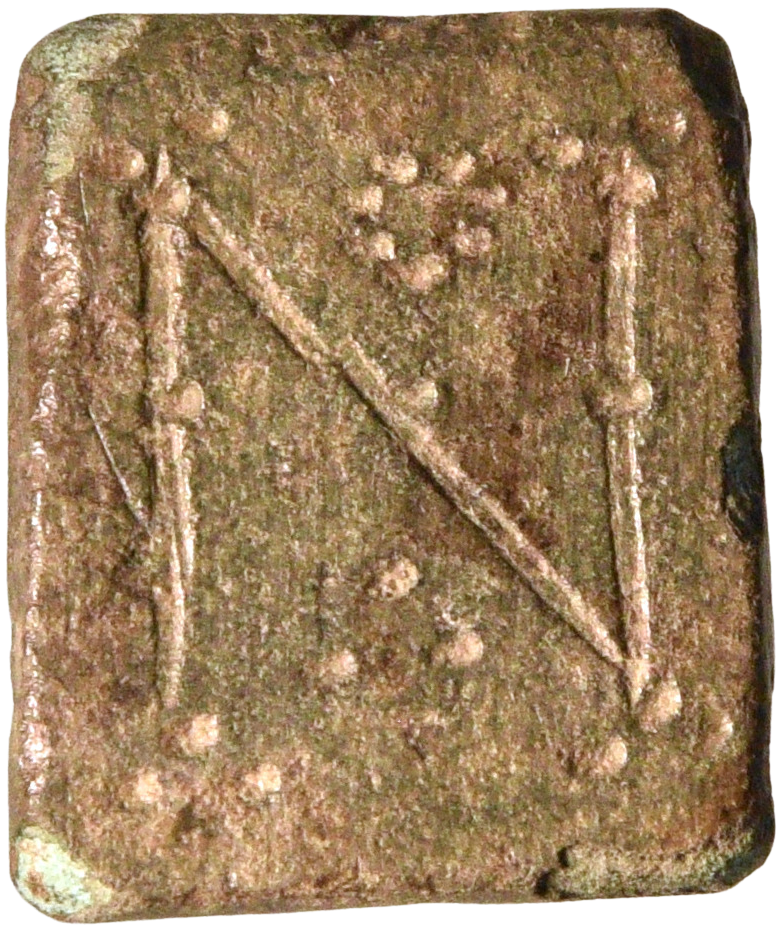
45) Inv. no. 2017-196
(fig. 45). AE 4.0 g, 12 x 14 x 3 mm. One nomisma. Square in
form with plain edges; engraved and punched on the top with the
denominational mark Ν ο; three-dot motifs in below angle. The
bottom is blank. It dates to the 4th–7th
century AD. Unpublished.
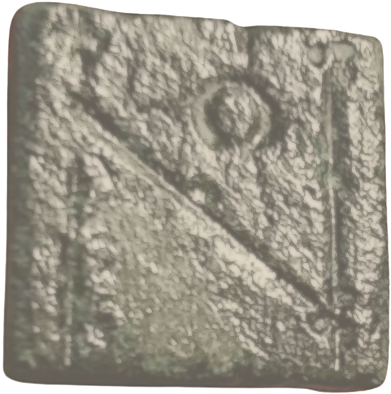
46) Inv. no. 2017-306
(fig. 46). AE 3.8 g, 14 x 13 x 2 mm. One nomisma. Square in
form with plain profile; engraved and punched on the top with
the denominational mark Ν ο. The bottom is blank. It dates to
the 4th–7th century AD. Unpublished.
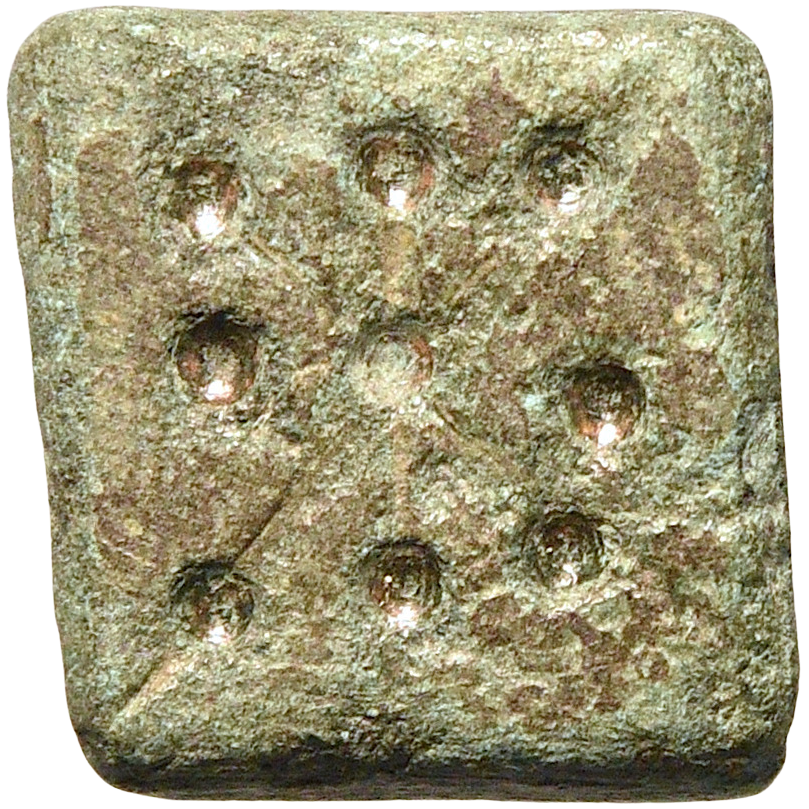
47) Inv. no. 2017-208
(fig. 47). AE 3.7 g, 12 x 12 x 2 mm. One nomisma. Square in
form. Engraved and punched on the top and bottom with an
eight-pointed star[9].
It dates to the Roman Imperial – Early Byzantine period.
Unpublished.
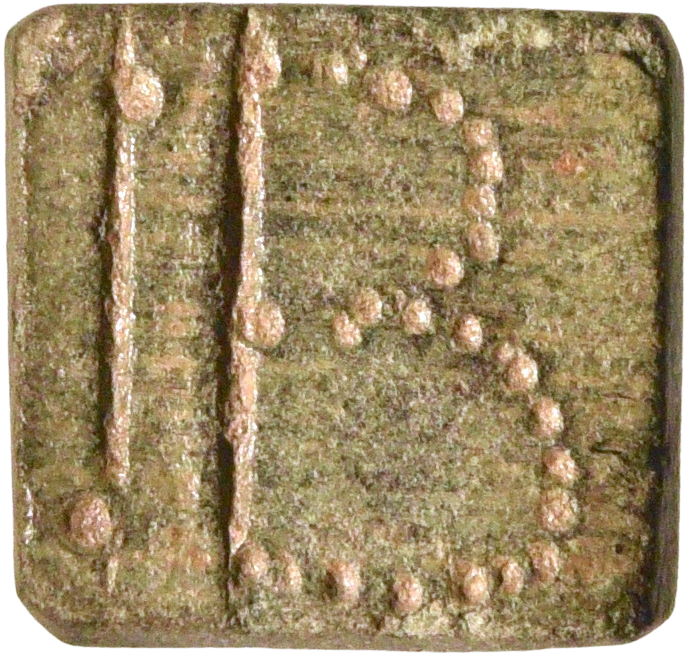
48) Inv. no. 2017-167
(fig. 48). AE 2.2 g, 10 x 10 x 2 mm. Twelve grammata (gramma
of 0.18 g). Square in form with plain profile. Engraved and
punched on the top with the denominational mark
Ι Β.
The bottom is blank. It dates to the 4th–7th
century AD. Unpublished.
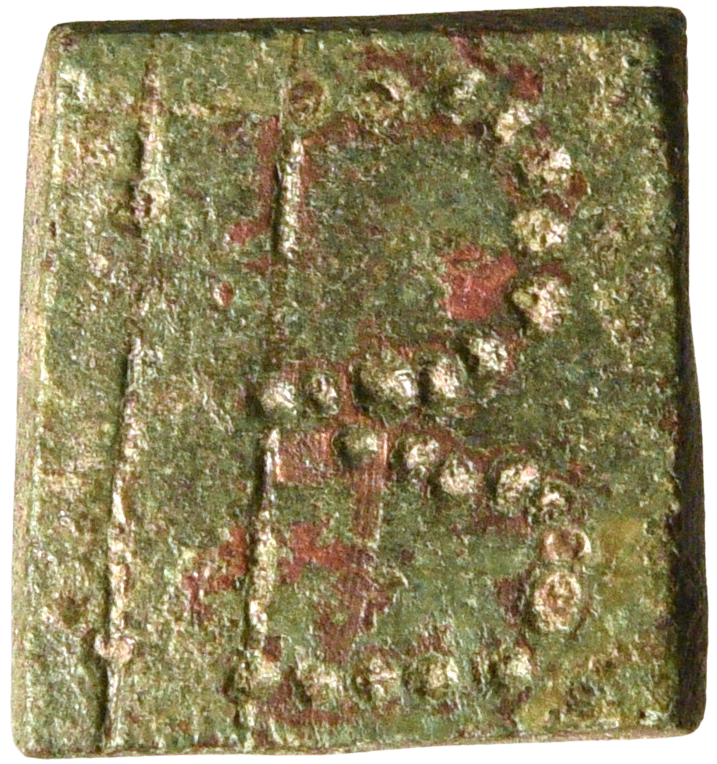
49) Inv. no. 2017-180
(fig. 49). AE 2.1 g, 11 x 11 x 2 mm. Twelve grammata (gramma
of 0.18 g). Square in form with plain profile. Engraved and
punched on the top with the denominational mark
I B.
The bottom is blank. It dates to the 4th–7th
century AD. Unpublished.
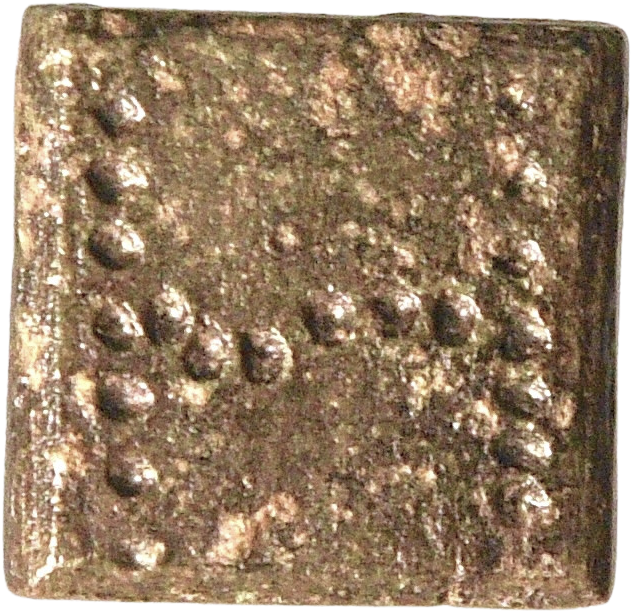
50) Inv. no. 2017-176
(fig. 50). AE 1.7 g, 9 x 9 x 2 mm. Eight keratia (keration
of 0.21 g). Square in form with plain profile. On the top,
punched with the denominational mark H. The bottom is blank. It
dates to the 4th–6th century AD.
Unpublished.
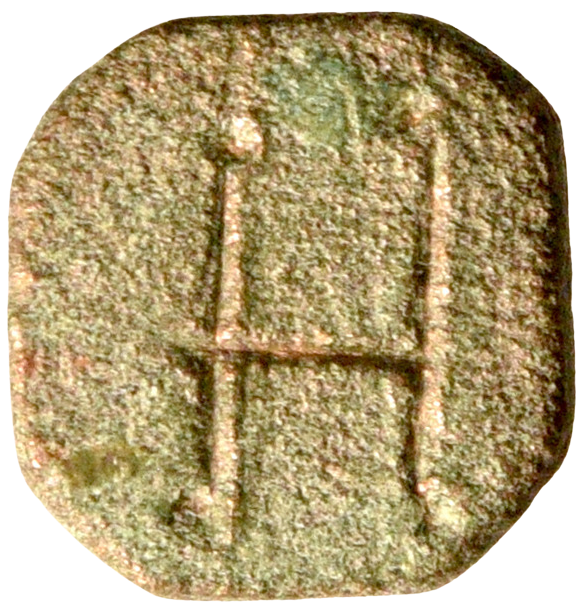
51) Inv. no. 2017-207
(fig. 51). AE 1.3 g, 9 x 1 mm. Eight keratia (keration of
0.16 g). Square in form with cutted corners. On the top,
engraved and punched with the denominational mark Η. The bottom
is blank. It dates to the 4th–6th
century AD. Unpublished.
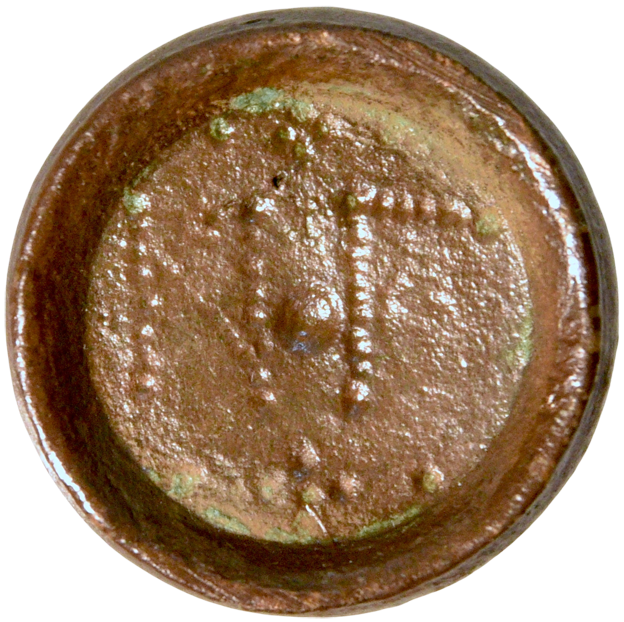
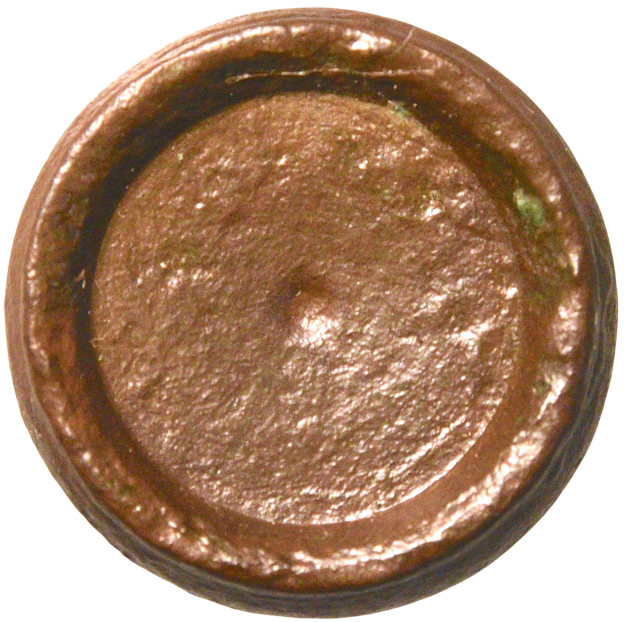
52) Inv. no. 2017-435
(fig. 52). AE 12.1 g, 19 x 6 mm. Three nomismata (nomisma of
4.03 g). Discoid in form with raised edges and centring points
on the top and bottom; convex profile. On the top, punched with
the denominational mark with Ν Γ; motifs of dots above and
below. It dates to the 4th–6th
century AD. Unpublished.
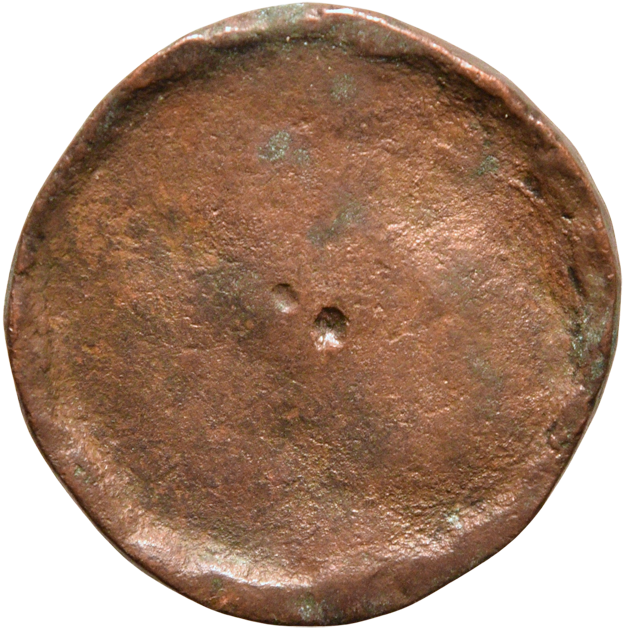
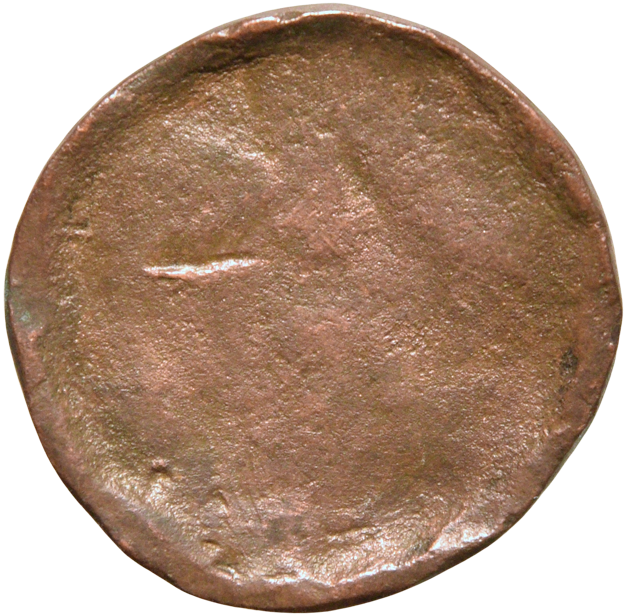
53) Inv. no. 2017-199
(fig. 53). AE 8.8 g, 24 x 12 mm. Two nomismata (nomisma of
4.4 g). Discoid in form with raised edges on the top and bottom;
small centring point on one face; plain profile. Both faces are
blank. It dates to the 6th–7th
century AD. Unpublished.
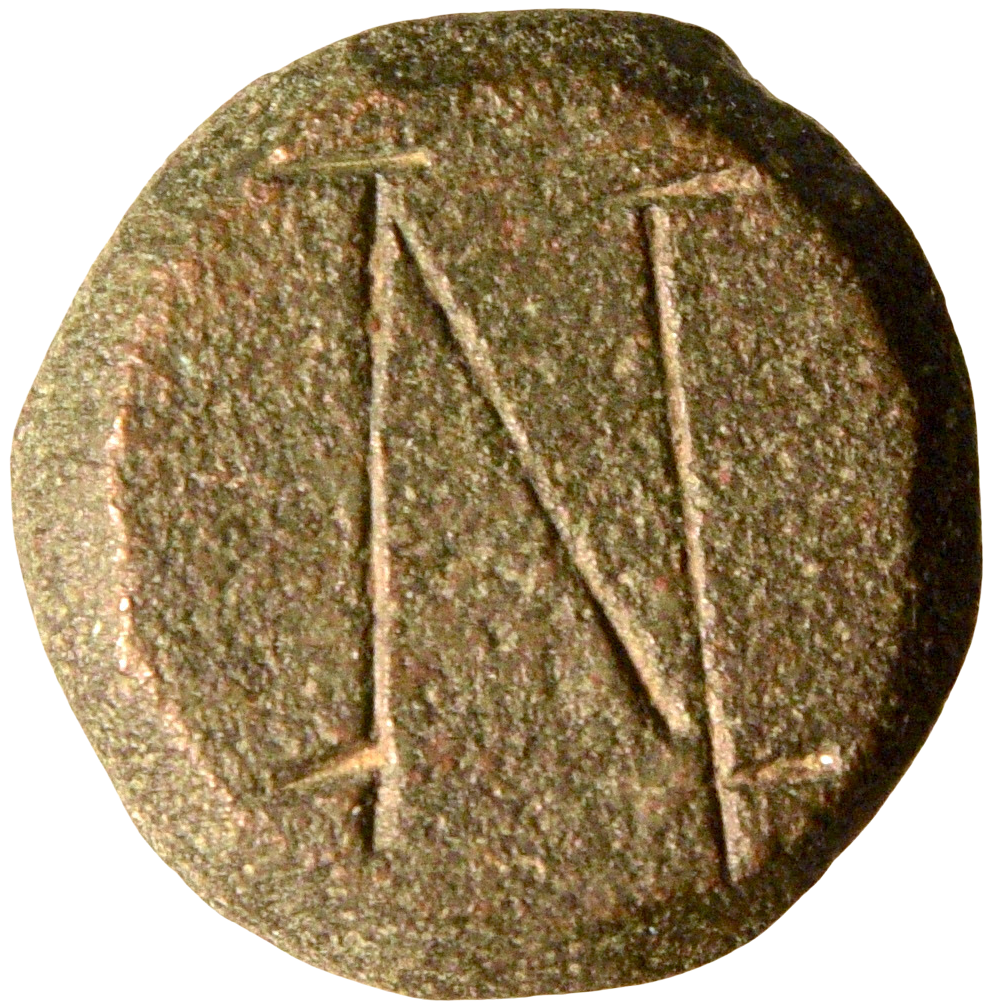
54) Inv. no. 2017-205
(fig. 54). AE 4.4 g, 15 x 2 mm. One nomisma. Discoid in form
with plain profile; engraved and punched on the top with the
denominational mark Ν. The bottom is blank. It dates to the 4th–7th
century AD. Unpublished.
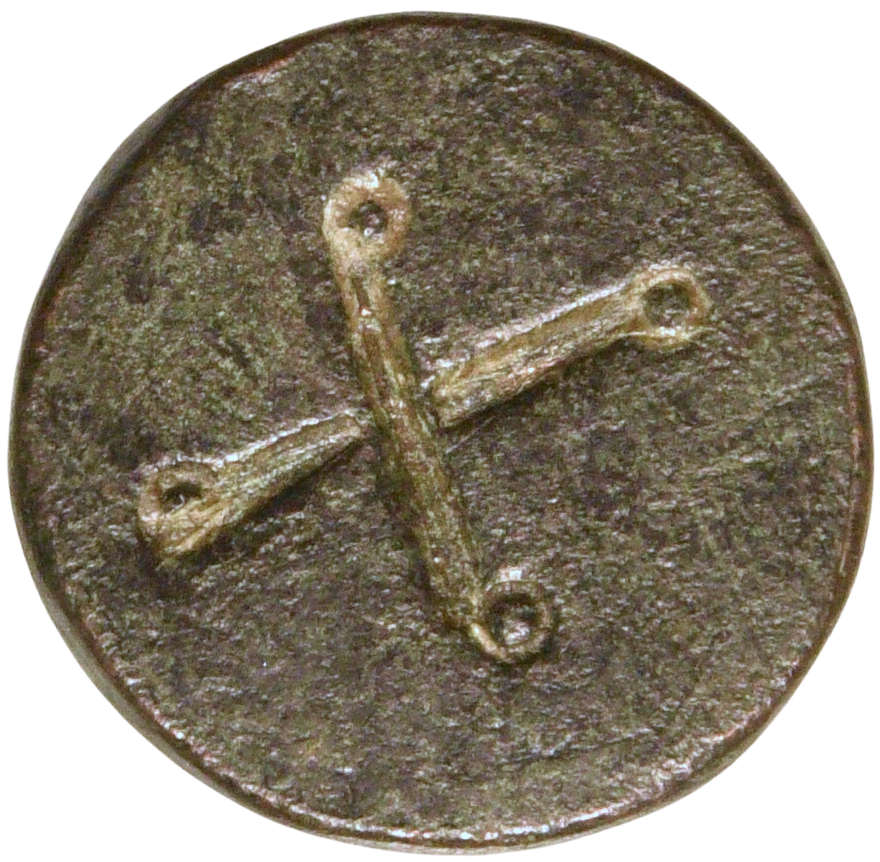
55) Inv. no. 2017-177
(fig. 55). AE 4.4 g, 13 mm. One nomisma. Discoid in form
with plain profile. On the top and bottom, engraved and punched
with a Χ. It may be dated to the early Byzantine period.
Unpublished.
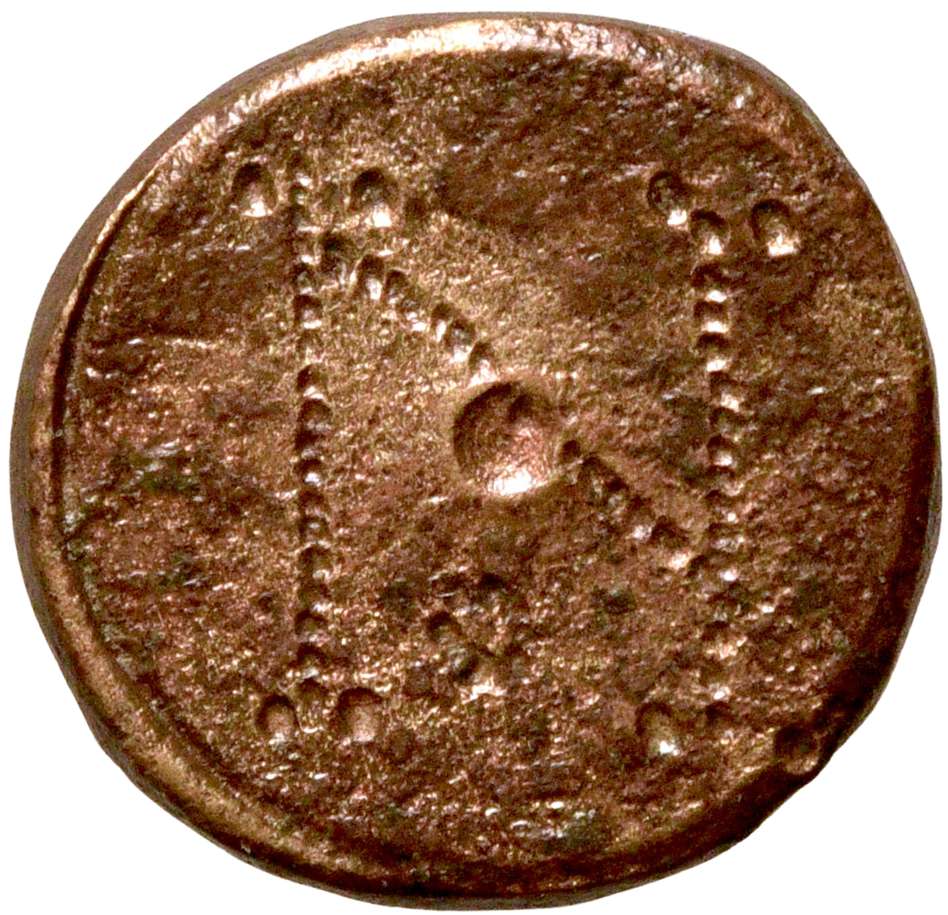
56) Inv. no. 2017-169
(fig. 56). AE 4.3 g, 14 x 2 mm. One nomisma. Discoid in form
with plain profile and centring point on the top; punched on the
top with the denominational mark Ν. The bottom is blank. It
dates to the 4th–7th century AD.
Unpublished.
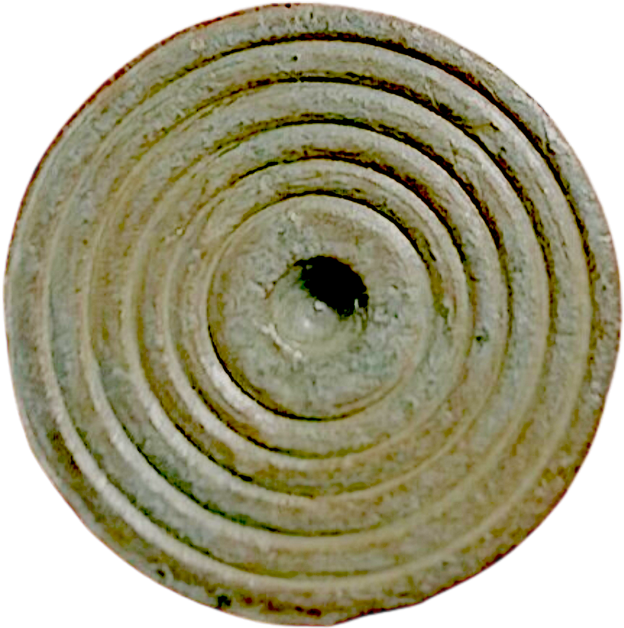
57) Inv. no. 2017-206
(fig. 57). AE. 4.1 g, 17 x 1 mm. One nomisma. Discoid
in form; centring points on the top and bottom; engraved
concentric circles from the centring point through the edge; the
bottom is blank. It may be dated to the 10th–12th
century AD. Unpublished[10].
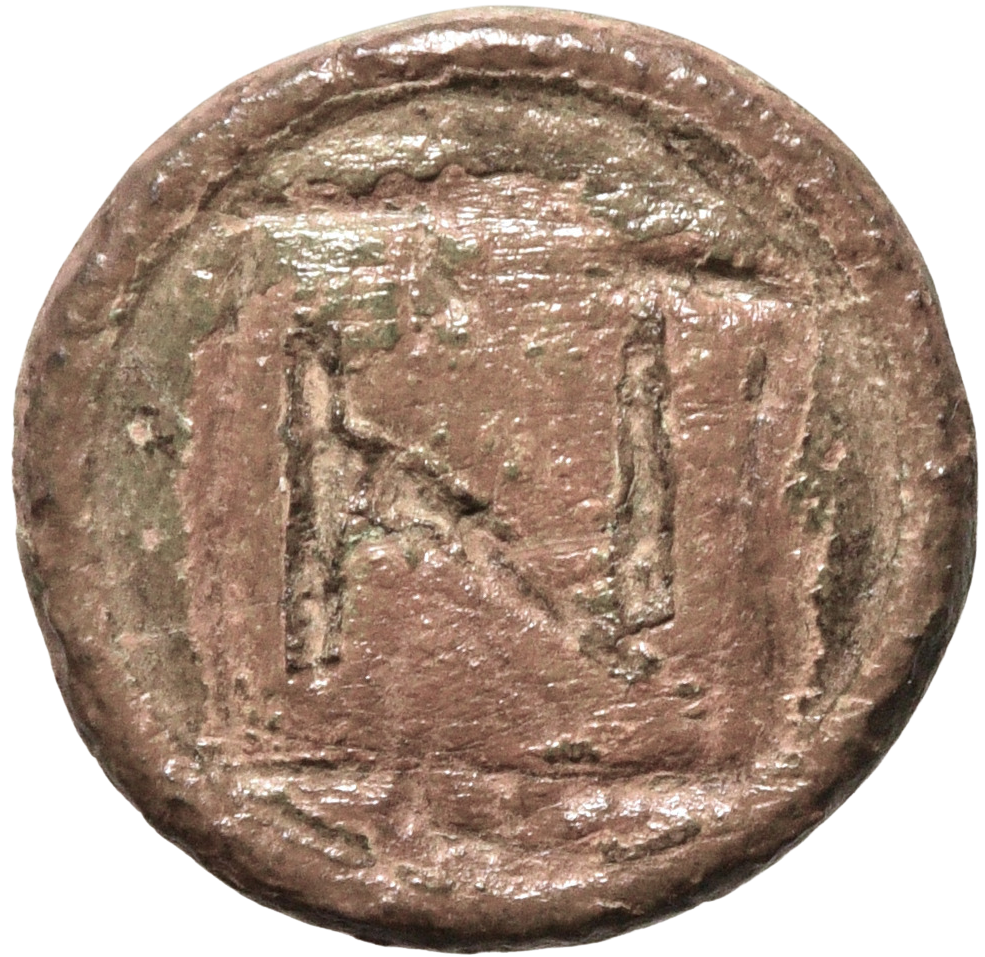

58) Inv. no. 2017-188
(fig. 58). AE 4.00 g, 14 x 2 mm. One nomisma. Discoid in
form with raised edges and centring points on the top and
bottom; convex profile. On the top, engraved with the
denominational mark with N within square frame. The bottom is
blank but convex. It dates to the 4th–7th
century AD. Unpublished.
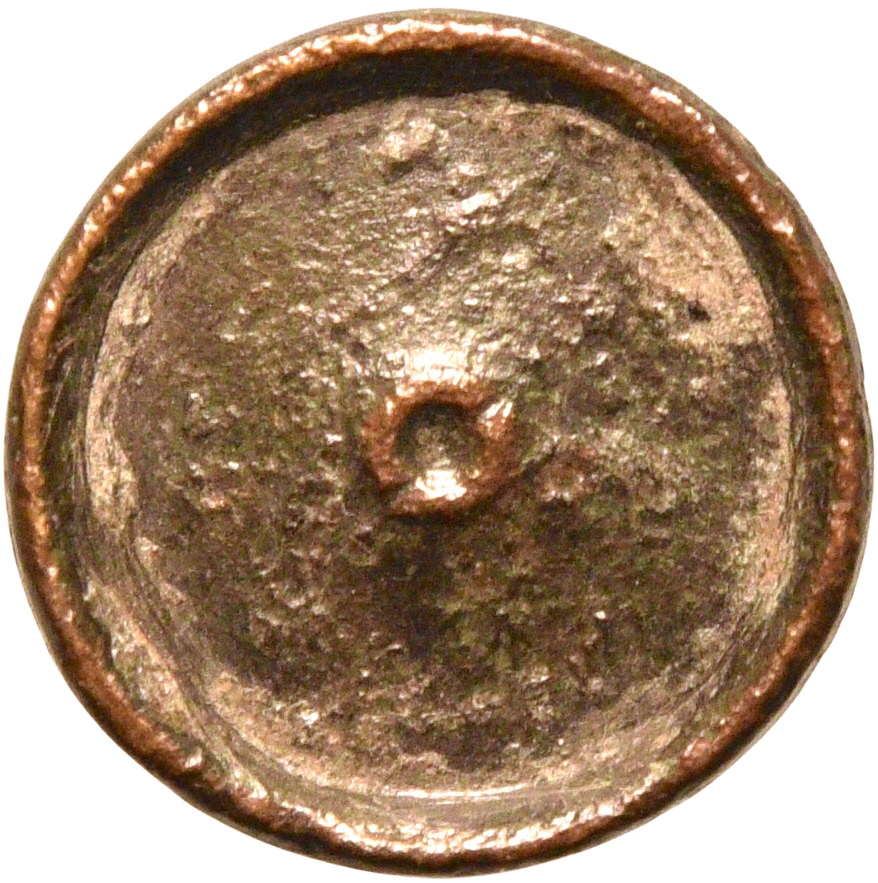
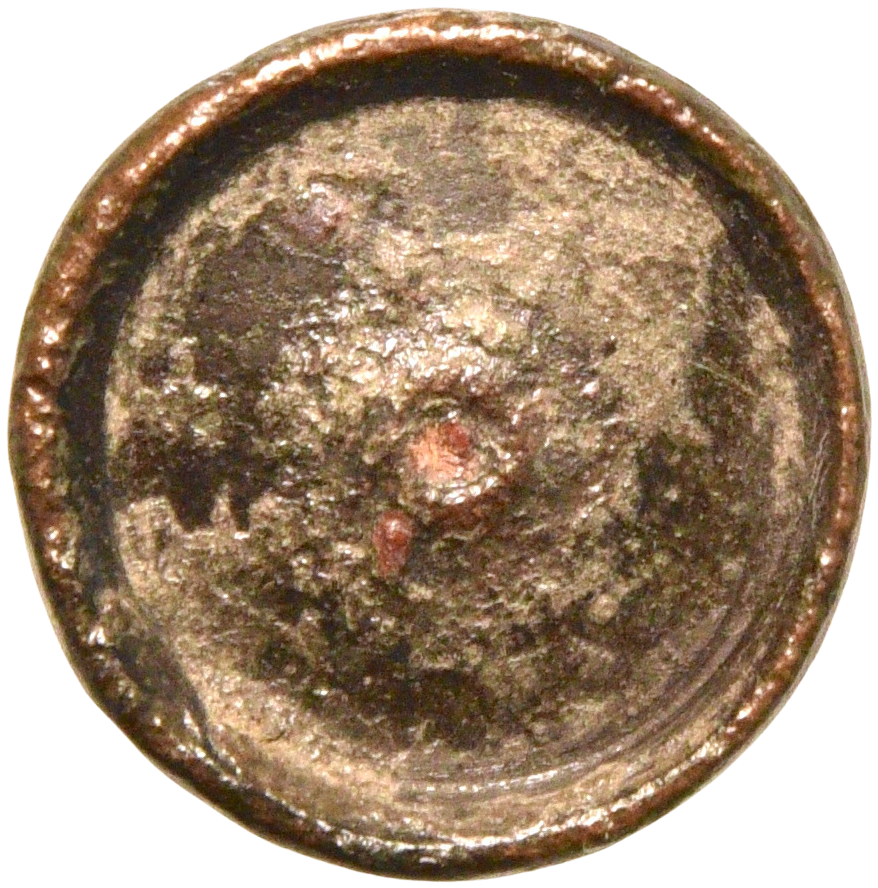
59) Inv. no. 2017-204
(fig. 59). AE 2.1 g, 13 x 2 mm. ½ nomisma (nomisma of 4.2
g). Discoid in form with plain profile; raised rim and prominent
centring points on the top and bottom. Both faces are blank or
illegible. It dates to the 6th–7th
centuries. Unpublished.
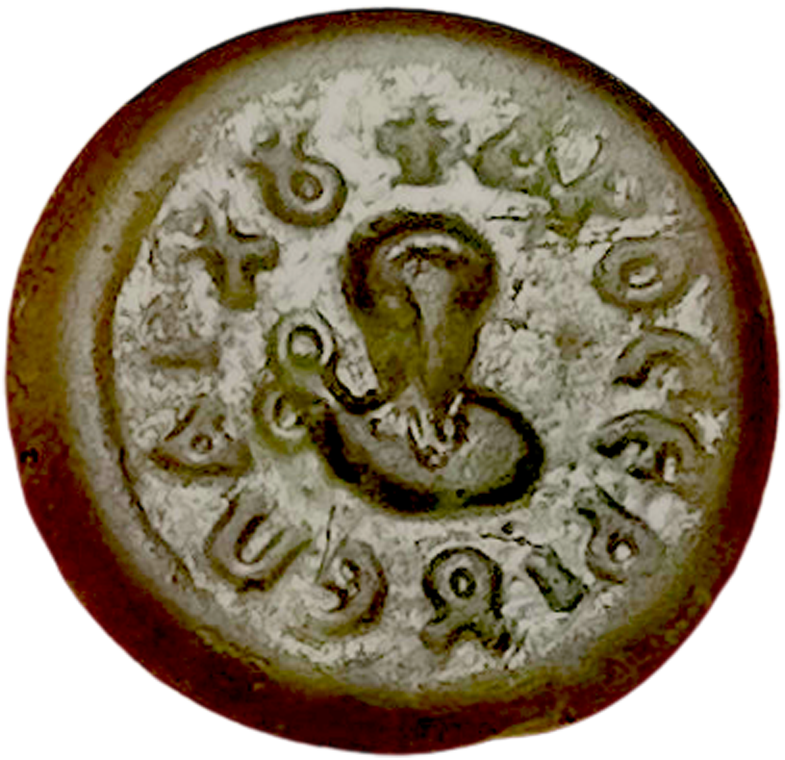
60) Inv. no. 58 (fig.
60). Glass 2.25 g, 20 x 4 mm. Semissis (solidus of 4.50 g).
Constantinople. Discoid in form with raised edges. Green
coloured. On the top, the bust of a dignitary, holding a mappa
in his raised right hand. Legend around the bust reads +ΔΡΟΣЄΡΙꙋ
ЄΠΑΡΧꙋ
(Δροσερίου ἐπάρχου =
of Eparkhos Droserios)[11].
Unpublished.
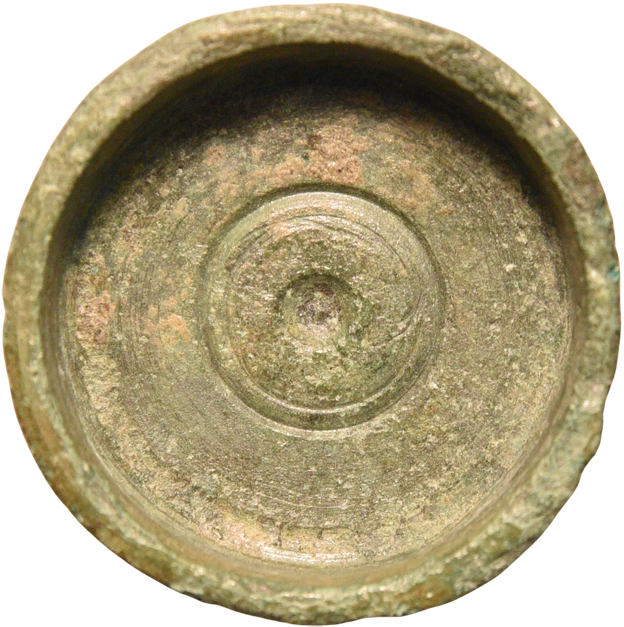
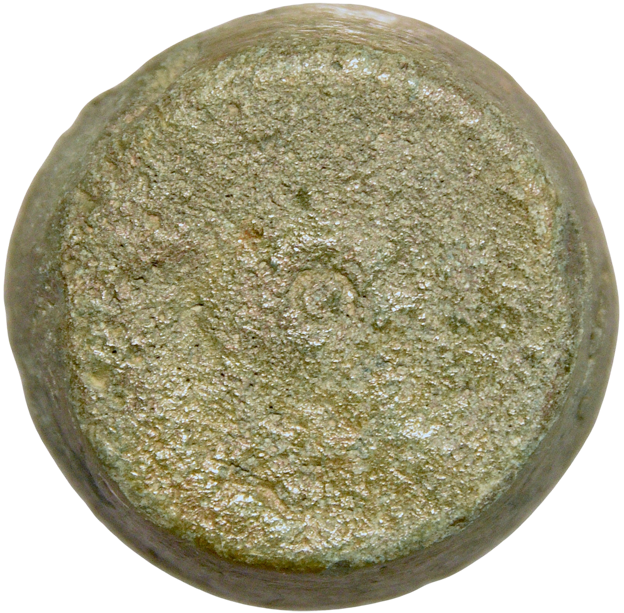
61) Inv. no. 2017-203
(fig. 61). AE 11.4 g, 25 x 7 mm. ½ uncia (uncia of 22.8 g).
Bowl-shaped, shallow; centring points in the bottom interior and
on the bottom. Concentric circles around the centring point in
the interior. It dates to the Middle or Late Byzantine period.
Unpublished.
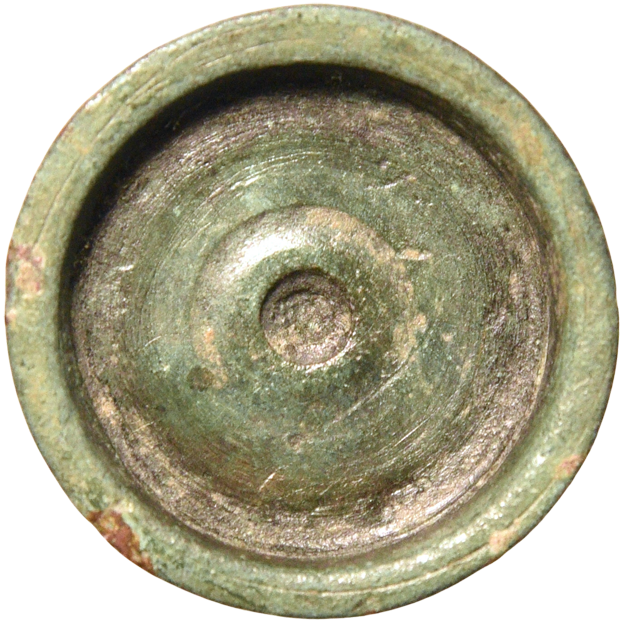
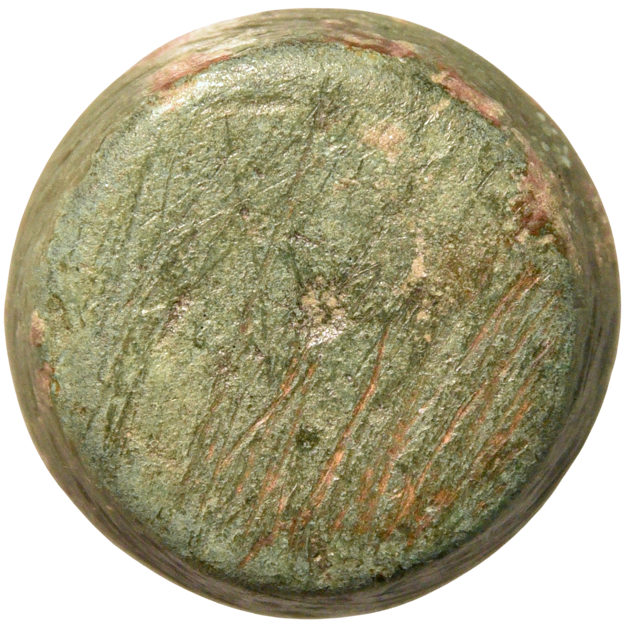
62) Inv. no. 2017-202
(fig. 62). AE 8.4 g, 20 x 5 mm. Two nomismata (nomisma of
4.2 g). Bowl-shaped, shallow; centring points in the bottom
interior and a small centring point on the bottom. It dates to
the Middle or Late Byzantine period. Unpublished.
Islamic
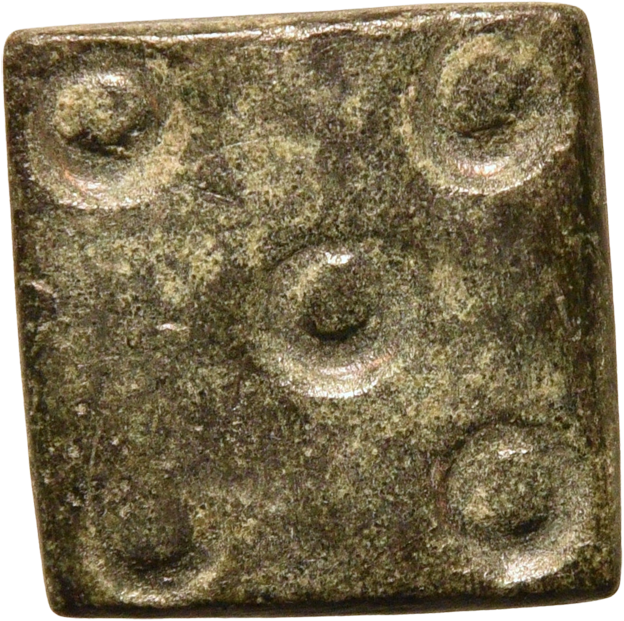
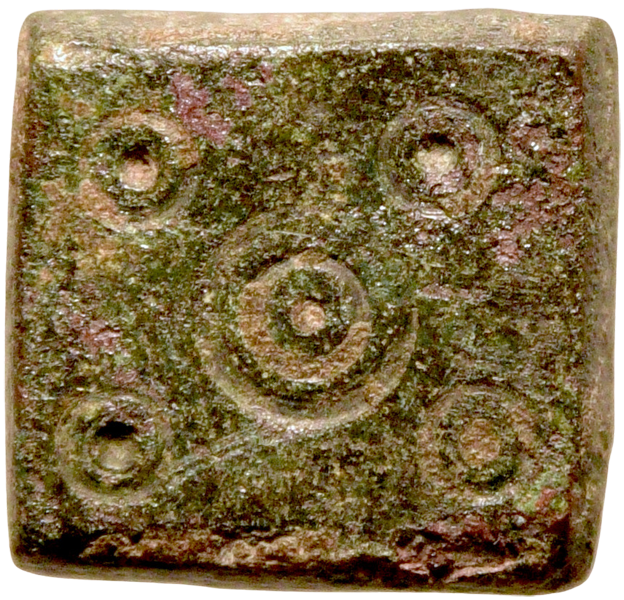
63) Inv. no. 2017-178
(fig. 63). AE 5.7 g, 12 x 12 x 4 mm. Islamic two dirhams
(dirham of 2.85 g). Thick square in form with plain profile. On
the top, a quincunx of five bird’s-eye motifs. The same motif is
repeated on the bottom as well. It dates to the 13th–17th
centuries. Unpublished.
[1] I
would like to thank Hüseyin Vural, the Museum Director,
for granting me permission to study and publish the
weights of the collection, and Faruk Tekin, the Museum
specialist, for assisting me during my work at the
museum and facilitating the process. The découpage of
the weights was done by Orkun Kurumer; I am indebted to
him.
[2] Acc.
1885/70 (=
Pondera #
7302)
[3]
BnF, inv. no.
Schlumberger 3978 (=
Pondera #
7283);
Antonio Salinas Regional Archaeological Museum
(Palermo), inv. No. 1 (=
Pondera # 6401);
Bank of Canada Museum
(Ottawa), inv. no. NCC2014.33.1 (=
Pondera # 3053).
[4]
Tekin 2016, 115, no. 3 (=
Pondera # 13307).
Mistakenly listed as part of
the Ephesus Museum collection.
[5]
Tekin 2016, 115, no. 4 (=
Pondera # 13308).
Mistakenly listed as part of
the Ephesus Museum collection.
[6]
Cf. CPAI 3/1, no. 234 (80.75 g) =
Pondera # 2216. For another example (E, not EK)
weighing 30.70 g see
Pondera # 16703.
[7] Cf.
CPAI 3/1, no. 268 ff.; Pondera
»ten drachmas«.
[8] Tekin
2024a, no. 61 (misidentified as five-mna / seven-litra
but corrected as six-litra by the author in
Tekin 2024b, 19, fig. 1).
[9]
For a similar example see CPAI 3/2, 463
(misdescribed as N on one side but both sides has an
eight-pointed star).
[10]
For similar examples cf. CPAI 3 / 2, no.
667 ff.
[11]
Cf.
Schlumberger, 1895: 63, no. 2
(solidus, 4.15 g;
Pondera # 7302
[Berlin, 2.17 g]). See also footnote 3 above.